Stucco Repair Contract Terms: Payment Schedule, Timeline, and Warranty Protection
If you are comparing bids for stucco work in Castle Rock, the paperwork matters as much as the price. Stucco repair contract terms spell out when you pay, what the crew will actually do, how long the job takes, and what happens if the repair fails a year later. Most homeowners read the number at the bottom and skim the rest. That is how people end up with a patch that does not match their siding, a crew that disappears mid-job, or a surprise charge once the wall is opened up.
This guide walks through the contract terms that matter on a stucco repair job: the payment schedule, the scope of work, the timeline, change orders, and warranty language. It also explains why these terms look different depending on who you hire. A franchise routing calls through a national call center writes contracts one way. A local crew that does nothing but stucco writes them another. Knowing the difference helps you read past the dollar figure and figure out which quote actually protects you.
Why Contract Terms Matter More Than the Quote Number
Two bids for the same crack repair can land thousands of dollars apart, and the contract usually explains why. The low bid might cover only a surface patch with no texture matching and no warranty. The higher bid might include removing loose material, inspecting the paper behind the wall, matching your home's finish, and a written warranty on the work. Same wall, different jobs.
For homeowners dealing with hail or wind damage, the stakes are higher. Insurance adjusters want a written estimate with a clear scope, and your claim moves faster when the contract matches the damage documentation. Hail is not a small problem here. Colorado's May 8, 2017 Front Range hailstorm caused $2.3 billion in insured damage, the state's costliest catastrophe, according to the National Insurance Crime Bureau. When a storm like that rolls through, out-of-area crews flood in, and vague contracts follow them.
A clear contract also protects the contractor, which is a good sign, not a bad one. A crew that puts the scope, the payment schedule, and the warranty in writing is a crew planning to be around when the warranty matters.
The Core Stucco Repair Contract Terms to Check Before You Sign
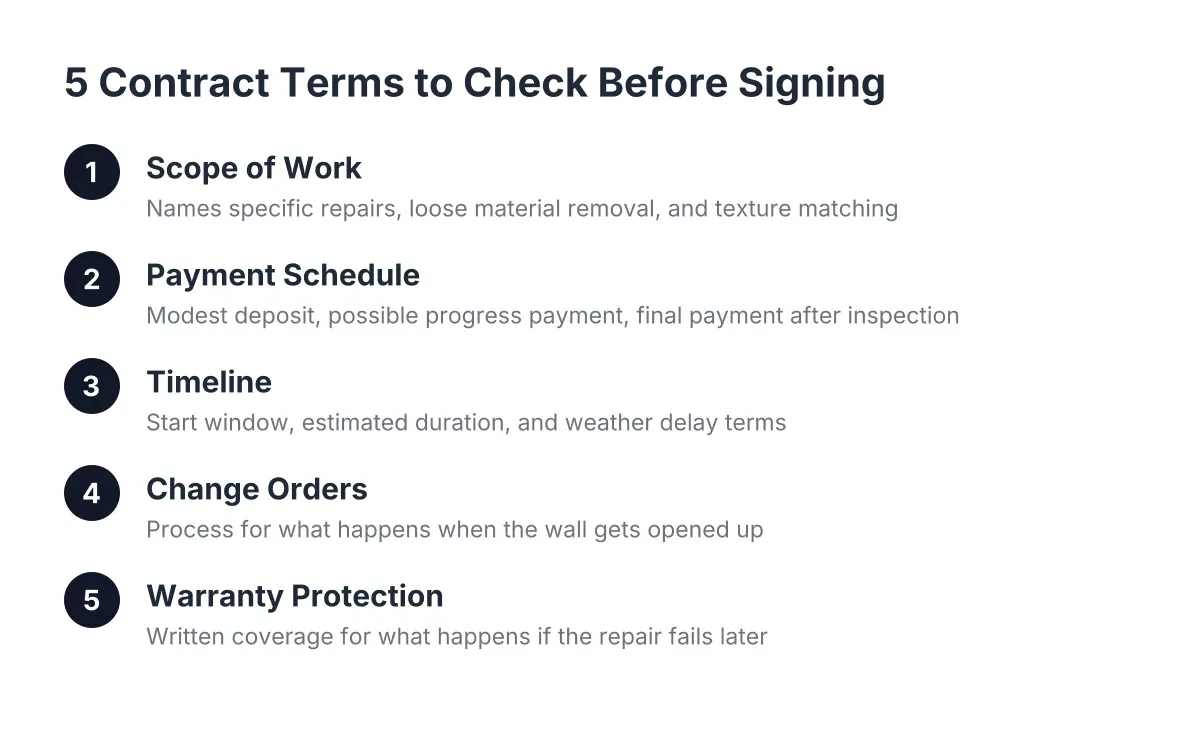
A solid stucco repair contract covers five things: scope of work, payment schedule, timeline, change order process, and warranty. If any of these is missing or vague, ask for it in writing before you sign. Here is what each one should say on a residential repair job.
Scope of Work: What Exactly Gets Fixed
The scope should name the specific repairs, not just "repair stucco as needed." On a crack repair, that means which cracks, how they will be prepped, and what goes into them. On a patch, it means the size of the area, whether loose or buckling material gets removed first, and how the new material ties into the old.
Removal of loose material is worth checking for specifically. Loose or buckling stucco has to come off before any repair, because leaving it in place lets rain keep working on the wood underneath. A scope that skips straight to "apply patch material" is a scope written by someone who has not thought the job through.
Texture matching deserves its own line. Castle Rock homes carry a range of finishes, and a patch that holds water out but sticks out visually is only half a repair. The contract should say the new work will match the existing texture and color, and it should say who judges the match. A poor texture match is often the first sign that the person who did the repair did not know the original technique. Get the matching commitment in writing.
Payment Schedule: When Money Changes Hands
A fair payment schedule on a residential stucco repair follows a simple pattern: a modest deposit, possibly a progress payment on larger jobs, and a final payment after you have walked the finished work. The deposit covers materials and secures your spot on the schedule. The final payment is your leverage to get the texture match and cleanup right.
Watch for these payment red flags:
- A demand for full payment up front, before any work starts
- Cash-only terms with no written receipt
- A deposit that covers most of the job on a small repair
- Final payment due before you have inspected the finished patch in daylight
- No written record of what each payment covers
On a typical Castle Rock repair in the $1,500 to $10,000 range, a deposit somewhere around a quarter to a third of the total is a reasonable illustrative benchmark. Anything structured so the contractor holds all the money before the finish coat goes on shifts the risk entirely onto you.
If insurance is paying, the schedule should also line up with how your insurer releases funds. Many carriers pay in stages, with a final check after completion. A local contractor who has worked storm claims before will structure payments around that reality instead of pressuring you to front money your insurer has not released.
Timeline: Start Date, Duration, and Weather Delays
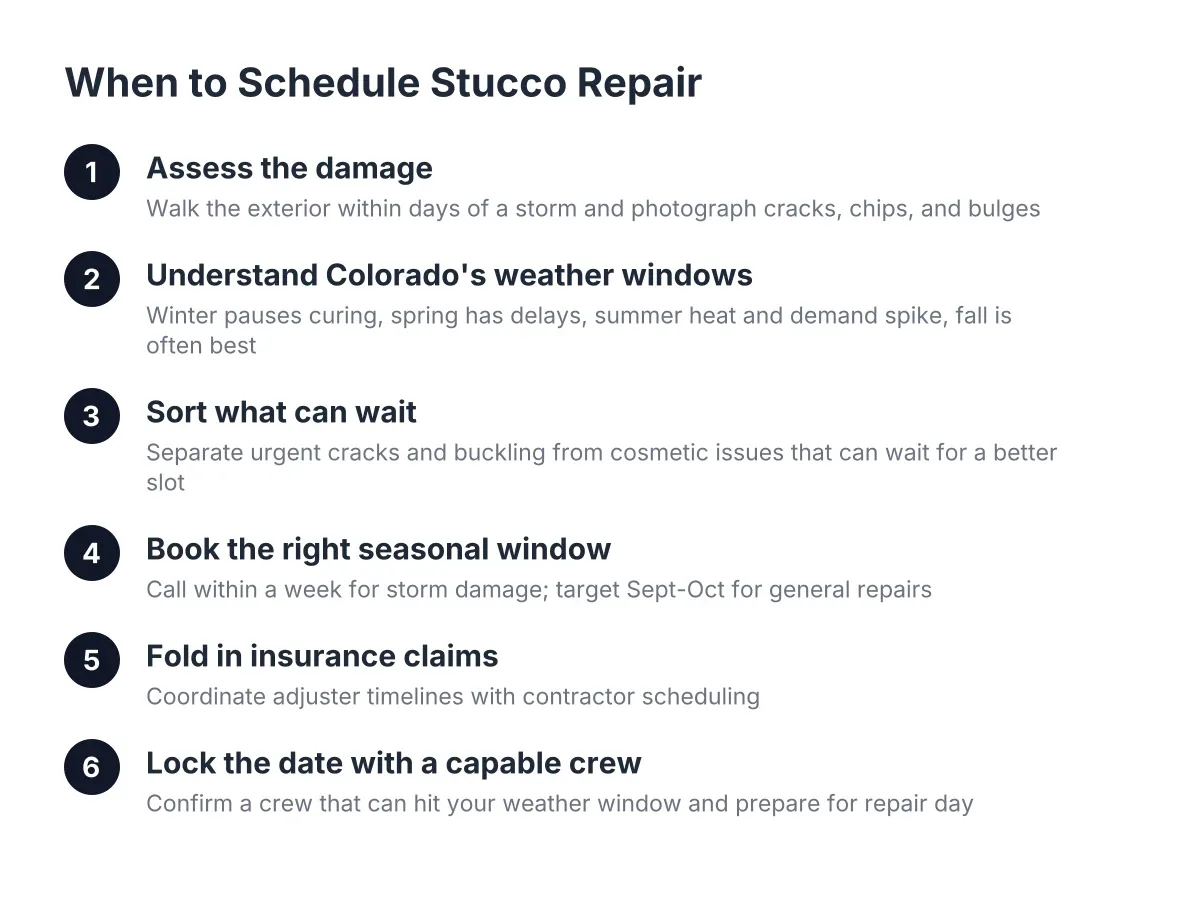
The contract should give a start window, an estimated duration, and a plain statement of what delays the work. Stucco is weather-sensitive. Fresh material and sealants do not behave well in extreme heat or cold, and experienced crews plan around conditions. For example, large crack repairs with sealant are better done in the cool of the morning than in hot afternoon sun, because heat affects how the material cures.
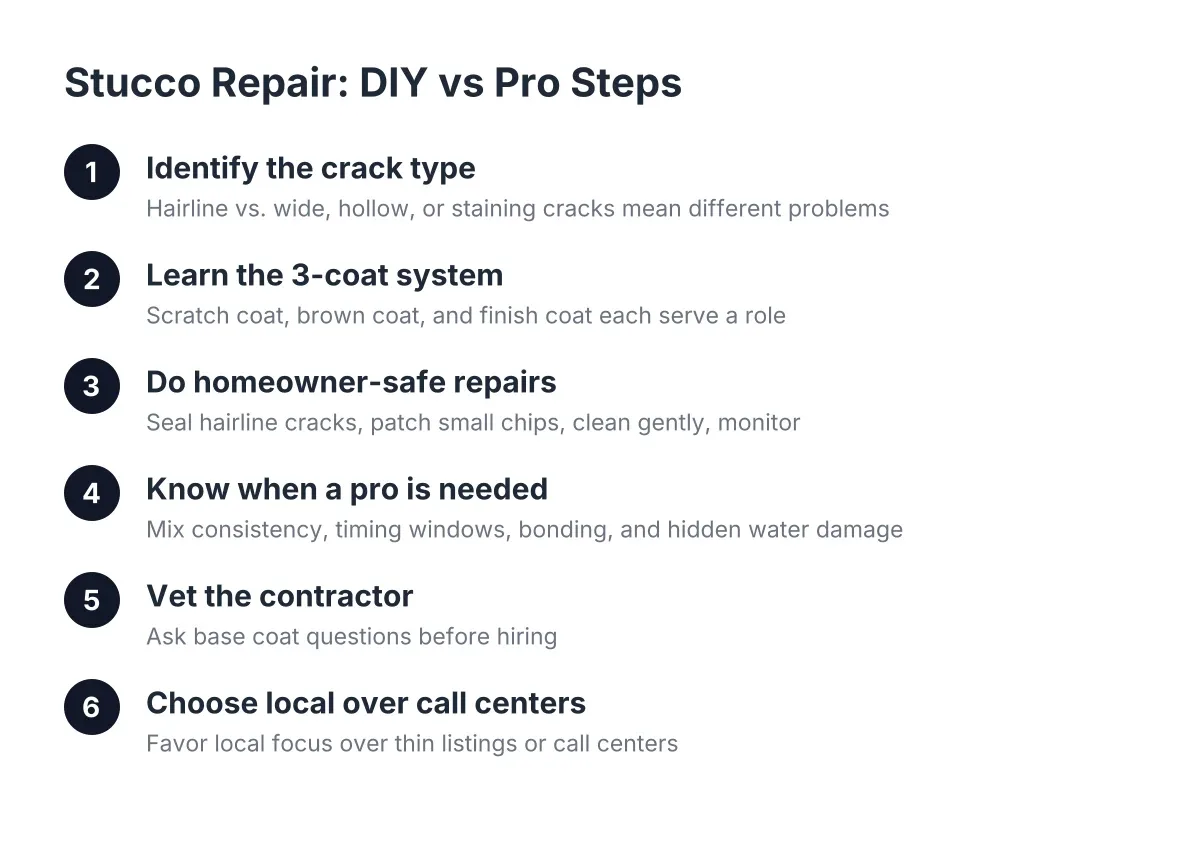
Cure times matter too. Stucco repair is a layered process. Traditional work goes on in three coats: a scratch coat, a brown coat, and a finish coat, with time between each. Some repairs use modern polymer-modified patch products that replace the three-coat system with a single application, which shortens the job. The contract or the estimate conversation should tell you which approach your repair uses and why. A one-day promise on a job that needs multiple coats and cure time is a promise someone plans to break.
Therefore, read the timeline for honesty, not speed. "Two to four working days, weather permitting, with a day between coats" tells you the contractor knows the material. "In and out in an afternoon" on a large patch tells you the opposite.
Change Orders: What Happens When the Wall Gets Opened
Hidden damage is the biggest source of mid-job price disputes, so the contract needs a change order clause. Stucco hides what is behind it. A crack that looks cosmetic can sit over building paper that has gone brittle after years of wall flexing, and torn paper means water has had a path inside. Nobody knows for certain until the damaged material comes off.
A fair change order clause says three things. First, the contractor stops and shows you the hidden damage before doing extra work. Second, you get the added cost in writing before approving it. Third, you sign off before the extra work starts. That structure protects you from the classic upsell, where the price climbs after demolition and you have no practical way to say no.
Suppose a homeowner in Castle Pines gets a $2,800 quote to patch hail damage on a south-facing wall. The crew opens the wall and finds water-damaged sheathing behind one impact point. With a change order clause, the homeowner gets photos, a written price for the added sheathing work, and a choice. Without one, the homeowner gets a bigger invoice at the end and an argument. The clause costs nothing to include, and its absence tells you something.
How Stucco Repair Contract Terms Differ by Contractor Type
The same repair gets papered three different ways depending on who writes the contract. This is where comparing quotes gets easier, because the contract style usually reveals the operation behind it.
Franchise Call Centers and Rotating Crews
National franchise operations route your call through a call center, send out an estimator, and then assign whichever crew is available. The contract is usually a corporate template. It can be thorough on paper, but the terms often favor the company: broad scope language like "repair as necessary," arbitration clauses, and warranty service that runs back through the same call center that took your first call.
The practical problem is accountability. The person who sold you the job, the person who wrote the contract, and the crew on your wall may never have met. If the texture match comes out wrong, your warranty claim goes into a queue. Rotating crews also make consistency harder; the finish on your wall depends on who shows up that week, and the next visit may bring different people.
Thin Local Sites and Lead-Gen Listings
Then there are the websites that rank for "stucco repair near me" but exist mainly to sell your contact information to whoever pays for the lead. The contract, if you get one, comes from a contractor you did not choose and could not research. Terms vary job to job because the actual operator varies job to job. If the scope is a single sentence and the warranty is verbal, you are looking at this category. Walk away from any stucco job where the paperwork is thinner than the patch.
Dedicated Local Stucco Crews
A local contractor who works only on stucco tends to write narrower, more specific contracts, because they know exactly what the job involves. The scope names the walls, the prep, the coats, and the texture match. The timeline reflects real cure times. Additionally, the warranty has a name and a phone number behind it, not a ticket system.
The trade-off is honest to state: a focused local crew is rarely the cheapest bid and may not have the soonest opening after a major hailstorm, when demand spikes. However, for a repair that has to match your existing siding and hold up through Colorado freeze-thaw cycles, specific terms from a reachable local operator usually beat a cheap template from a rotating crew. When you are hiring a stucco contractor, the contract is the clearest window you get into how the company actually runs.
Warranty Protection: What the Fine Print Should Cover
A stucco repair warranty should state four things in writing: what is covered, for how long, who performs warranty work, and what voids coverage. Workmanship coverage of one to a few years is a common range on repair work, though terms vary by contractor and job. Anything shorter than a year on workmanship is worth questioning, since some failures only show up after a full freeze-thaw season.
Separate the two kinds of coverage in your head. The material warranty comes from the product manufacturer and covers defects in the stucco or sealant itself. The workmanship warranty comes from the contractor and covers how it was applied. Most repair failures, cracks reopening, patches debonding, and texture mismatch, are workmanship issues. The contractor's warranty is the one you will actually use, so read it harder.
In addition, check the exclusions. Reasonable exclusions include new damage from a later storm, settling of the structure, and problems caused by conditions the contractor flagged but you chose not to fix. For example, if a corner keeps cracking because of a drainage problem and you decline the drainage fix, a reasonable contract excludes that recurrence. Unreasonable exclusions are the ones written so broadly that nothing is ever covered.
Ask who does the warranty work. With a local operation, the answer is the same crew that did the repair. With a franchise, it may be whoever is in rotation that month. For an insurance-driven repair, keep the warranty document with your claim file; if a covered repair fails and causes water damage later, that paperwork matters.
Insurance Claims and Your Repair Contract
If a hailstorm put the cracks in your wall, your contract and your insurance claim need to tell the same story. The written estimate should describe the damage in terms an adjuster can match to their inspection: impact marks, cracked areas by wall and size, and any water damage behind the surface. A contractor who has worked storm claims will write the estimate that way without being asked.
This is not a small corner of the market in Colorado. The state logged 182,591 hail insurance claims from 2013 to 2015, second in the nation behind Texas, according to the Rocky Mountain Insurance Information Association. Premiums reflect it; Colorado home insurance premiums rose 65% over the last five years, with hail cited as a major driver, according to the National Association of Insurance Commissioners. After every major storm, adjusters are stretched thin and door-knocking contractors multiply.
Be careful with anyone who offers to "handle the insurance for you" or waive your deductible. Between 2018 and 2020, hail-related claims nationally rose 2% while questionable claim submissions rose 34%, according to RMIIA data. Insurers watch for inflated storm claims, and a contract that plays games with your deductible puts your claim and your coverage at risk. The clean arrangement is simple: the contractor writes an honest estimate, you submit it, the insurer pays its share, and you pay your deductible. Every payment shows up in the contract.
One caution on scope: insurance decisions about what a policy covers belong to you and your adjuster, and complex claims or disputed coverage are worth a conversation with your agent or a public adjuster before you sign a repair contract.
Questions That Test a Contract Before You Sign It
Use the contract review as a final vetting step. A contractor's answers to these questions tell you whether the terms on paper match the operation behind them:
- Can you walk me through the payment schedule and what each payment covers?
- What happens if you open the wall and find water damage behind the stucco?
- How many coats does this repair need, and how long between them?
- Who matches the texture, and what happens if the match is off?
- Who performs warranty work, and how do I reach them, by name?
- How does this estimate line up with what my insurance adjuster documented?
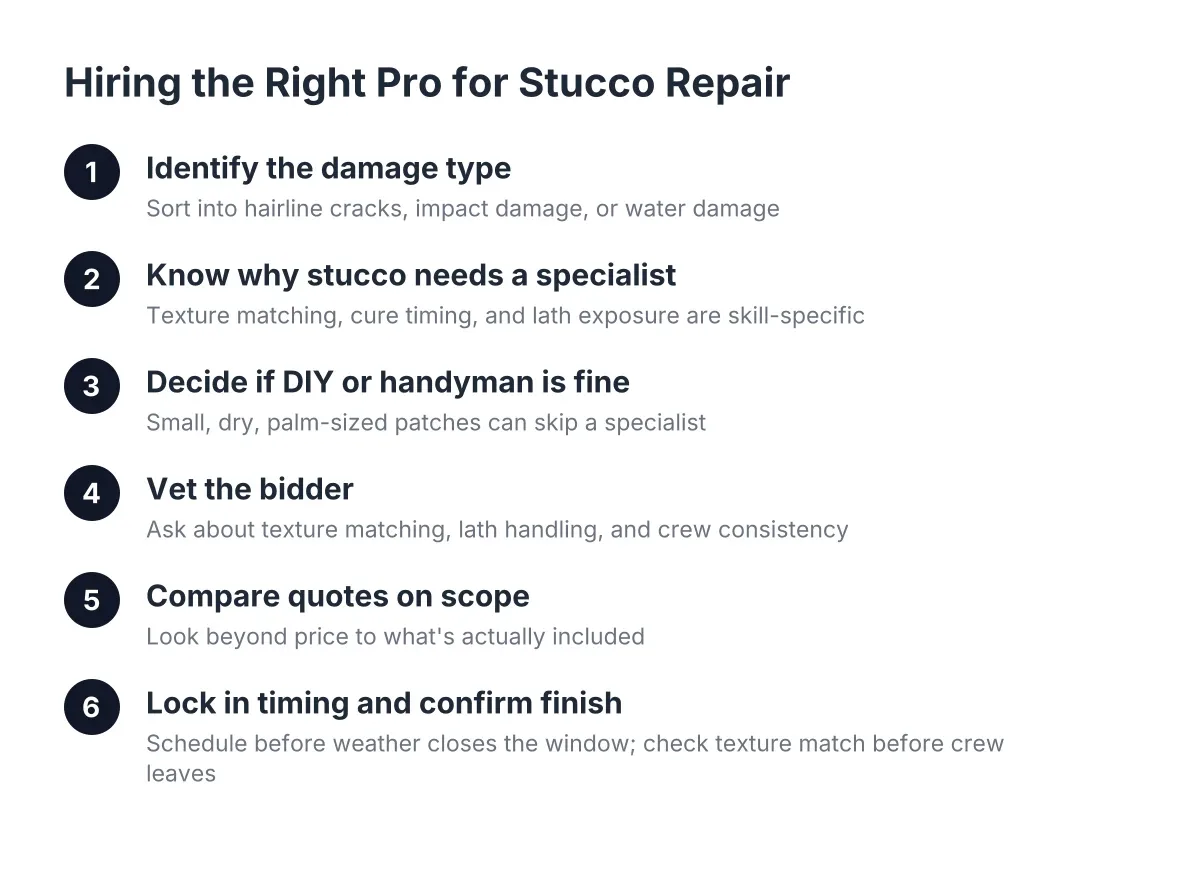
Listen for specifics. A stucco specialist answers in concrete terms: which product, which coat system, which crew member handles finish work. A generalist answers in reassurances. Vague answers before you sign become vague accountability after you pay.
A final practical note on timing. Small cracks are cheap to fix and expensive to ignore. Years of delay let the building paper behind a crack grow brittle, and once wall flexing tears that paper, water gets a real path inside and the repair scope grows. Reading stucco repair contract terms carefully takes an evening. Living with a bad repair, or chasing a call center for warranty service, takes years. Choose the contract, and the contractor, built for the second conversation, not just the first one.
If you need stucco repair, Castle Rock Stucco Pros can help.
Prefer to talk it through? Call (720) 797-8506 — a quick call is usually the fastest way to get a straight answer for your situation.