Stucco Contractor Qualifications and Licensing: What Actually Matters in Castle Rock
If you are comparing bids for stucco repair in Castle Rock, you have probably already searched something like stucco contractor qualifications licensing and found a wall of state licensing pages for California, Florida, and Arizona. Those pages will not help you much here. Colorado does not license stucco contractors at the state level, which means stucco licensing in Colorado works differently than in other states, and the credential shortcuts you might rely on elsewhere do not exist in Douglas County. That changes how you vet people, and it explains why so many Castle Rock homeowners end up with a patch that sticks out from thirty feet away.
This guide covers what qualifications actually mean in a state without a stucco license, which paperwork still matters, and how to tell a dedicated stucco crew from a franchise call center or a generalist who does stucco on the side. It is written from the point of view of a local specialist, so take the comparison for what it is: candid, but not neutral. The vetting questions work no matter who you hire.
Why You Are Reading This: The Patch You Can See From the Driveway
Most homeowners do not research contractor qualifications for fun. Usually one of two things happened. Either a previous repair looks wrong, the texture is flatter or the color is a shade off, and you notice it every single time you pull in. Or you are getting ready to list the house and your realtor or a pre-listing inspection flagged cracks, staining, or a hole that could spook buyers.
Both situations come down to the same problem. Stucco repair is easy to do badly and hard to do well. Almost anyone with a trowel and a bag of pre-mix can fill a crack. Making the repair disappear into a wall that has weathered in Colorado sun for fifteen years is a different skill entirely. The gap between those two outcomes is exactly what qualifications are supposed to predict.
Therefore the real question is not "does this contractor have a license number?" It is "what evidence do I have that this crew can match my wall?" The rest of this article walks through how to answer that.
Understanding Stucco Licensing Requirements and Alternatives in Colorado
Colorado has no statewide contractor license for stucco, plastering, or lathing work. Licensing in Colorado happens at the city and county level, and it mostly applies to trades like electrical and plumbing, plus general contractors pulling permits for structural work. A crew doing exterior stucco repair on your Castle Rock home is typically not required to hold a trade-specific stucco license, because no such license exists here.
This surprises people who have moved from states like California, where a C-35 lathing and plastering license is a real, testable credential. If you search "licensed stucco contractor near me" from Castle Rock, you will mostly find either out-of-state licensing pages or contractors using the word loosely. Be careful with anyone who leans hard on vague credential language. If a company implies a stucco-specific license in Colorado, ask them exactly which authority issued it. The honest answer is usually a business license or a general contractor registration with a municipality, which is fine, but it is not proof of stucco skill.
So what should you check instead? Three things still matter and are verifiable:
- Business registration. The company should be a real registered business in Colorado, findable through the Secretary of State's website. A name, a registered agent, and a filing history tell you this is not a truck-and-a-magnet operation that dissolves after a bad job.
- General liability insurance. Ask for a certificate of insurance sent directly from their insurer, not a photocopy. If a ladder goes through your window or a scaffold damages your roofline, this is what pays.
- Workers' compensation coverage, or a legitimate exemption. If someone gets hurt on your property and the contractor carries no coverage, you can end up exposed. Sole proprietors in Colorado can be exempt; larger crews should carry it.
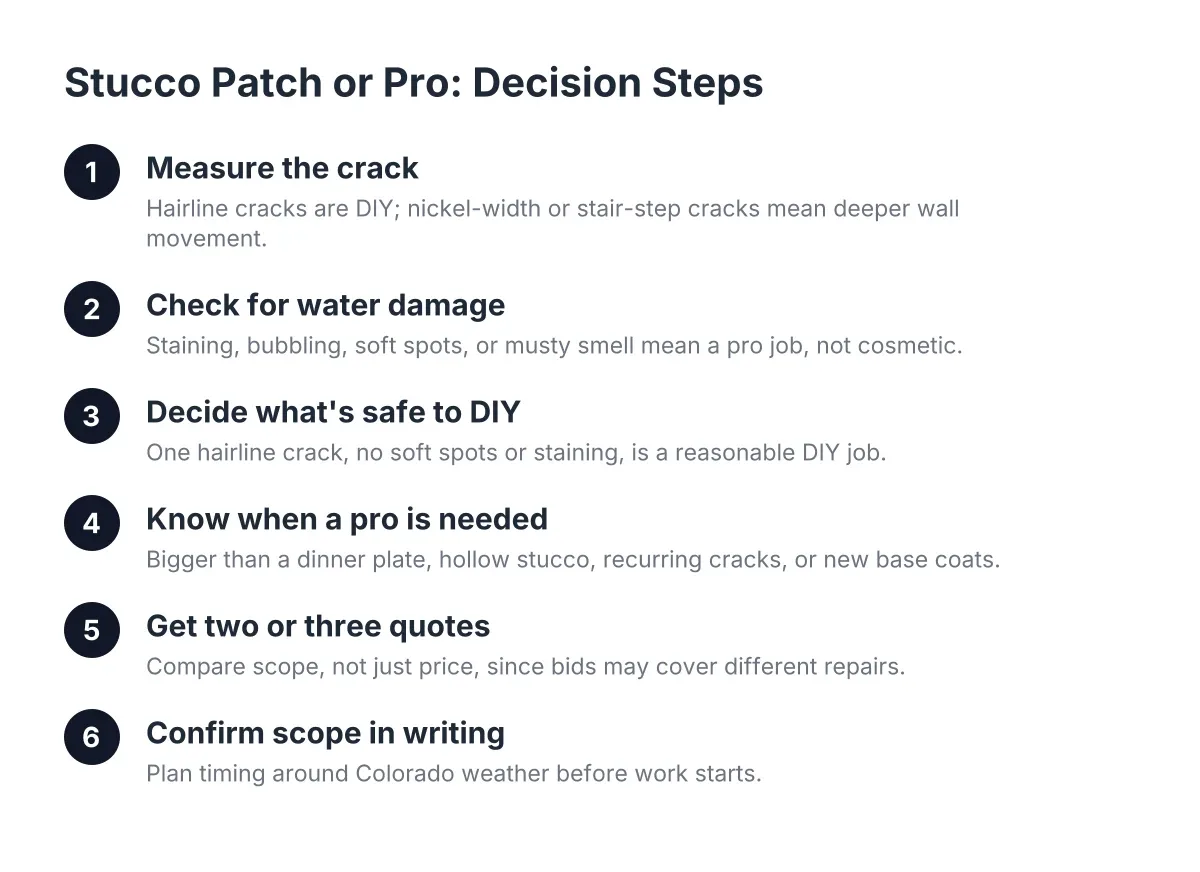
In addition, permits can come into play. Small crack repair and patching in Castle Rock usually does not require a permit. Larger stucco siding material replacement, or repairs tied to structural or water damage issues, might. A contractor who knows the local permit thresholds without having to look them up has done work in this town before. That local familiarity is a qualification in itself.
The Qualifications That Predict a Good Repair
Since licensing will not sort candidates for you in Colorado, experience has to do the heavy lifting. However, "experience" is easy to claim and hard to verify, so you need to test it with specifics.
They can explain your wall before they quote it
A qualified stucco contractor should be able to tell you what your wall is made of. Traditional three-coat stucco goes on in layers: a scratch coat that gets scored so the next layer bonds, a brown coat, and a finish coat that carries the color and texture. Under all of that sits a moisture barrier and metal lath. Many newer homes have a synthetic system instead, which repairs differently.
A contractor who cannot identify your system, or who quotes a price without knowing whether your cracks are surface-level or a sign of water damage behind the wall, is guessing. Guessing is how you get a patch that fails or a repair that traps moisture. Any competent estimator will check whether cracks follow window corners, whether staining suggests water intrusion, and whether the existing surface is sound enough to bond to.
They talk about surface prep without being asked
Bad patches usually fail at the bond line. New material will not hold to a wall covered in loose debris, dust, oils, or crumbling old stucco. Before any patching, the surface needs to be cleaned and any loose burrs or rough spots scraped off so the new material has something clean to grab.
For example, listen to how an estimator describes the first day of work. If the answer is "we show up and start patching," that is a red flag. If the answer covers cutting back to sound material, keeping the existing lath usable for weatherproofing, and prepping the surface before mix touches the wall, you are talking to someone who has done this many times. Small details like how they cut into existing stucco matter; opening the area the wrong way can force a bigger repair and a bigger bill.
They treat texture matching as its own step, not an afterthought
This is where the Texture-Match Perfectionist got burned last time. Matching texture and color is a separate skill from patching a hole. The finish coat has to replicate the pattern of the surrounding wall, and the color has to account for the fact that your existing stucco has weathered. A brand-new color-matched finish next to fifteen-year-old stucco can still read as a patch if nobody accounts for fading.
Ask directly: how do you match texture, and what do you do when the color sample dries lighter or darker than the wall? A qualified answer includes making test patches, matching the application technique used on the original wall, and sometimes recommending that a larger section be refinished so the transition lands at a natural break like a corner or control joint. An honest contractor will also tell you the limits. On an older, heavily weathered wall, a perfect invisible match is not always possible, and someone who promises perfection without seeing your wall is selling, not assessing.
They know how the material behaves
Stucco is time-sensitive material. Professional plasterers can put up multiple coats in a day because they know how to dose accelerators; too much and the mix hardens in minutes before it can be worked. Timing between coats, curing conditions, and Colorado's temperature swings all affect the result. Cold snaps and dry air change how the finish cures, and a crew that works here year-round plans around that. A generalist who does stucco a few times a year does not carry that judgment.
Franchise Call Centers, Lead-Gen Sites, and Local Crews: An Honest Comparison
When you search stucco repair near me in Castle Rock, you will get three kinds of results, and they behave differently once you call.
National franchise operations route your call through a call center, then dispatch whichever crew is available. The company brand may be solid, but the person who shows up at your house may have never worked with the crew that quoted the job. For texture matching, that rotation is a real problem. The estimator who studied your wall and the finisher who floats the final coat may never speak to each other. Franchises can be a reasonable fit for large, standardized projects. For a repair where the whole job is making a patch disappear, continuity between the person who assessed the wall and the person who finishes it matters more than brand recognition.
Thin local lead-gen sites rank well on Google but are often just a form that sells your contact information to whoever pays for the lead. You cannot vet a website that has no crew behind it. If a site has no real information about how they handle repairs, no local phone number that reaches a person, and no substance beyond a quote form, treat it as a directory, not a contractor.
Dedicated local stucco crews are reachable directly, work in your area repeatedly, and live or die on local reputation. The trade-off is honest: a small local operation may book out further than a franchise with rotating crews, and you should still verify their insurance and registration like anyone else. Local does not automatically mean good. It does mean the person who quotes your wall is usually the person responsible for how it looks when the scaffolding comes down, and that you can find them again if something needs a follow-up visit.
None of these categories is dishonest by definition. The point is to know which one you are calling before you compare quotes, because a low bid from a rotating crew and a higher bid from a specialist are not quotes for the same job.
Questions That Separate Specialists from Generalists
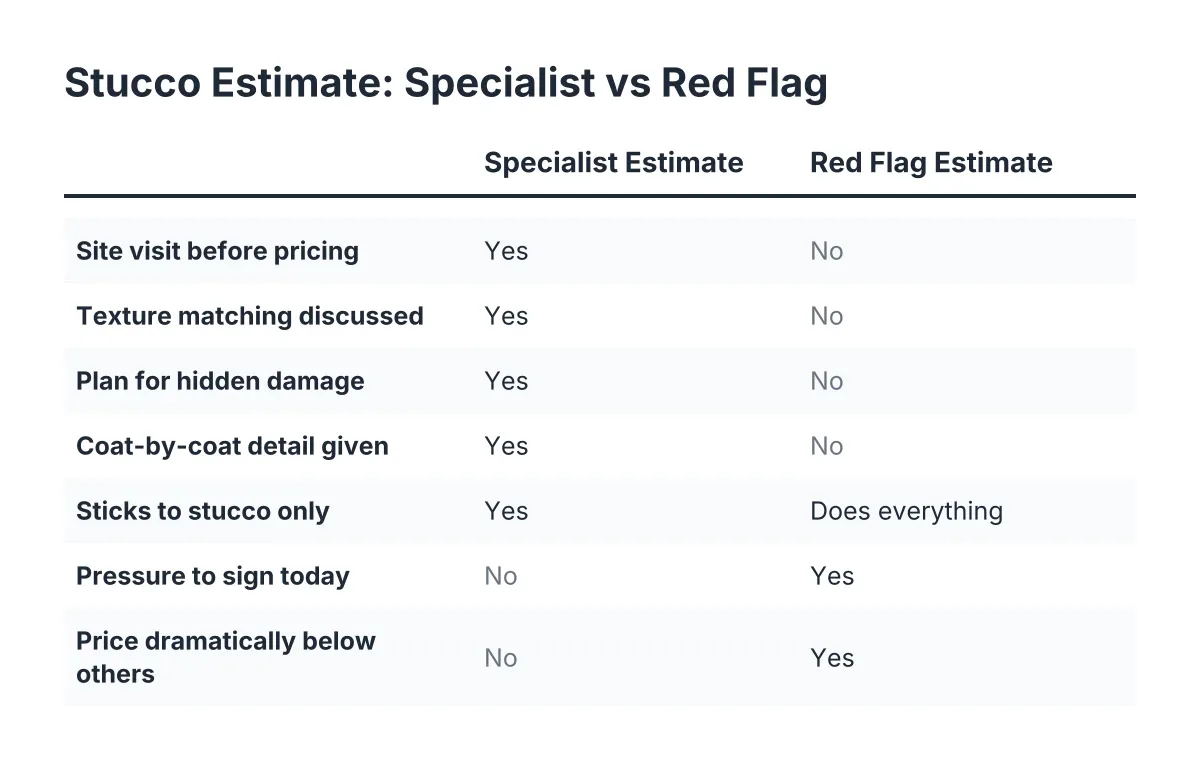
When you are hiring a stucco contractor, the goal of the first conversation is not to get a price. It is to find out whether this person understands your specific wall. Use questions that cannot be answered with a sales script:
- What kind of stucco system is on my house, and how does that change the repair? They should be able to answer after looking at the wall, not before.
- How will you match my existing texture and color? Listen for test patches, technique matching, and a plan for weathered color, not just "we color match everything."
- What surface prep do you do before patching? Cleaning, cutting back to sound material, and preserving the lath for weatherproofing should come up unprompted.
- Who exactly will be on my wall, and did that person see the estimate? This exposes rotating-crew operations immediately.
- What happens if the patch does not blend after it cures? You want to hear their process for adjusting, not a shrug.
- Can you send a certificate of insurance directly from your insurer? Anyone who stalls on this is telling you something.
- What does your warranty cover, in writing? Stucco repair warranty questions matter because verbal promises about blending are worthless. Get the scope, duration, and what voids it on paper.
A general painter or handyman can answer maybe two of these well. That is the practical difference between a stucco contractor and a general painter: the painter can make the color close; the stucco specialist controls the texture, the bond, and the weatherproofing underneath it.
Red Flags That Should End the Conversation
Some warning signs are worth walking away from regardless of price:
- A quote given over the phone for texture-matching work, sight unseen.
- Pressure to pay a large deposit in cash before any materials arrive.
- Vague credential claims that do not survive one follow-up question.
- No physical local presence, no direct phone contact, and no one who can name recent work in Castle Rock or nearby areas.
- A promise that the repair will be completely invisible, made before anyone has examined the wall's age and weathering.
- Refusal to put warranty terms in writing.
One more Colorado-specific caution. This state gets hammered by hail; the National Association of Insurance Commissioners reports Colorado home insurance premiums rose 65% over the last five years, with hail cited as a major driver. Storm-heavy markets attract door-knocking storm chasers who follow the damage and leave before problems surface. Rocky Mountain Insurance Information Association data shows that between 2018 and 2020, hail claims nationally rose 2% while questionable claim submissions jumped 34%. If someone knocks on your door after a storm offering to handle your stucco through insurance, apply every check in this article twice.
A Pre-Listing Scenario: How Qualifications Play Out on a Deadline
Suppose a homeowner in Castle Rock is listing in six weeks. The pre-listing inspection flags stair-step cracks near two window corners and an old patch on the garage wall that a previous owner had done, visibly darker and smoother than the surrounding finish. The realtor wants it handled before photos.
In that scenario, the vetting stakes are concrete. A generalist can skim coat the cracks in an afternoon for a low price, and under listing photos taken at the wrong angle, the sheen difference will show. A buyer's inspector may then flag "recent unexplained stucco repair," which raises more questions than the original cracks did. Additionally, a qualified stucco contractor would instead check whether the window-corner cracks indicate movement or water damage, cut back the old garage patch to sound material, and rebuild the finish to match the surrounding texture, likely finishing the section to a natural break so no transition line lands mid-wall.
The second approach costs more and might take a few extra days. However, for a sale where a visible defect can trigger a price reduction larger than the entire repair bill, the qualification questions in this article are cheap insurance. As a general rule of thumb, targeted repairs on visible defects tend to land in the hundreds to low thousands depending on scope; treat that as a rough illustrative range, not a quote, since access, damage depth, and finish type move the number.
The Bottom Line on Vetting a Stucco Crew in 2026
In Colorado, checking stucco contractor qualifications means verifying insurance and business registration yourself, then testing experience with specific questions, because no state stucco license will do the sorting for you. Focus your evaluation on three things: proof of insurance sent directly from the insurer, evidence the crew understands your specific wall system and prep requirements, and a concrete, written answer to how they will match your texture and color.
Prefer whoever can explain your wall best, whether that turns out to be a local specialist or someone else. If the repair involves suspected structural movement or hidden water damage behind the stucco, bring in the appropriate professional to assess it before anyone starts patching; cosmetic work over an active problem fails every time. Get the scope and warranty in writing, confirm the person who assessed the wall stays connected to the person finishing it, and do not pay in full until you have seen the cured result in daylight. That is the whole playbook, and it works on every contractor in town, including us.
If you'd rather have a professional handle it, Contact Castle Rock Stucco Pros is the place to start.
Prefer to talk it through? Call (720) 797-8506 — a quick call is usually the fastest way to get a straight answer for your situation.