Stucco Repair Warranty Coverage: What Insurance Pays For and What Contractors Promise
A hailstorm rolls through Castle Rock, your stucco takes a beating, and now you have two pieces of paper in front of you: an insurance policy and a contractor's estimate. Both use the word "coverage," and neither explains what it actually means for the wall on the side of your house. Understanding the distinction between stucco warranty and insurance can be confusing, sitting right at that intersection where what your insurance company pays for and what your contractor stands behind are two different things that homeowners often mix up. This guide separates them, written from the perspective of a crew that has worked alongside adjusters on Colorado hail claims, not a generalist siding outfit guessing at insurance language.
If you are reading this after a storm, you probably want three things: to know what is actually damaged, to know who pays for it, and to know what happens if the repair fails or looks wrong a year from now. That third question is the one almost nobody asks before signing, and it is the one that costs people the most.
Two Different Promises, One Confused Homeowner
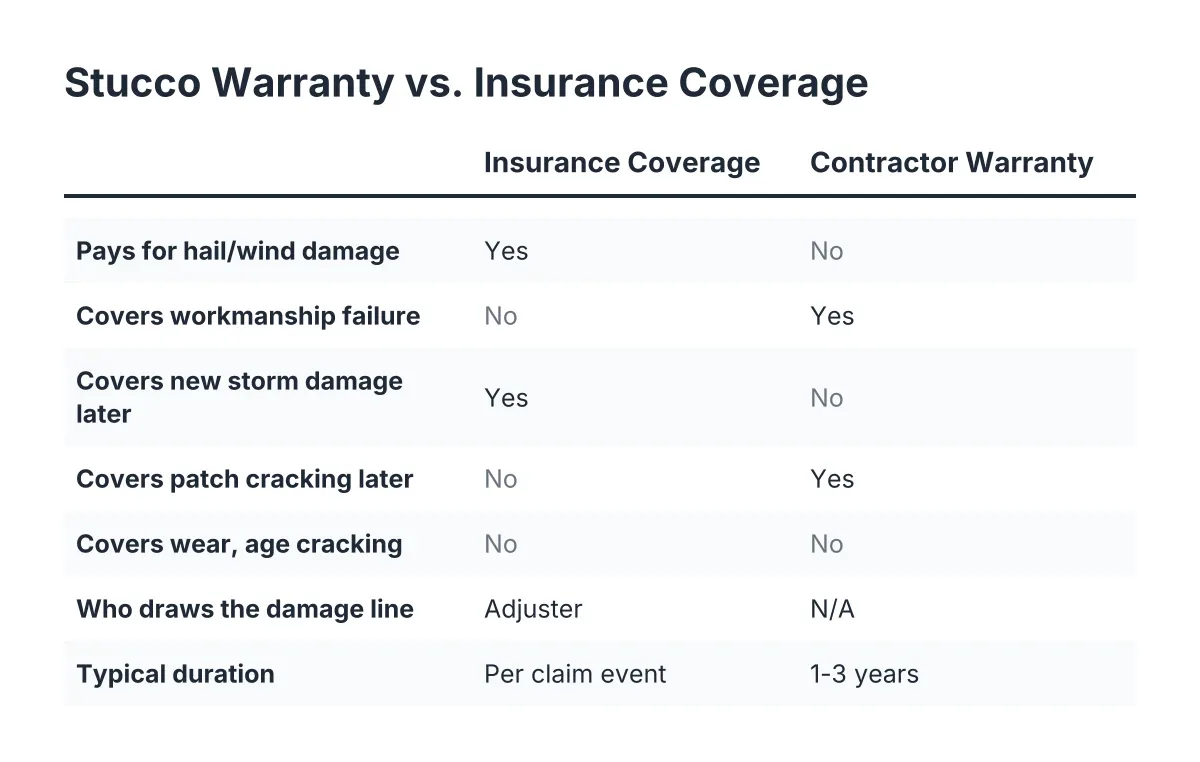
Here is the core distinction. Insurance coverage pays to fix damage caused by a covered event, like hail or wind. A contractor warranty promises the repair itself will hold up for some period of time. They come from different parties, they cover different failures, and one does not back up the other.
Suppose hail cracks the stucco on your west-facing wall. Your insurance policy may cover the cost of repairing that crack, minus your deductible. Then a contractor patches it. If that patch fails in eight months, your insurance will not pay to redo it. That failure is a workmanship problem, and workmanship is the contractor's territory, not the insurer's.
The reverse is also true. If a new storm hits the repaired wall next spring and cracks it again, that is not a warranty claim against the contractor. That is a new insurance event. Homeowners who do not understand this split end up arguing with the wrong party, and the clock runs out while they do.
This matters more in Colorado than in most places. According to the National Insurance Crime Bureau, the May 8, 2017 Front Range hailstorm caused $2.3 billion in insured damage, the costliest catastrophe in state history. Storms like that generate thousands of rushed repairs, and rushed repairs are where warranty language gets tested.
Understanding Stucco Warranty vs. Insurance Coverage on Storm-Damaged Stucco
Homeowners insurance in Colorado typically covers stucco damage caused by hail and wind, because those are sudden, accidental events. What it does not cover is wear, age cracking, poor original installation, or a previous bad patch that never matched in the first place. The adjuster's job is to draw that line, and on stucco the line is blurrier than it is on a roof.
Hail damage on stucco shows up as circular impact marks, chipped finish coat, spalled spots, and radiating cracks around impact points. Age and settling damage shows up as long diagonal cracks from window corners, hairline map cracking, and staining. An adjuster who sees both on the same wall will try to separate them, and the scope they approve depends heavily on what gets documented and how.
In addition, there is a reason adjusters scrutinize these claims closely. Rocky Mountain Insurance Information Association data shows that between 2018 and 2020, hail-related insurance claims nationally rose 2% while questionable claim submissions rose 34%. Adjusters are not being difficult for sport; they see inflated and vague claims constantly. A clear, honest, well-documented stucco storm damage inspection cuts through that skepticism better than any argument.
How to Document Stucco Storm Damage for a Claim
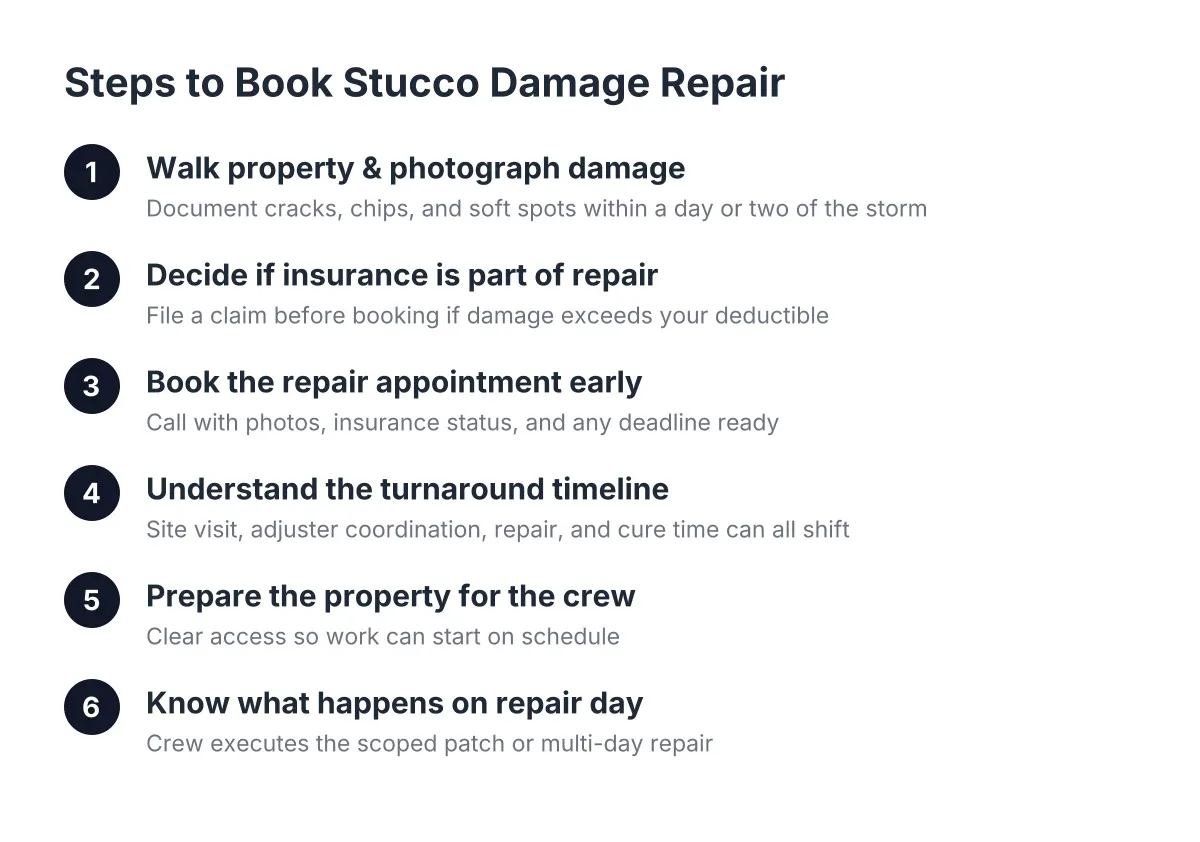
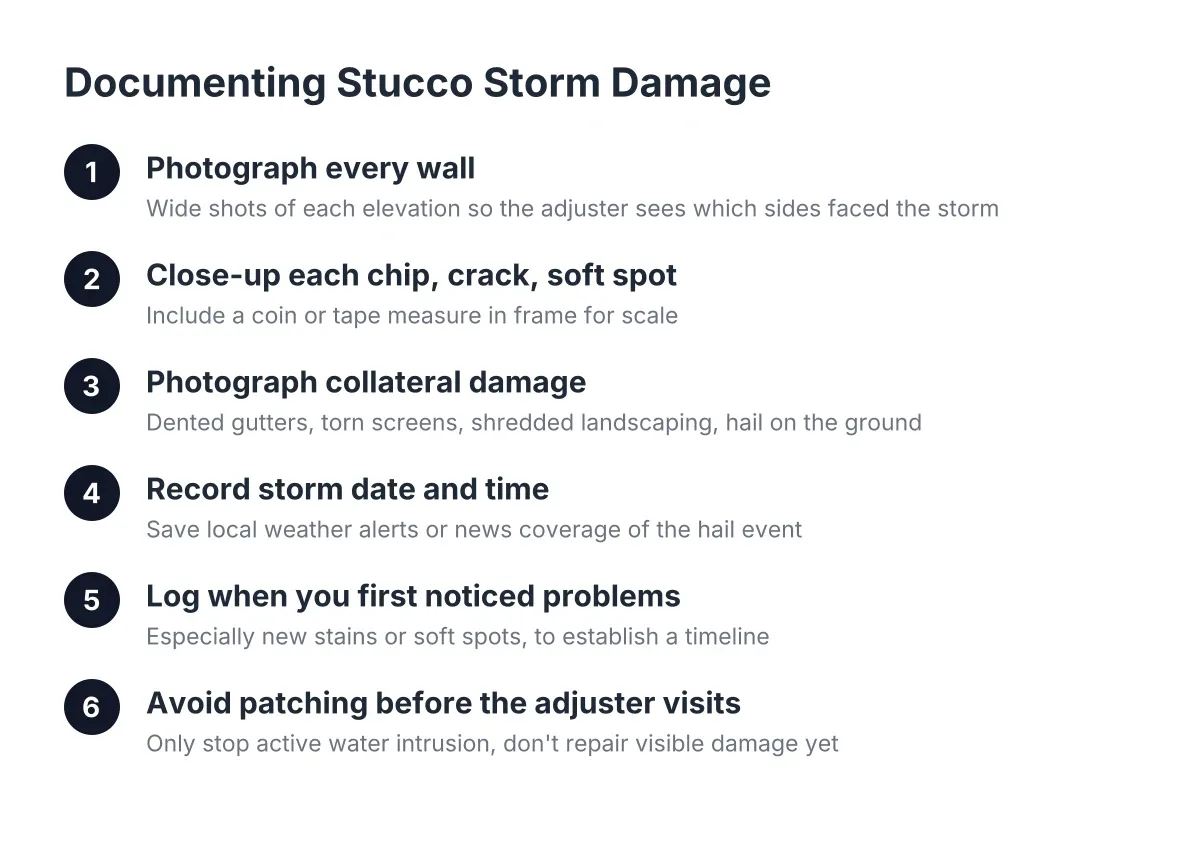
Documenting stucco storm damage means photographing every impact mark with something for scale, noting the date of the storm, and getting a written repair estimate that separates storm damage from pre-existing cracks. Do this before any temporary patching. Adjusters approve scopes based on what they can verify, not what you remember.
A practical documentation checklist:
- Photograph each damaged wall from a distance, then close up, with a coin or tape measure next to impact marks for scale
- Note which walls face the direction the storm came from; hail damage concentrates on one or two exposures
- Record the storm date and keep any local weather reports or news coverage from that day
- Get a written estimate that lists each repair area separately, with square footage and the repair method
- Do not remove loose material before the adjuster sees it, but photograph anything that falls off on its own
One more point from the field side. Before any real repair starts, all loose or buckling stucco has to come off, because leaving it in place lets rain keep working into the wall and expanding the damage underneath. Your documentation should happen before that demolition, which is why the sequence matters: photos first, adjuster visit, then tear-out and repair.
What Stucco Warranty vs. Insurance Should Cover From a Contractor
A contractor's stucco warranty and insurance coverage considerations should involve a statement, in writing, of what is covered, for how long, and what voids it. At minimum it should cover the repair bonding to the wall, the patch not cracking under normal conditions, and the materials performing as specified. If a contractor cannot put that in a sentence or two on the estimate, that tells you something.
Most reputable stucco repair warranties run one to three years on workmanship. Material manufacturers sometimes add their own warranty on the products used, but read those closely; manufacturer warranties usually cover the cost of replacement material only, not the labor to redo the work. Labor is the expensive part of exterior stucco repair, so a materials-only warranty is thinner protection than it sounds.
Be cautious with the phrase "lifetime warranty" on a stucco patch. Stucco is a cement-based material on a house that moves with Colorado's freeze-thaw cycles. A patch that never cracks over a lifetime is not a realistic promise, and contractors who make unrealistic promises tend to be hard to reach when you try to collect. A specific, modest, written warranty from a local company you can call directly beats a sweeping promise from an outfit that routes calls through a national center.
What Warranties on Stucco Repair Usually Exclude
Nearly every stucco repair warranty excludes new storm damage, damage from the homeowner or landscaping equipment, settling of the structure, and failures caused by problems the contractor flagged but was not hired to fix. These exclusions are standard and reasonable. The ones to question are vague exclusions that could cover anything, like "environmental conditions."
That last standard exclusion deserves attention. Say a corner of your stucco keeps cracking because an air conditioning unit sits against the wall and vibrates it, and water pools against the foundation there. A partial patch on that corner is a legitimate, cheaper alternative to re-stuccoing the wall. However, if the vibration and drainage never get fixed, the crack will likely return, and the contractor who warned you about the cause in writing is within their rights to decline the warranty claim. A good contractor names the underlying cause on the estimate; a good homeowner either fixes it or accepts the trade-off knowingly.
Hairline cracking is another common gray area. Fine cracks in a cured patch can be normal as the material settles, while a crack you can slip a fingernail into is not. Ask your contractor where they draw that line before work starts, not after.
Why Texture Match Belongs in the Warranty Conversation
If you have already lived with a patch that does not match, you know the frustration. The color is close but wrong, the texture is flat where the wall is knocked down, and you see it every time you pull into the driveway. A poor texture match on a repair usually means the person who did it did not match the original technique or finish type, not that matching was impossible.
Here is the uncomfortable truth about most warranty documents: they cover structural failure of the patch, and they stay silent on appearance. The patch can hold perfectly and still look like a scar. If the finished look matters to you, and for most Castle Rock homeowners it does, get the appearance standard into the written scope before work begins. Language like "finish coat textured and color-matched to blend with the surrounding wall, reviewed with homeowner before final coat" gives you something to point to.
Texture matching is real craft, not guesswork. On a knockdown dash finish, common across Castle Rock neighborhoods, the crew sprays the finish coat onto the patched area and then lightly trowels it down so the pattern blends into the existing wall. Done by someone who knows the technique, the repair disappears. Done by a generalist with a trowel and good intentions, it reads as a patch from the street. One honest limitation worth stating: on an older, weathered wall, a perfect match on day one is not always possible, because the surrounding stucco has faded and the new finish has not. A skilled match gets close and weathers in over the following seasons; a contractor who explains that up front is being straight with you.
Where Insurance Scope and Repair Warranties Collide
The friction point on storm claims is scope. An adjuster might approve patching five impact areas on a wall. A stucco contractor looking at the same wall might tell you the finish coat across that whole exposure needs recoating for the repair to blend and hold. When the approved scope and the sound repair diverge, the warranty often lives or dies in that gap.
For example, suppose a homeowner in the Meadows gets an insurance approval of $2,400 to patch hail impacts on two walls, against a $1,000 deductible. A contractor quotes the patching at that figure but notes the texture will not blend without refinishing the full wall sections, an added $1,800 the policy does not cover. That is a real decision with no free answer: pay the difference for a blended result, or accept visible patches that are structurally sound. In comparing stucco warranty and insurance coverage options, what the contractor should never do is promise an invisible match within the insurance-only scope. If they do, ask them to put it in the warranty. Watch what happens.
This is also where supplement requests come in. If tear-out reveals damage the adjuster could not see, such as torn building paper behind a crack, the contractor documents it with photos and the claim scope gets revised. A structural crack left alone for years lets the building paper behind it grow brittle; wall flexing can then tear the paper, and what started as a surface repair becomes a water intrusion problem. Contractors who have worked storm damage stucco repair alongside Colorado adjusters know how to document a supplement so it gets reviewed instead of denied. That experience is worth asking about directly when you compare bids.
Premiums raise the stakes on getting this right the first time. According to the National Association of Insurance Commissioners, Colorado home insurance premiums rose 65% over the last five years, with hail cited as a major driver. Every claim matters more now, and a repair that fails and triggers a second claim later is the worst outcome for your wallet.
Questions That Reveal Real Stucco Repair Warranty Coverage
You learn more about a contractor's warranty in five minutes of questions than in any brochure. The goal is not to catch anyone; it is to find out whether the promise is specific, written, and backed by someone you can actually reach in Castle Rock when something goes wrong.
Ask these before you sign:
- What exactly does your workmanship warranty cover, and for how long? Get the answer in writing on the estimate.
- Does the warranty cover the patch cracking, or only the patch falling off? Those are different failures.
- What voids the warranty, and is any underlying cause, like drainage or vibration, noted on my estimate?
- Is the texture and color match part of the written scope, and do I review it before the final coat?
- If I call about a warranty issue next year, who answers, you or a call center?
- How do you handle it if the adjuster's approved scope is smaller than what the repair needs?
Pay attention to how the answers sound. A contractor who says "the patch is warranted against delamination and cracking beyond hairline for two years, here is what voids it" is telling you something verifiable. A contractor who says "we stand behind everything, no worries" is telling you nothing. As of 2026, with Colorado premiums where they are, vague promises are a luxury homeowners cannot afford. Rocky Mountain Insurance Information Association figures show the average homeowner's premium in the state rose 57.9% from 2018 to 2023, well above the 33.8% national average, driven in part by catastrophic hail losses.
What a Warranty Cannot Fix: Getting the Repair Right the First Time
No warranty document substitutes for sound work. The strongest stucco repair warranty in the county does not help much if you have to invoke it, because invoking it means living with a failed patch, scheduling the redo, and hoping the second attempt blends better than the first. The warranty is the backstop. Additionally, the repair method is the actual protection.
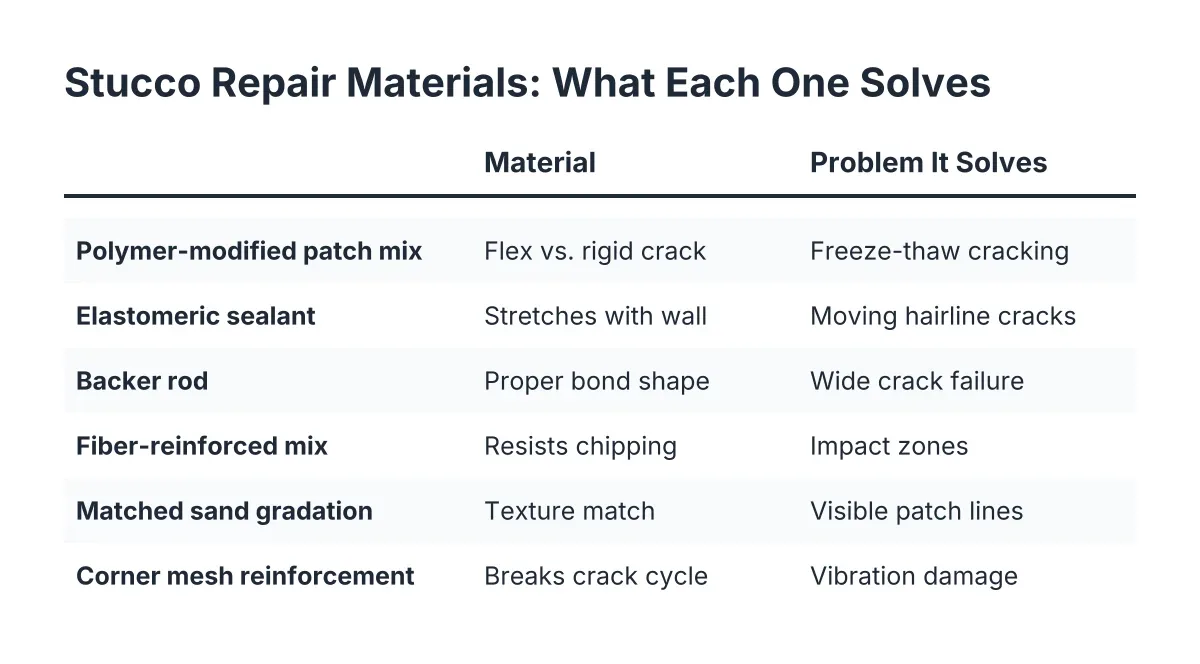
A sound storm repair in Castle Rock follows a sequence. First, all loose and damaged material comes off, down to solid stucco and intact lath. Next, the crew checks the building paper and lath behind the damage; torn paper gets addressed, because that is your water barrier. The edges of the opening matter too: a rough break that leaves the wire lath exposed and torn gives the repair something to tie into and weatherproof against, while a clean grinder cut forces the crew to open up more wall, adding cost. Then the patch goes on, working from the bottom of the repair area upward. Modern polymer-modified, rapid-setting patch materials can replace the old three-coat process with a single application on repair work, and a properly cured fiber-reinforced repair stays flexible enough to move with the wall and shrug off the occasional hit from a lawn mower or a kicked ball. Last comes the finish coat and the texture work, which is where the repair either disappears or announces itself.
If any step gets skipped, the warranty becomes the plan instead of the backup. That is backwards.
One honest note on limits: if your stucco shows widespread cracking across multiple walls, staining that suggests water behind the surface, or soft spots when you press on it, a patch-and-warranty conversation is premature. That situation calls for a professional inspection of what is happening behind the stucco siding before anyone talks scope, because patching over active water damage warranties nothing.
The Short Version
Insurance pays for the storm. The contractor warrants the repair. Neither covers the other's territory, and the gap between an adjuster's approved scope and a repair that blends and lasts is where Castle Rock homeowners get stuck. Document the damage before anything gets removed, get the warranty terms and the texture-match standard in writing, ask who answers the phone next year, and treat the warranty as a backstop for work done right rather than a substitute for it. A local crew that knows stucco, knows the common textures in this area, and has sat through adjuster walkthroughs will have specific answers to every question above. Vague answers are the earliest warning sign you will get. Take it.
If you need stucco repair, Castle Rock Stucco Pros can help.
Prefer to talk it through? Call (720) 797-8506 — a quick call is usually the fastest way to get a straight answer for your situation.