How to Choose a Stucco Contractor in Castle Rock: A 9-Point Vetting Checklist
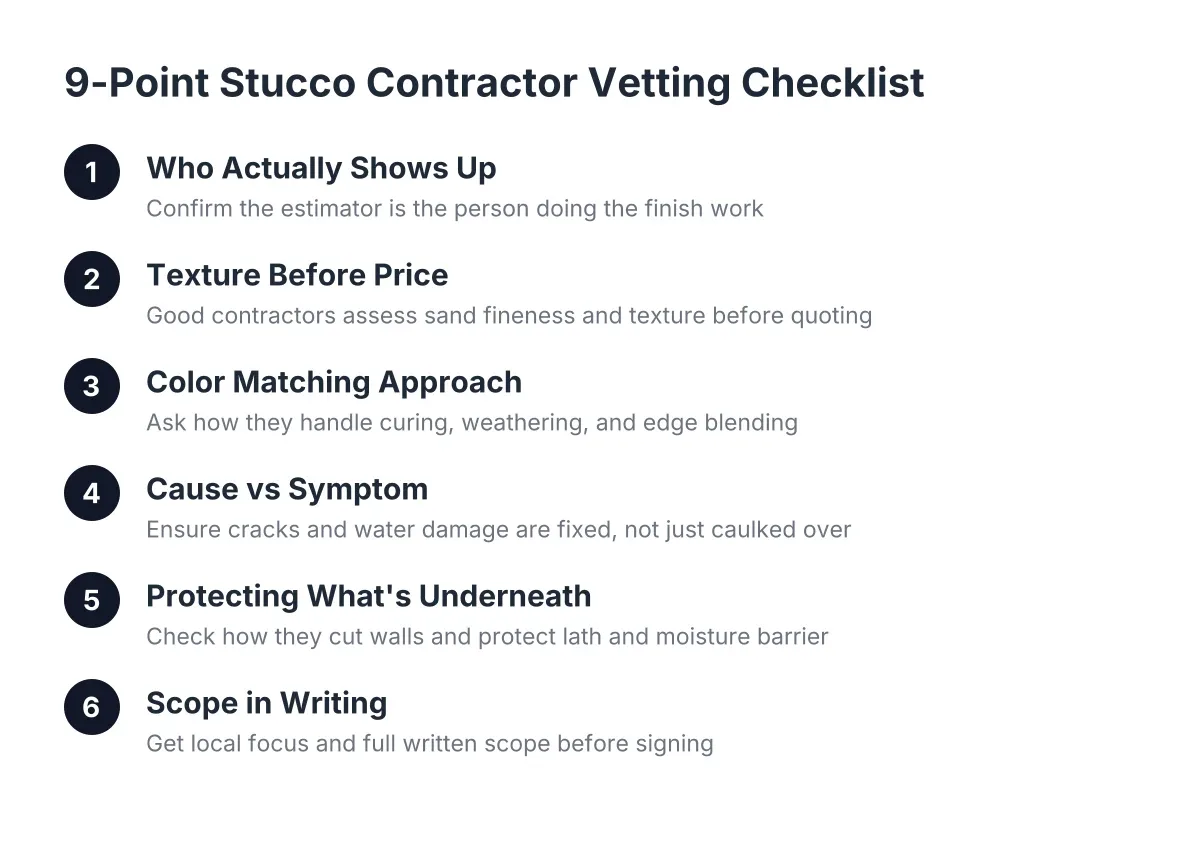
If you have a patch on your wall that you can spot from the street, you already know the hard truth: most stucco repairs fail on the finish, not the fix. Learning how to choose a stucco contractor in Castle Rock is mostly about learning who can match texture and color, and who just fills a hole and hopes. A proper vetting checklist stucco contractor uses nine key checkpoints before you hand anyone a deposit, including the difference between a dedicated local crew, a franchise call center, and a thin lead-gen site that ranks on Google but has nobody real behind it.
The stakes are higher than they look. A bad patch is not just ugly. It usually means the underlying problem, whether that is a moving crack, water damage behind the wall, or torn lath, was never handled either. So you end up paying twice: once for the patch that does not match, and again for the person who has to open it back up and do it right.
1. Ask Who Actually Shows Up on Your Wall
The first thing to pin down is whether the person quoting the job is the person doing the job. National franchise operations often route your call through a call center in another state, then dispatch whichever crew is available that week. The crew that gives the estimate may not be the crew that does the work, and neither may have laid a trowel on Castle Rock stucco before.
Texture matching is a hands-on skill that lives in the specific person holding the trowel. Different applicators flatten and finish stucco in different ways; there is no single correct technique, only an end result that either blends or does not. If the company cannot tell you who will do your finish coat, you cannot judge whether they can match your wall.
2. Make Them Talk About Texture Before They Talk About Price
A contractor who leads with a price before looking closely at your existing finish is quoting a patch, not a match. A good stucco repair conversation starts with your wall: what the texture is, how weathered it is, what sand fineness the original applicator used, and how the light hits that elevation in the afternoon.
Here is a detail that separates specialists from generalists: the fineness of the sand in the repair mix has to match the texture of the existing finish. A crew that uses whatever pre-mixed bag is on the truck will produce a patch that reads slightly wrong even when the color is close. If you have ever pulled into your driveway and had your eye go straight to the old repair, this is usually why.
3. Ask How They Handle Color, Not Just Crack Repair
Color matching on stucco is harder than paint matching because stucco color shifts as it cures and weathers. A patch mixed to match a chip of fresh material will dry lighter or darker than the ten-year-old wall around it. Ask the contractor how they account for weathering, whether they do test patches, and how they blend the edges so the repair does not have a hard border.
Be wary of anyone who promises the repair will disappear completely on a heavily weathered wall. An honest contractor will tell you that on older, sun-faded stucco, a perfect invisible match is sometimes not possible without refinishing a larger section or the whole elevation. That candor is a good sign, not a bad one. The contractor who promised your last patch would blend in and then vanished is exactly who this question filters out.
4. Check Whether They Fix the Cause or Just the Symptom
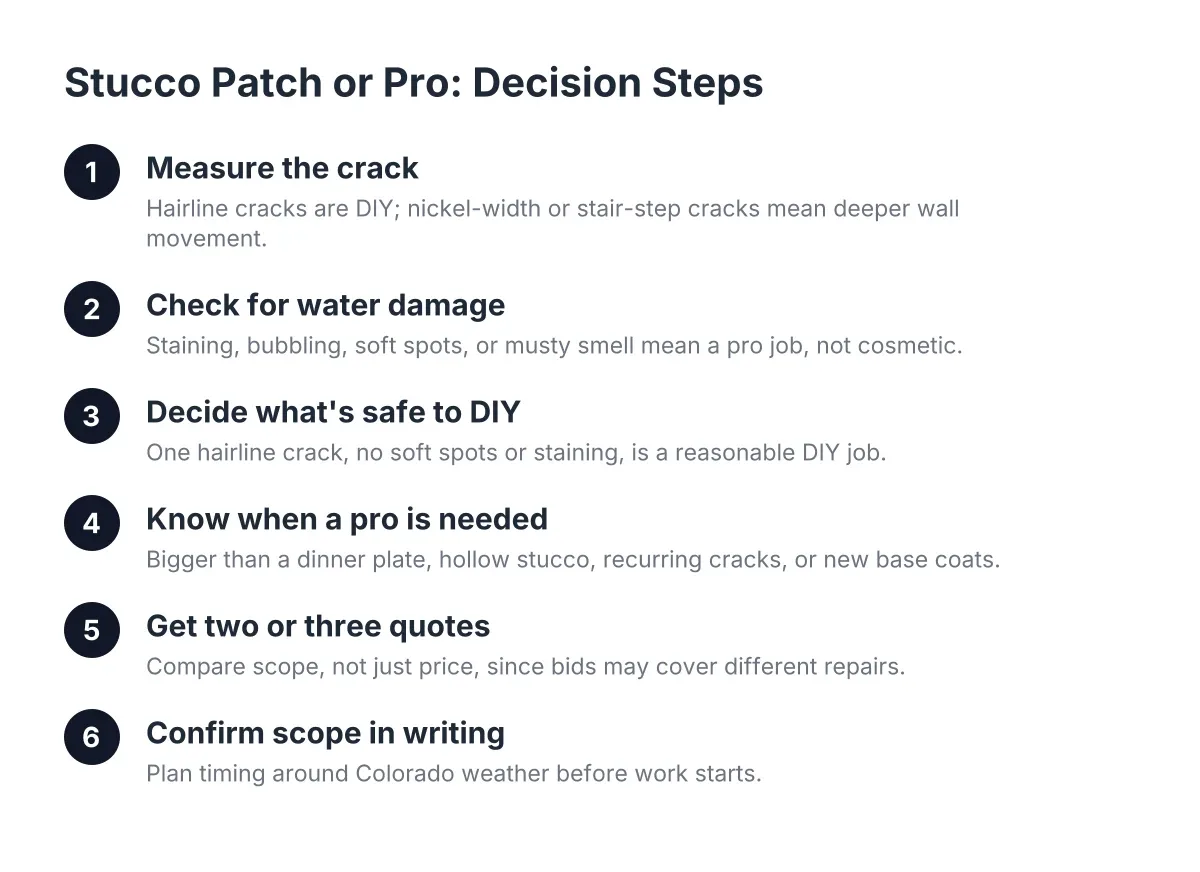
Suppose a homeowner in Stonegate has a four-year-old home with a crack running down from a window corner. The builder warranty has expired, the builder stopped returning calls, and a handyman smeared caulk over the crack last spring. The caulk line is now a shiny scar, and the crack is telegraphing through it because nothing about the movement or the water path behind it was addressed.
In that scenario, the right contractor opens the question up before quoting. Is the crack structural movement or normal shrinkage? Is there water damage behind it? Proper crack repair often means routing the crack, using backer rod, which according to Sika is a closed-cell foam cord that creates a backing inside the crack before sealant goes in, and then refinishing over the top. A quote that skips the cause is a quote for the same failure in a new color.
5. Ask What Is Under the Stucco and How They Protect It
Exterior stucco repair is a weatherproofing job before it is a cosmetic one. Traditional stucco goes on in three coats: a scratch coat that gets scored so the next layer bonds, a brown coat, and a finish coat that carries the color and texture. Behind all of that sits lath and a moisture barrier that keep water out of your framing.
How a contractor cuts into the wall tells you a lot. When sizing an opening, a clean grinder cut through everything can slice the lath flush, which forces the repair crew to open up even more wall to tie the new lath in and weatherproof the patch properly. A crew that understands the assembly leaves the lath workable and keeps the repair, and your stucco repair cost, as contained as possible.
6. Building Your Contractor Vetting Checklist for Stucco Work
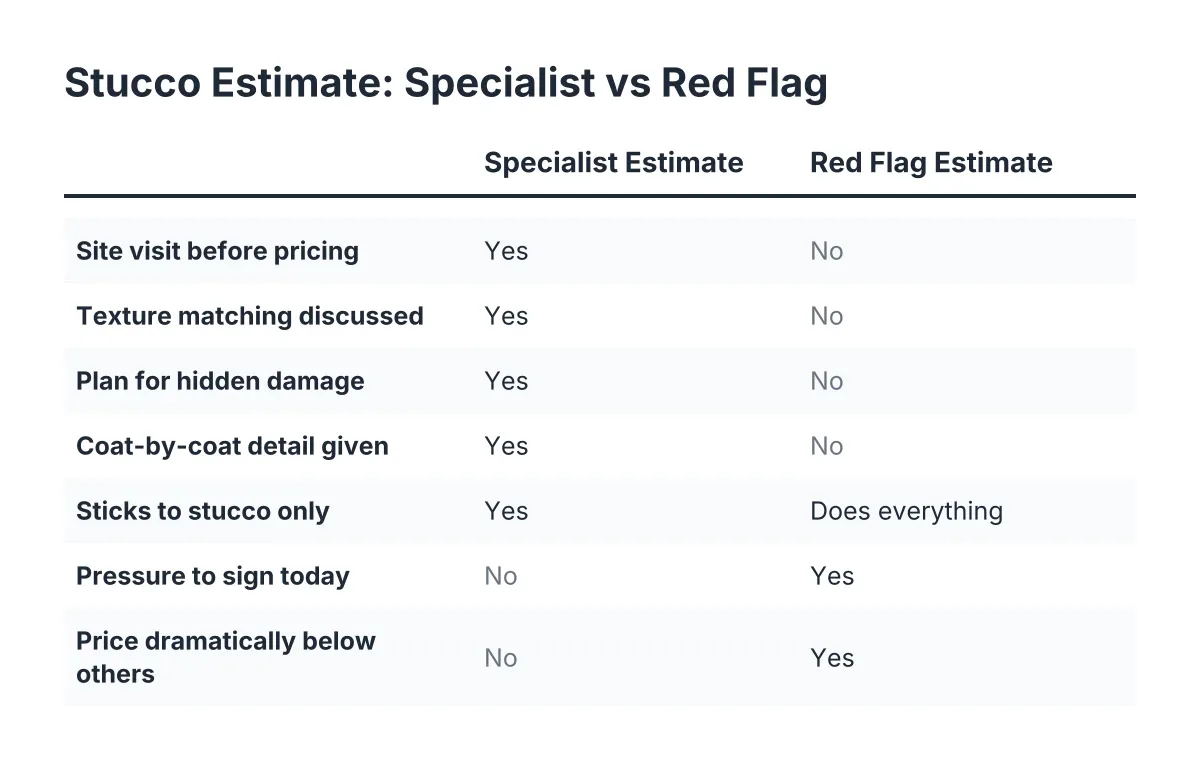
Choosing a stucco contractor in Castle Rock starts with figuring out who is actually behind the website. Search "stucco repair near me" and you will find three kinds of results: real local crews, national franchises with local-looking pages, and thin lead-gen sites that exist only to sell your phone number to whoever pays for it. Only the first group has any accountability to you.
A few quick tests sort them out:
- Call the number. Does a person who knows Castle Rock answer, or a script-reading call center?
- Ask a specific question, such as how they would match a heavy dash finish on a north-facing wall. A real crew answers; a lead-gen operator stalls.
- Ask for a local address or where they were working last week. Vague answers mean the "local" page is a mask.
- Check whether the site says anything specific about stucco patching, texture matching, or water damage repair, or just repeats the town name over generic filler.
None of this requires expertise on your part. It only requires noticing whether the answers are specific or evasive.
7. Questions That Expose a Generalist Stucco Contractor
You do not need to know stucco to vet a stucco contractor. You just need questions where a generalist's answer falls apart. In addition to the texture and cause questions above, ask these:
- How will you match my existing texture, and can I see a test patch before you do the full finish coat?
- What do you do if you open the wall and find water damage behind the crack?
- How do you handle curing between coats, and how long will the repair take start to finish?
- What does your written scope include, and what happens if the match is off when it dries?
- Have you repaired stucco on newer builds in neighborhoods like Meridian or Carriage Club, where early cracking shows up in the first few years?
The curing question matters more than it sounds. Experienced plasterers can apply multiple coats in a day because they know how to dose accelerators; too much and the mix hardens in minutes before it can be worked. A crew that rushes coats without that skill produces weak, poorly bonded patches. That is one of several reasons how to repair stucco holes is a worse DIY project than it appears, and why scratch and brown coat work is generally hired out rather than attempted by homeowners.
8. Get the Scope in Writing, Especially for a Redo
If you are fixing a bad patch, the second repair has to undo the first one. That means removing the failed material, scraping off loose burrs and rough spots so the new coat bonds to a clean surface, and often opening the area slightly wider than the visible patch so the new finish can feather into the surrounding texture. A written scope should say all of that, not just "repair stucco, match finish."
The scope also protects you on the match itself. If the agreement says the contractor will do a sample patch for your approval before finishing the full area, you have a checkpoint instead of a surprise. Homeowners who were burned once by a "trust me, it will blend" promise should treat that sample step as non-negotiable when hiring a stucco contractor for the redo.
9. Weigh Local Focus Against the Cheapest Bid
Price matters, and a fair range for most residential repairs runs from a few hundred dollars for small crack repair to several thousand for larger sections with water damage; treat those as rough illustrative figures, since every wall is different. But the cheapest bid on a texture-sensitive repair is often the most expensive path, because you pay for it, look at it for a year, and then pay someone else to redo it.
Colorado weather raises the stakes on getting it right once. According to the National Association of Insurance Commissioners, Colorado home insurance premiums rose 65% over the last five years, with hail cited as a major driver. Hail-battered, sun-baked stucco siding here takes more abuse than the same wall would in a milder state, so a repair that is bonded properly and sealed against water is worth more than a cheap skim that fails by 2026's first freeze-thaw cycle.
The Short Version of the Checklist
When you choose a stucco contractor, Castle Rock homeowners really only need to confirm five things: a reachable local human, a texture-first conversation, a cause-not-symptom diagnosis, a sample patch before the full finish, and a written scope. Everything else on this list feeds one of those five.
One honest caveat: if your stucco problem involves widespread delamination, suspected structural movement, or water damage you can smell inside the house, get a professional assessment before anyone quotes a cosmetic repair. A patch, however well matched, cannot fix a wall system that is failing underneath. The right contractor will tell you that on the first visit, which is itself the final test worth running.
If you need stucco repair, Castle Rock Stucco Pros can help.
Prefer to talk it through? Call (720) 797-8506 — a quick call is usually the fastest way to get a straight answer for your situation.