
Stucco Repair — Complete Guide
Cracked, crumbling, or stained stucco rarely fixes itself, and in Castle Rock's climate it usually gets worse fast. This guide covers everything you need to know about stucco repair, from spotting the first hairline crack to understanding how professional stucco patching actually works. You'll learn how to identify the damage you're seeing, why so many patches fail within a year, and when a DIY fix makes sense versus calling a local crew. Along the way, we link to detailed guides on each subtopic so you can go as deep as your situation requires. By the end, you'll know exactly what your stucco needs and what a repair done right should look like.
What You'll Find in This Guide
- Why Stucco Patches Fail and How Professionals Make Repairs That Last
- Identifying Stucco Damage Types: 8 Cracks, Holes, and Water Signs to Know
- How to Repair Stucco Cracks Step by Step: A Castle Rock, CO Guide
- Stucco Repair Terms Explained: A Plain-English Glossary
Prefer to have a pro handle it? Stucco repair is one call away.
Reading the Damage: What Your Stucco Is Telling You
Stucco damage speaks a language. Thin vertical hairline cracks near windows usually signal normal settling, while stair-step cracks can indicate foundation movement. Soft spots, bubbling, or dark staining below a crack almost always signal trapped water behind the surface. Each problem requires different repairs, making diagnosis critical.
Castle Rock homes face specific stressors: freeze-thaw cycles push moisture into tiny cracks, expanding them each winter. Intense sun breaks down surfaces over time, and hail causes real damage. Colorado logged 182,591 hail insurance claims from 2013 to 2015—the second-highest total in the country—according to the Rocky Mountain Insurance Information Association. Hail chips stucco, opens hairline fractures, and creates water entry points you won't notice until months later.
Walk your home's exterior twice yearly and look closely at corners, around windows and doors, along the foundation line, and where rooflines meet walls—these spots fail first. Our guide to identifying the eight most common types of stucco damage provides a plain checklist with warning signs ranked by urgency.
Don't panic over every line in the finish. Hairline cracks under a sixteenth of an inch are often cosmetic. However, cracks widening over a season, holes exposing lath or paper underneath, and any moisture warrant immediate attention. The gap between a small patch and major damage is usually time. Early repairs cost a fraction of water damage remediation because water travels down and sideways behind walls, damaging sheathing and framing.
Why Most Quick Stucco Patching Fails
Here's the uncomfortable truth about stucco patching: most patches fail, and they fail for predictable reasons. The tube of caulk or premixed patch compound from the hardware store sits on top of the damage instead of bonding into it. As a result, the patch shrinks, cracks, or pops loose within a year or two. Worse, it often traps moisture behind it, so the wall deteriorates quietly while the surface looks fixed.
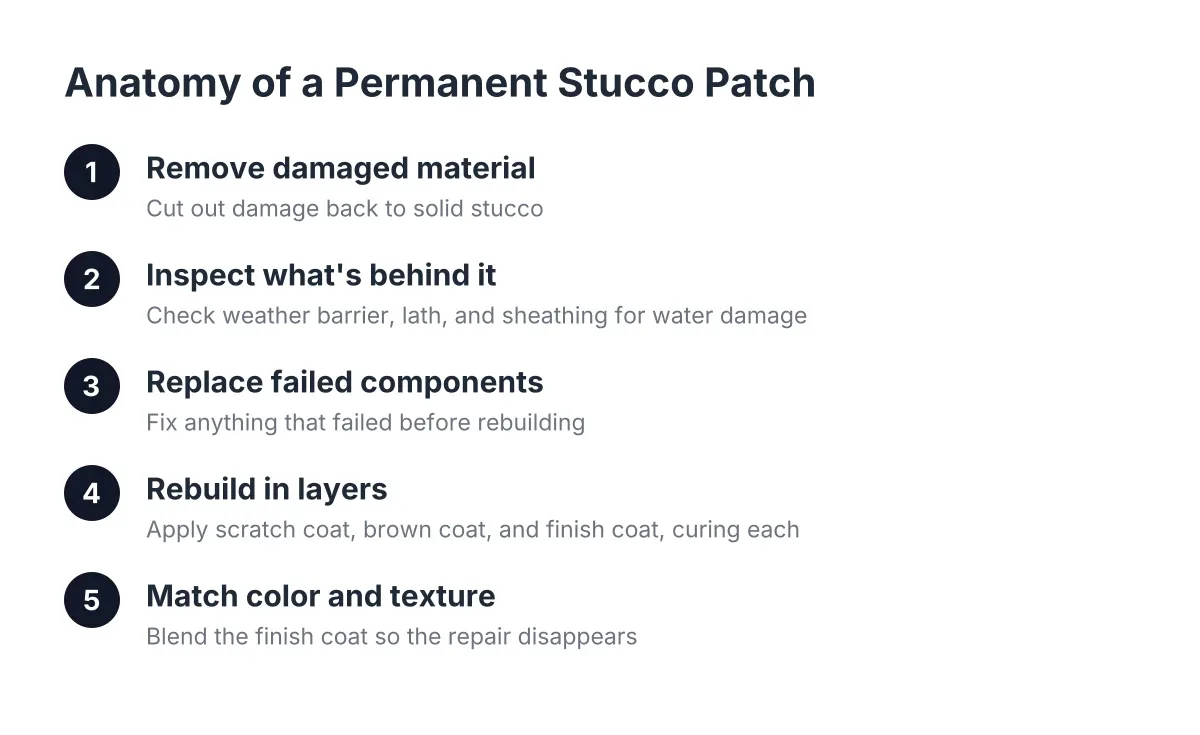
A permanent repair works differently. It starts with cutting back the damaged area to sound material rather than smearing filler over a crack. Then the repair rebuilds the wall system in layers, matching the original construction: the moisture barrier, the lath, the scratch coat, the brown coat, and the finish. Skip a layer, and you've built a weak spot that will fail at the seams. Our article on why stucco patches fail and how professionals make repairs that last breaks down each failure mode in detail.
Why Texture and Color Matching Matter in Stucco Patching
Beyond durability, there's the part most homeowners notice first: appearance. A structurally sound patch that doesn't match your home's texture and color is still a failed repair in your eyes. You'll see it every time you pull into the driveway. In practice, matching texture takes real skill. Castle Rock homes carry everything from fine sand finishes to heavy lace and dash textures, and each one requires a different application technique and tool.
Color matching adds another layer of difficulty, because stucco weathers. Even a perfect pigment match to the original formula will look different next to twenty years of sun exposure. For this reason, a good crew matches the aged color on your wall, not the color on an old spec sheet, and feathers the finish so the repair edge disappears. If you want to see the full process from start to finish, our step-by-step guide to repairing stucco cracks in Castle Rock shows what each stage should look like when it's done right. Use it as a benchmark, whether you do the work yourself or watch a contractor do it.
DIY or Hire a Pro: Making the Right Call for Your Wall
Some stucco repairs are genuinely DIY-friendly. A single hairline crack in a low-visibility spot, filled carefully with the right flexible material, can hold up fine. Small nail holes and minor chips fall into the same category. If the damage is cosmetic, isolated, and dry, a careful homeowner can handle it over a weekend.
However, three situations should push you toward a professional. First, any sign of water: staining, soft spots, bubbling paint, or a musty smell near the wall. Water damage repair requires opening the wall, assessing what's wet, and rebuilding the moisture barrier correctly. Second, any damage larger than a few inches across, because larger exterior repairs have to tie into the surrounding layers or they will separate at the edges. Third, anywhere the repair will be highly visible, since texture and color matching is where DIY attempts most often fall short.
Know What You're Buying Before You Sign
If you do hire out the work, get quotes you can actually read. A vague line item like "repair stucco, $1,800" tells you nothing about whether the crew plans to cut back to sound material or just skim over the crack. Ask what layers they'll rebuild, how they'll match your texture, and what their work looks like a year later. To decode the terminology in those estimates, keep our plain-English stucco repair glossary open while you read. It turns words like "elastomeric" and "scratch coat" into decisions you can evaluate.
Cost pressure is real right now, too. Colorado home insurance premiums rose 65% over the last five years, with hail cited as a major driver, according to the National Association of Insurance Commissioners. Consequently, more homeowners are paying for exterior repairs out of pocket rather than filing claims and risking further premium hikes. That makes it even more important that a repair lasts. Paying once for proper stucco patching beats paying three times for cover-ups that fail each spring. To put it simply, the cheapest quote is rarely the cheapest repair.
One more local note: avoid national franchise operations that route your call through a call center and send a different crew each visit. Stucco work rewards familiarity with the material and the local climate. A crew that patches Castle Rock stucco every week knows how our homes age, which textures dominate which neighborhoods, and which products survive our winters.
Ready to Get Started?
If you've spotted a crack, a hole, or a stain that's been nagging at you, don't give it another winter to spread. We're a local Castle Rock crew that treats every repair as a permanent, invisible fix, and we'll walk you through exactly what your wall needs before any work begins. Reach out for a straightforward assessment and a quote you can actually understand.