Can Homeowner Insurance Cover Stucco Storm Damage Repair in Castle Rock?
A hailstorm rolls through Castle Rock, and the next morning you walk the house. There are chips in the stucco on the west wall, a crack running from a window corner, and a dark stain that was not there last week. The first question most homeowners ask is simple: can homeowner insurance cover the cost of fixing this damage from a storm? The short answer is yes, in many cases insurance can cover stucco storm damage, because hail and wind are standard covered perils on most Colorado policies. Additionally, the longer answer depends on what the adjuster sees, how you document the damage, and whether the problem reads as storm damage or as wear and tear. This guide walks through that whole process the way a contractor who has stood on driveways with adjusters would explain it, not the way a generic insurance FAQ would.
Colorado is hail country, and the numbers back that up. The May 8, 2017 Front Range hailstorm caused $2.3 billion in insured damage, still the state's costliest catastrophe, with about 100,600 homeowners claims, according to the National Insurance Crime Bureau. From 2013 to 2015, Colorado had 182,591 hail insurance claims, second only to Texas, according to the Rocky Mountain Insurance Information Association. If your stucco took a hit, you are in well-traveled territory. Insurers here process stucco hail claims all the time. The question is whether your specific damage qualifies, and that is what the rest of this article sorts out.
When Can Homeowner Insurance Cover Stucco Repair Costs?
Homeowner insurance can cover stucco repair when the damage comes from a sudden, specific event that your policy names as a covered peril. Hail, windstorms, falling tree limbs, and wind-driven debris all fit that definition on most standard policies. Gradual problems like age cracks, settling, and slow water seepage usually do not qualify.
That distinction between sudden and gradual is the hinge the whole claim swings on. An adjuster looking at your wall is asking one question: did a storm do this, or did time do this? Hail impact marks, fresh fractures radiating from a strike point, and dents in nearby gutters or window screens all say storm. Hairline cracks that follow the lines of the framing, chalky fading, and stains below a window that has leaked for two summers all say maintenance.
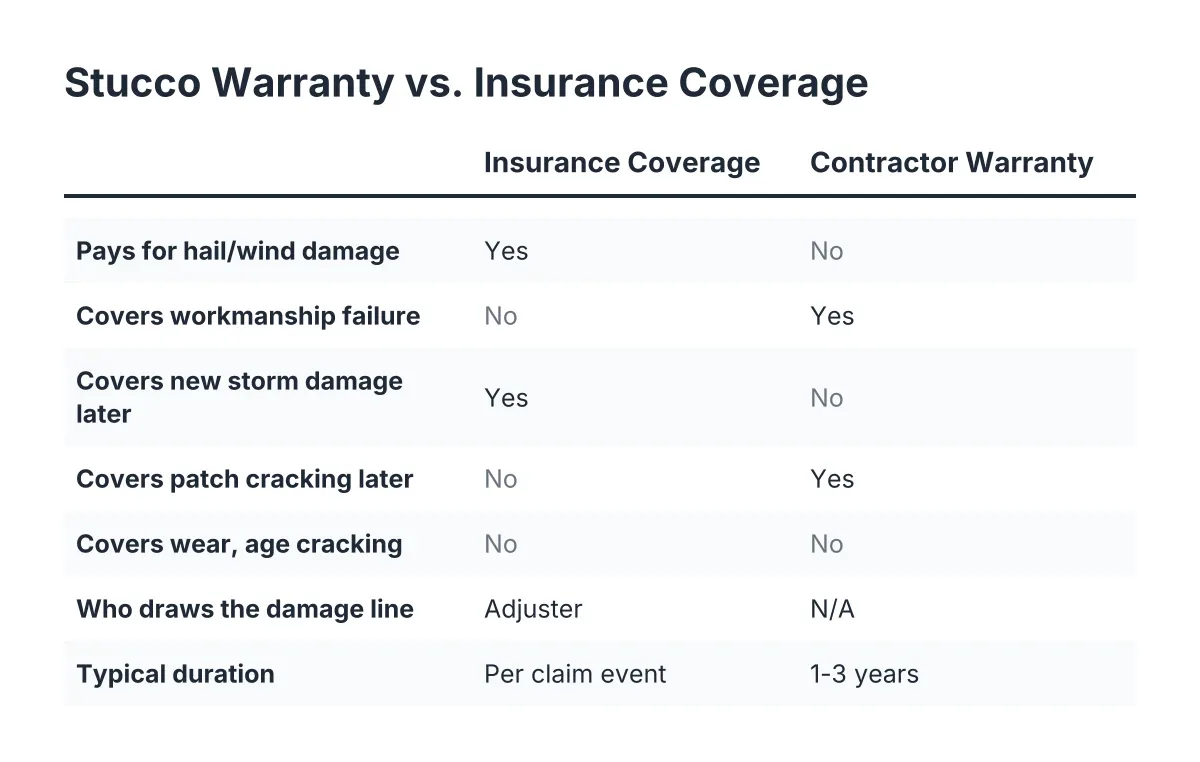
Here is where it gets tricky for the Castle Rock homeowner with a newer house in Stonegate or Meridian. Some stucco problems on homes under five years old trace back to how the siding was installed or how the stucco cured, not to any storm. If the adjuster concludes the cracking is a construction defect, insurance will deny it, and the conversation shifts to the builder warranty instead. A storm can also make an existing defect worse, which turns into a judgment call. The more clearly you can show fresh, impact-related damage, the stronger your position.
One honest note before going further. A stucco repair contractor can point out damage, explain what likely caused it, and write a scope of repair. A contractor cannot promise what your insurer will pay, and any contractor who does is overstepping. Coverage decisions belong to your policy language and your adjuster.
How Hail and Wind Cause Insurance Stucco Storm Damage
Hail damage on stucco is easier to miss than hail damage on a roof. Stucco does not dent the way metal does. Instead, look for these signs after a storm:
- Circular chips or divots where the finish coat popped off, often lighter in color than the surrounding wall
- Spider cracks radiating out from a central impact point, like a cracked windshield in miniature
- Crushed or crumbly spots that feel soft when you press a thumb against them
- Fresh cracks at window and door corners that were not there before the storm
- Matching damage on gutters, downspouts, screens, and the AC condenser fins, which helps prove the storm hit your house
Wind damage looks different. High wind drives debris into walls, lifts flashing, and can flex the wall enough to open cracks at stress points. Wind also pushes rain sideways into cracks that used to shed water fine. That is why a wall that never leaked suddenly shows a stain after one big spring storm.
For the homeowner staring at a dark stain near a window sill, the storm connection matters. If hail cracked the stucco and the next rain got behind it, the water damage flows from a covered peril, and homeowner insurance can cover both the stucco repair and often the interior damage. However, if water has been seeping through a slow crack for two years, insurers treat that as a maintenance issue. Timing and documentation make the difference, which is why the next section matters more than any other in this guide.
How to Document Stucco Storm Damage Before You Call Anyone
Documentation is the part homeowners skip, and it is the part that decides contested claims. Adjusters work from evidence. Give them good evidence and the claim moves; give them a vague "the wall looks worse" and it stalls.
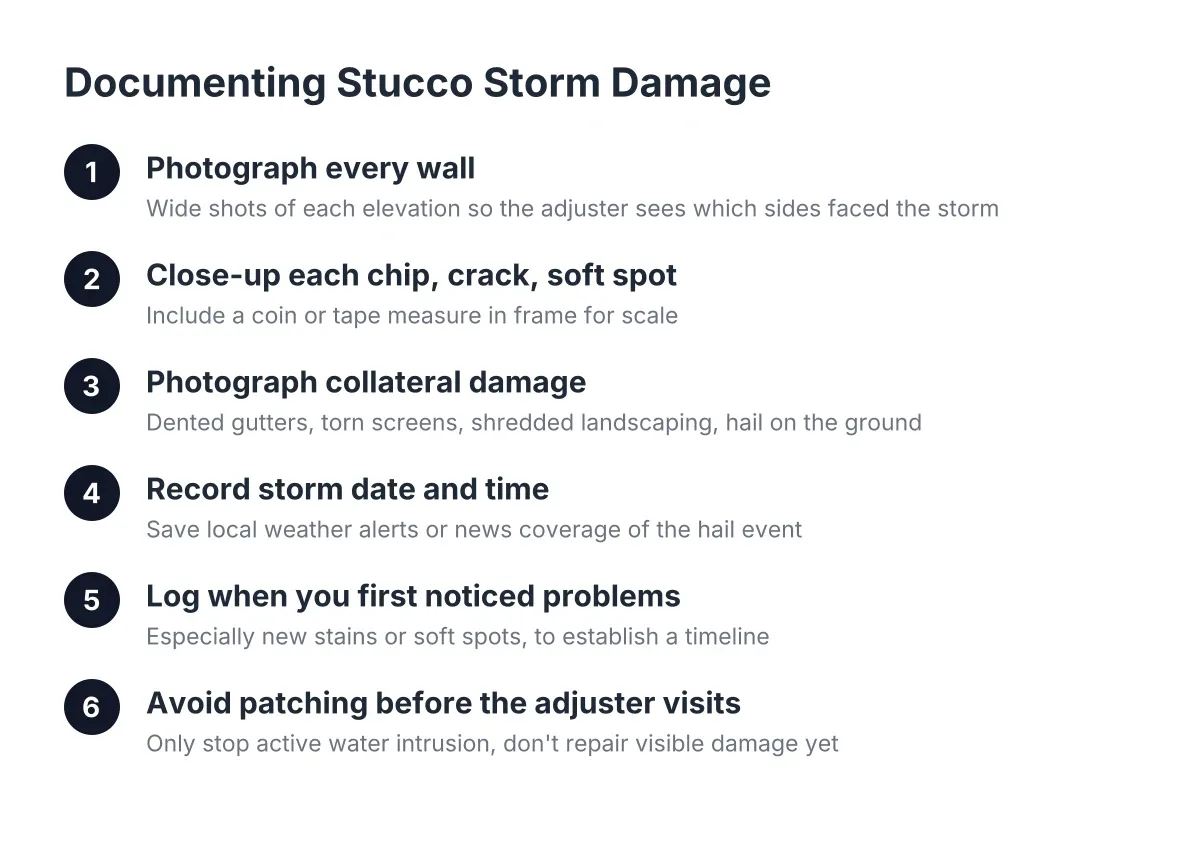
Do this within a day or two of the storm, before any cleanup or repair work:
- Photograph every wall of the house, wide shots first, so the adjuster can see which elevations faced the storm.
- Take close-ups of each chip, crack, and soft spot, with a coin or tape measure in frame for scale.
- Photograph collateral damage: dented gutters, torn screens, shredded landscaping, hail on the ground if you caught it in time.
- Note the date and time of the storm, and save any local weather alerts or news coverage of hail in Castle Rock that day.
- Write down when you first noticed each problem, especially new stains or soft spots, so the timeline is on record.
In addition, resist the urge to patch anything before the adjuster sees it. You can and should stop active water intrusion; tape plastic sheeting over an open crack if rain is coming. But a patched wall is hard to evaluate, and a premature repair can cost you the claim. Temporary protection yes, permanent repair after the inspection.
If you find a soft or spongy spot, do not dig into it yourself. Opening the wall before the inspection destroys the evidence of how the water got in. Mark it, photograph it, and leave it for the inspection. Mold behind stucco is a real concern, and most policies only pay for mold remediation when the mold resulted from a covered water event, so preserving that cause-and-effect chain matters.
How Insurance Processes a Claim for Stucco Storm Damage
Once you file, the insurer assigns an adjuster who inspects the home, usually within a couple of weeks of a major storm, longer when a big hailstorm floods the system with claims. The adjuster documents damage, applies your policy terms, and produces an estimate of covered repairs.
Having a stucco contractor walk the inspection with the adjuster helps on stucco claims specifically, because stucco damage hides in ways roof damage does not. An adjuster trained mostly on shingles can walk past a delaminated section that sounds hollow when tapped. A contractor who knows the material can point out impact fractures in the finish coat, hollow spots where the stucco has separated from the lath, and staining patterns that trace back to a storm-opened crack. That is the difference between a scope that covers one visible chip and a scope that covers the real repair.
Two policy terms shape what you actually receive. Your deductible comes off the top, and in Colorado many policies now carry a separate wind and hail deductible that is a percentage of your dwelling coverage rather than a flat number. On a $600,000 home, a 1 percent hail deductible is $6,000, which can swallow a smaller stucco claim entirely. Second, replacement cost versus actual cash value matters: replacement cost coverage pays what the repair costs today, while actual cash value deducts depreciation from older stucco. Read your declarations page before you assume anything.
Premiums reflect how hard hail has hit this state. Colorado home insurance premiums rose 65 percent over the last five years, with hail cited as a major driver, according to the National Association of Insurance Commissioners. The average premium rate climbed 57.9 percent from 2018 to 2023, well above the national average, according to the Rocky Mountain Insurance Information Association. Insurers are paying attention to hail claims, which cuts both ways: they process them constantly, and they scrutinize them closely. Between 2018 and 2020, hail claims nationally rose 2 percent while questionable claim submissions rose 34 percent, according to the Rocky Mountain Insurance Information Association. Clean documentation and an honest scope keep your claim out of that scrutiny.
When Insurance Will Not Cover the Repair
Knowing the common denial reasons ahead of time saves frustration. Insurers typically decline stucco claims when:
- The damage is gradual: hairline cracking from normal settling, fading, or freeze-thaw wear accumulated over years
- The cause is a construction defect, such as stucco that cured improperly or siding installed without correct flashing
- Water intrusion happened slowly over months, even if you only noticed the stain recently
- The damage predates your policy or a prior claim already paid for it
- Mold grew from long-term moisture rather than from a single covered water event
The construction defect denial stings most for owners of newer homes. Suppose a homeowner in Carriage Club has a three-year-old house with cracking along the second-story band and a stain spreading under one window. A hailstorm comes through, they file, and the adjuster concludes most of the cracking is defect-related but approves the two clear impact zones on the west wall. In that scenario, the homeowner ends up with a partial payment, a denied builder warranty claim because the warranty expired at year two, and a decision to make: fund the rest of the repair out of pocket, typically somewhere in the $1,000 to $8,000 range for this kind of scope, or let the water keep working on the wall. That example is hypothetical, but the pattern is one plenty of Castle Rock owners of newer builds would recognize.
A denial on part of the claim does not mean the repair can wait. Water does not care who pays. If the stucco is cracked and the stain is spreading, the wall needs to be opened, dried, and patched before the damage reaches framing. Repairing early on your own dime is cheaper than repairing framing rot later, whoever ends up paying.
What a Proper Storm Damage Repair Involves
Whether insurance pays or you do, the repair itself should follow the same steps. Cutting corners here is how you end up with a patch that cracks again next spring, and it is the first thing to ask any contractor about before work starts.
First, all loose, cracked, or buckling stucco comes off. Leaving compromised material in place lets the next rain keep expanding the damage underneath, so a proper crew removes it with scrapers and wire brushes until they reach sound stucco. Be wary of anyone who wants to skim-coat over a soft spot; that hides the problem without fixing it.
Next, the crew inspects what is behind the wall. On a storm claim this is where water damage shows itself: wet building paper, stained sheathing, or in bad cases soft framing. Catching it at the sheathing stage is the whole point of acting fast. This step is also where the lath matters. The wire lath at the edges of the opening needs to stay exposed and workable so the new patch ties into the old wall and sheds water correctly; a patch that ignores this detail leaks at its own edges.
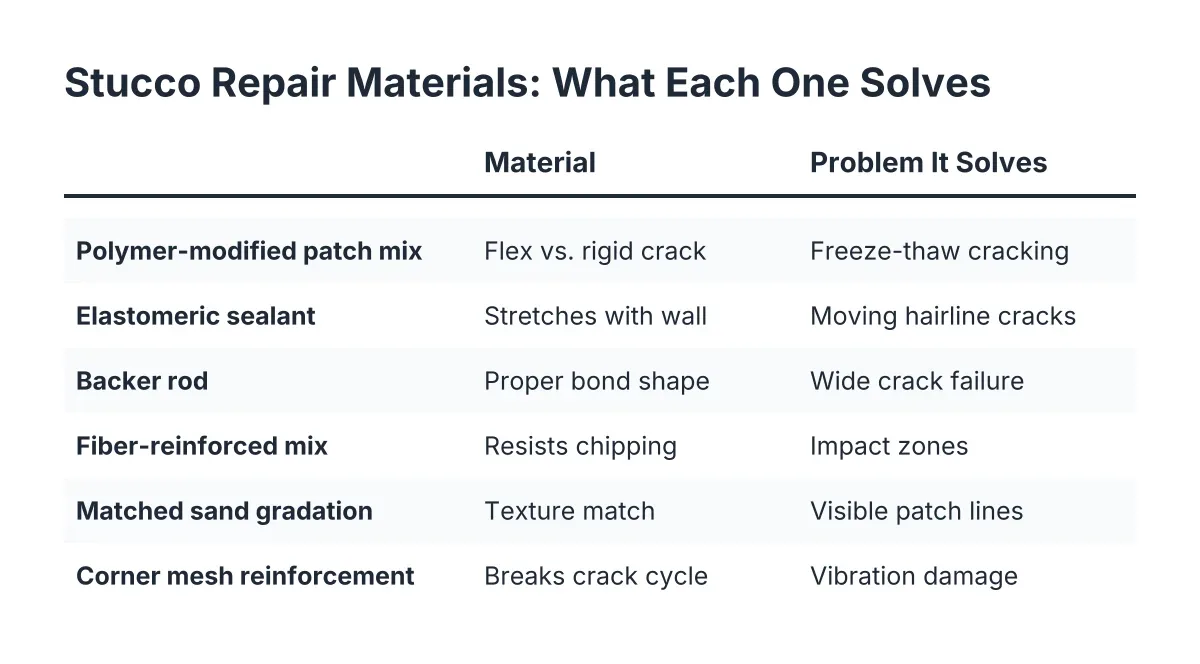
Then comes the patch itself: new paper, lath repair where needed, base coat, and finish coat. On deeper cracks, a backer rod, which is a closed-cell foam cord, creates a proper backing inside the crack before sealant goes in, according to Sika. On a damaged corner, a partial patch is the quicker and cheaper route, while the technically thorough fix is removing the stucco across the full wall section and repatching corner to corner. Both are legitimate options; the right one depends on how far the damage runs and what the insurance scope allows, and an honest contractor will explain the trade-off rather than default to the bigger job.
Finally, texture matching. Storm damage stucco repair fails the eye test when the patch reads as a different wall. On a knockdown finish, the crew sprays finish coat onto the patch and trowels it lightly to blend with the surrounding texture. Color matching takes samples and sometimes a test patch. This is the step where a crew that only does stucco separates itself from a general handyman outfit, and it is the step insurance scopes often underfund, so confirm it is included before signing off on the estimate.
One more point for storm claims: fix the cause, not just the symptom. If a downspout dumps water against the foundation and the soil settles, the corner will crack again no matter how good the patch is. The same goes for an AC unit vibrating against a wall. A repair scope that ignores the cause is a repair you will buy twice.
Can Homeowner Insurance Cover the Water Damage Behind the Stucco?
Homeowner insurance can cover water damage behind stucco when the water entered through storm-caused damage, such as a hail-cracked wall or wind-lifted flashing. Coverage typically extends to drying, interior repairs, and sometimes mold remediation tied to that event. Slow leaks and long-term seepage are excluded on nearly every standard policy.
This is the question that matters most if you are the homeowner with the stain that will not scrub off or the spot near the window that gives under your thumb. The coverage logic follows the cause. One storm, one crack, one wet wall cavity: covered, minus your deductible. A crack that has wicked water for two winters: that reads as deferred maintenance, and the claim likely fails even though the visible damage looks the same.
Therefore the clock matters twice. It matters for coverage, because the sooner you document and file after a storm, the easier it is to tie the water to the event. And it matters for the house, because water behind stucco moves from staining to rot to mold on its own schedule. If you smell mustiness inside near an exterior wall, or the stucco sounds hollow when tapped, get eyes on it within days, not months. For anything beyond a small, clearly surface-level patch, bring in a professional rather than opening the wall yourself; what is behind the stucco determines the repair, and guessing wrong makes it worse.
Deciding Your Next Step
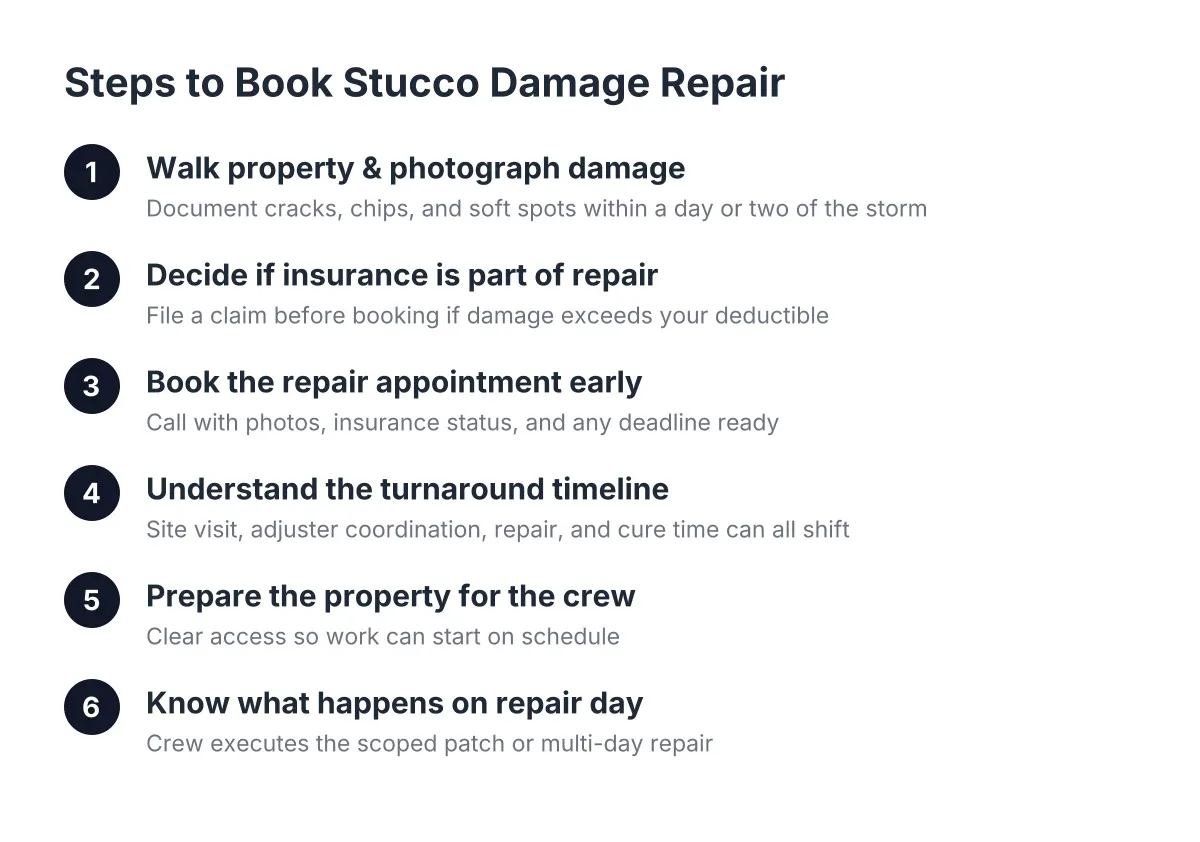
Pull it together into a simple sequence. After a storm hits Castle Rock, photograph everything before you touch anything. Check your declarations page for your wind and hail deductible, because that number decides whether a claim is even worth filing on smaller damage. File promptly if the damage clears the deductible, and have someone who knows stucco present when the adjuster walks the house. If the claim is denied or only partially paid, weigh the repair cost against what water will do to the wall while you wait, because that math almost always favors fixing it now.
The coverage question has a real answer, even if it is not a one-word answer. Yes, insurance can pay for storm-damaged stucco, and in a hail state like Colorado it does so constantly. What you control is the evidence, the timing, and the quality of the repair scope. Handle those three well, and whether the check comes from your insurer or your own account, you end up with the thing that actually matters: a dry wall, a patch that matches the rest of the house, and a stain that does not come back.
If you need stucco repair, Castle Rock Stucco Pros can help.
Prefer to talk it through? Call (720) 797-8506 — a quick call is usually the fastest way to get a straight answer for your situation.