Stucco Sprayer vs. Hand Applied Texture: Matching Your Home’s Original Finish
Most stucco repairs fail in the last hour of the job. The patch holds, the crack is sealed, but the texture stands out like a scar. Whether the crew uses a stucco sprayer or hand applied trowel work decides whether that patch disappears or announces itself every time the sun hits the wall. If you are comparing quotes for stucco repair in Castle Rock, this is the question that separates a crew that knows the material from one that just says yes to everything. Getting the texture right requires more than speed; it demands matching stucco repair texture to your original finish.
Here is the plain truth: the tool has to match how your wall was originally finished. A sprayed dash finish repaired by hand looks wrong. A hand-troweled skip finish repaired with a hopper gun looks worse. This guide walks you through the steps a good crew follows to match your existing texture, so you know what to ask for and what to expect before you sign anything.
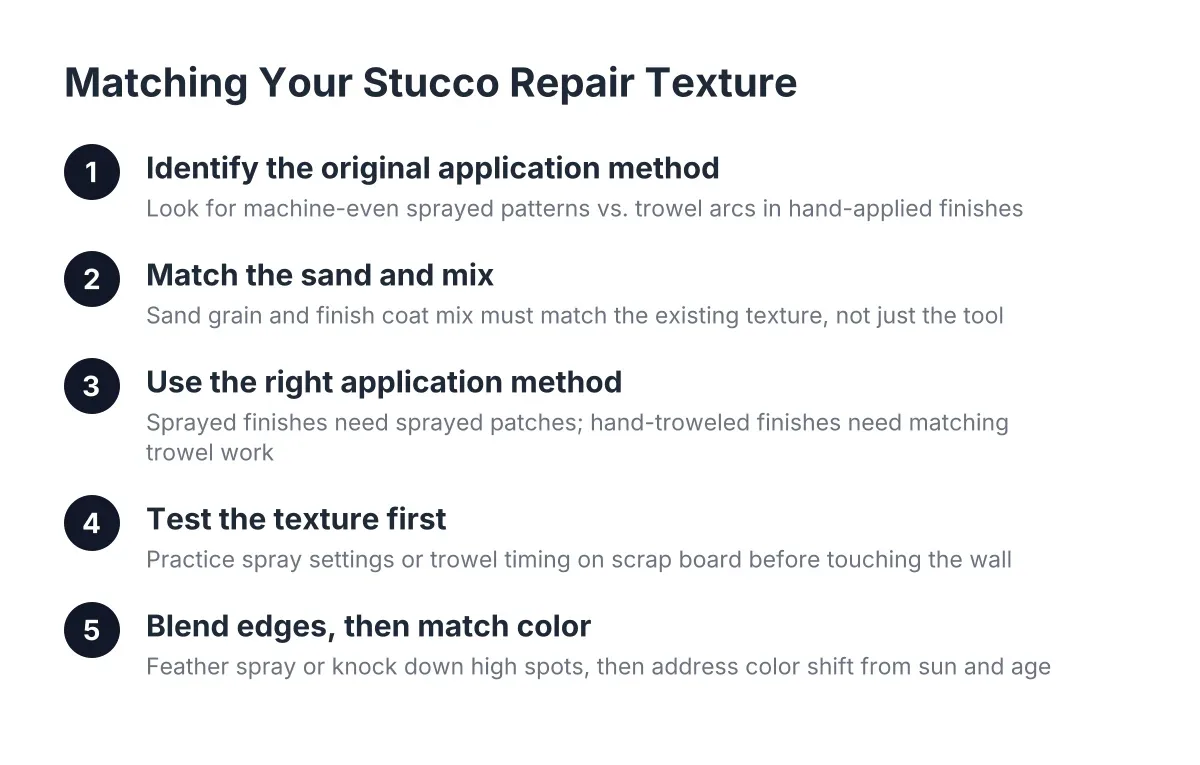
Step 1: Identify How Your Original Stucco Was Applied
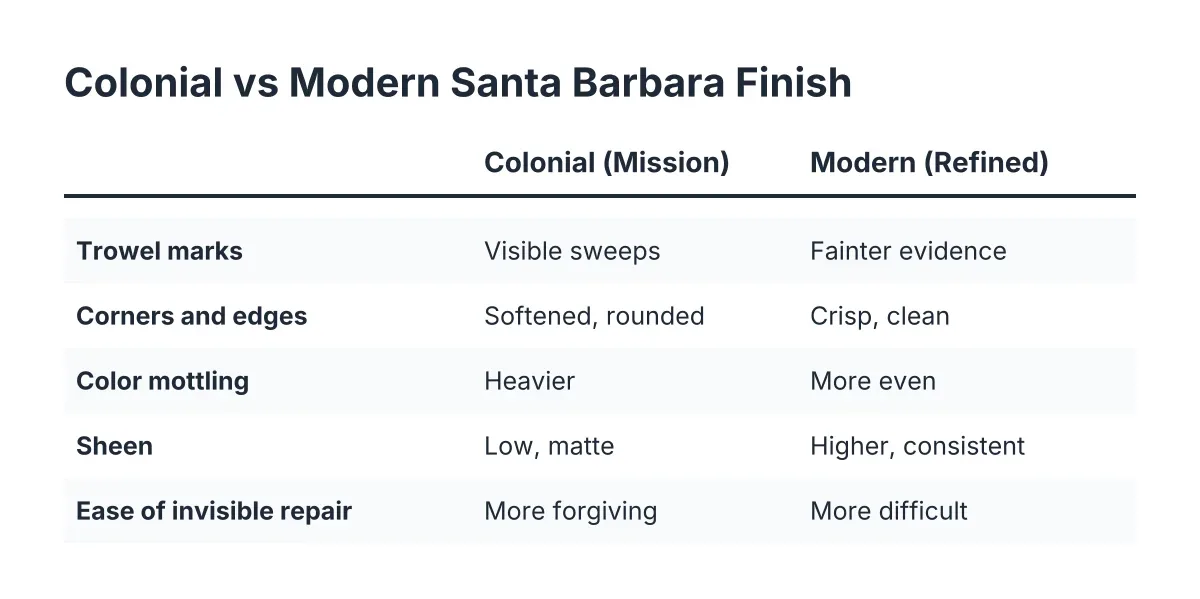
Before anyone mixes material, someone has to read the wall. Stand back ten feet and look at the pattern. Sprayed finishes, like dash or a fine sand spatter, have an even, machine-made rhythm across the whole wall. Hand-applied finishes, like knockdown, skip trowel, or smooth Santa Barbara, show subtle trowel arcs and slight variation from one section to the next.
This matters because a stucco sprayer and hand applied technique leave different fingerprints. A hopper gun throws material in a random spatter pattern. A trowel drags and compresses it. You cannot fake one with the other, at least not well.
On newer homes in neighborhoods like Stonegate, Meridian, or Carriage Club, production builders often used sprayed finishes because they are fast and consistent across dozens of houses. If your home is under five years old and the stucco is cracking or delaminating, odds are decent the original finish came out of a hopper gun. Older Castle Rock homes are more likely to carry hand-troweled textures.
Step 2: Match the Sand and the Mix Before the Tool
The tool gets the attention, but the mix matters just as much. The fineness of the sand in the repair mix should match the grain of your existing finish. Coarse sand in a patch next to a fine original finish will read as a different texture even if the application technique is identical.
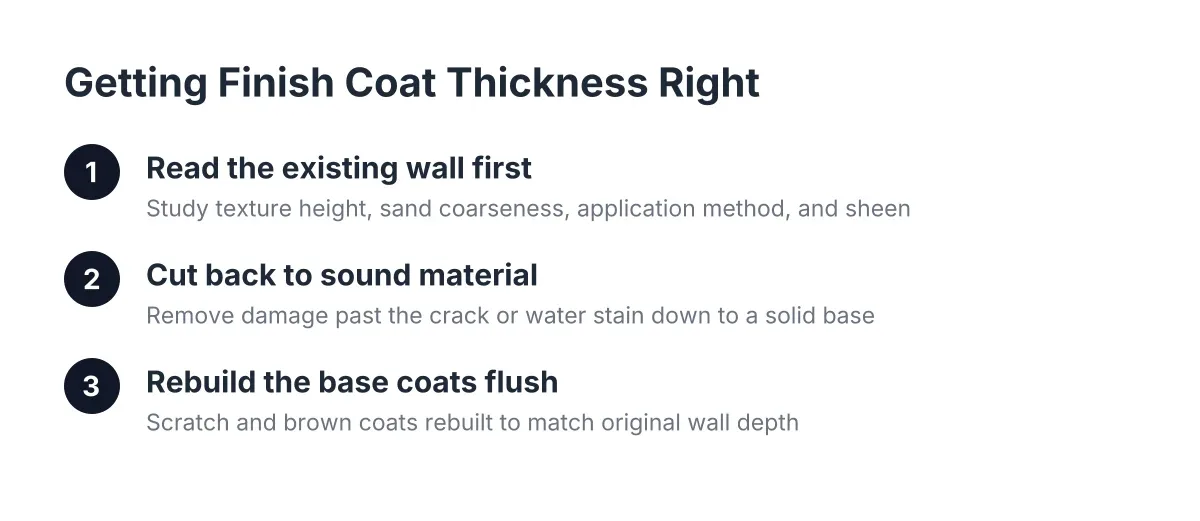
Traditional stucco goes on in three coats: a scratch coat that gets scored so the next layer bonds, a brown coat, and a finish coat that carries the color and texture. A repair has to rebuild whichever coats were damaged, then reproduce the finish coat on top. A crew that skips straight to a surface patch over a failed brown coat is setting you up for the same crack in two years.
Ask any contractor bidding your job what mix they plan to use for the finish coat and how they chose the sand. A stucco-focused crew will have an answer. A generalist will change the subject.
Step 3: Matching Stucco Repair Texture Through the Right Application Method
The rule is simple: repair with the same method the original finish used. In practice, a small patch complicates it. Setting up a stucco sprayer for a two-square-foot patch is like bringing a paint rig to touch up a doorknob scuff, so some crews will try to dab a sprayed texture on by hand instead. That shortcut is where most visible patches come from.
Dabbing a dash coat on with a brush or sponge, instead of flicking or spraying it, creates uneven valleys and high spots that never blend with the machine pattern around them. If your wall has a sprayed finish, the patch needs sprayed texture, even on a small area. Handheld hopper guns exist for exactly this reason, and a crew that owns one and knows how to dial it in is worth more than a lower bid from one that does not.
For hand-applied finishes, the reverse holds. A knockdown or skip trowel patch needs a person with a trowel who can copy the pressure, timing, and stroke of the original work. On these finishes, matching stucco repair texture between old and new surfaces is critical; spray on a troweled wall and the patch shows from the street.
Step 4: Test the Texture Before It Touches Your Wall
Good crews do not shoot the wall first. They test the spray pattern on a scrap of drywall or a sheet of plastic, adjusting air pressure and material volume until the spatter matches the fineness of your existing finish. For hand work, they practice the knockdown timing on the test board the same way.
This step takes maybe twenty minutes and saves the whole job. Suppose a homeowner in Meridian has hairline cracking around a window on a dash-finished wall. In that scenario, a careful crew patches the crack, then tests three or four sprayer settings on plastic taped next to the window until the pattern matches, and only then shoots the patch. A rushed crew shoots the wall on the first try and hopes.
When you are comparing quotes, ask each bidder one question: how do you match the texture before applying it? The answer tells you whether stucco texture matching is part of their process or an afterthought they will improvise on the day.
Step 5: Blend the Edges, Then Handle Color
Even a well-matched texture can show a hard edge where new meets old. Blending fixes that. On sprayed finishes, the crew feathers the spray past the patch boundary so the pattern transitions gradually. On troweled finishes, high spots on the patch can often be knocked down and scraped to blend with the surrounding surface, rather than tearing out and redoing the base coat.
Color is the second half of the match, and it is honestly the harder half. Stucco color shifts with age, sun exposure, and Colorado weather, so a patch mixed to the original color can still read lighter or darker. Sometimes a fog coat or careful color match closes the gap. When it cannot, the practical fallback is painting the entire wall or section so everything reads uniform. That is a cosmetic trade-off, not a failure; a mismatched texture is permanent, but a color difference can be painted over.
Keep in mind that texture mismatch is a cosmetic problem, not a structural one. However, if your stucco shows soft spots, bulging, or staining that suggests water damage behind the wall, texture is the least of your concerns; get a professional to open it up and check the underlayment before any cosmetic work happens.
What This Means When You Compare Quotes in Castle Rock
If you are gathering bids in 2026 and one quote comes in far above another, the texture and blending work is often the difference. A cheap patch is fast: fill the crack, smear some material, done in an hour. A proper repair includes reading the finish, matching the mix, testing the texture, and blending the edges. That takes longer and costs more, and it is the only version where the patch disappears.
A fair quote for exterior stucco repair should spell out:
- What is being repaired, including which coats get rebuilt, not just the surface
- How the crew will match your texture, spray or trowel, and whether they test first
- How color will be handled, whether by matching, fog coat, or painting the section
- What happens if they find water damage or a failed base coat once the wall is open
That last point matters for anyone worried about surprise costs. Hidden damage does happen, especially on newer builds where curing or flashing problems show up after the builder warranty runs out. A straightforward contractor will tell you up front how they price that scenario instead of springing it on you mid-job.
Hail is worth mentioning too. Colorado had 182,591 hail insurance claims from 2013 to 2015, the second most in the country, according to the Rocky Mountain Insurance Information Association. Hail-dinged stucco is one of the most common repairs along the Front Range, and dozens of small impact patches make texture matching even more important, because every one of them is a chance for a visible spot.
The Bottom Line: Match the Method, Not Just the Material
The one thing most repair jobs get wrong is treating texture as the last five minutes of work instead of the point of the job. Your wall was finished either by machine or by hand, and the repair has to follow suit. A crew that asks about your finish, tests before shooting, and explains the difference between sprayed and hand-troweled work is a crew that has done this many times.
If you are in Castle Rock or nearby and staring at a cracked or patched-over wall, get a second opinion from a local crew that works on stucco and nothing else. Reach out for an estimate; a walk around the wall and a straight answer about how your texture gets matched costs you nothing but a phone call.
If you need stucco repair, Castle Rock Stucco Pros can help.
Prefer to talk it through? Call (720) 797-8506 — a quick call is usually the fastest way to get a straight answer for your situation.