How Stucco Walls Hold Up to Colorado Weather: Real Durability Expectations
If you are comparing quotes for stucco work in Castle Rock, you have probably asked the same question every homeowner here asks: do stucco walls hold up to Colorado weather? The short answer is yes, when the wall was built right and maintained. Understanding stucco durability in Colorado weather is essential for any homeowner considering repairs or replacements. The longer answer is what this guide covers. Stucco handles our sun, wind, and temperature swings better than most siding materials. It also has specific weak points, and hail is the big one. Knowing where stucco is strong and where it fails will help you read a quote, question a contractor, and decide whether a repair or a full section replacement makes sense.
This matters more here than in most states. Colorado had the second-highest number of hail insurance claims in the country from 2013 to 2015, totaling 182,591 claims, according to the Rocky Mountain Insurance Information Association. If you own a home in Castle Rock long enough, weather will test your walls. Here is what to expect.
What a Stucco Wall Actually Is, and Why It Matters for Durability
Most homeowners think of stucco as a single hard shell. It is not. A traditional stucco wall is a layered system, and how well stucco walls hold up depends on every layer, not just the one you can see.
Behind the finish, a typical assembly looks like this:
- A moisture barrier, usually building paper or tar paper, fastened over the sheathing
- Metal lath or wire mesh attached over the paper to give the stucco something to grip
- Expansion and contraction channels trimming the edges so the wall can move without cracking
- A scratch coat, thin and scored so the next layer bonds
- A brown coat that builds thickness and flattens the wall
- A finish coat that carries the color and texture
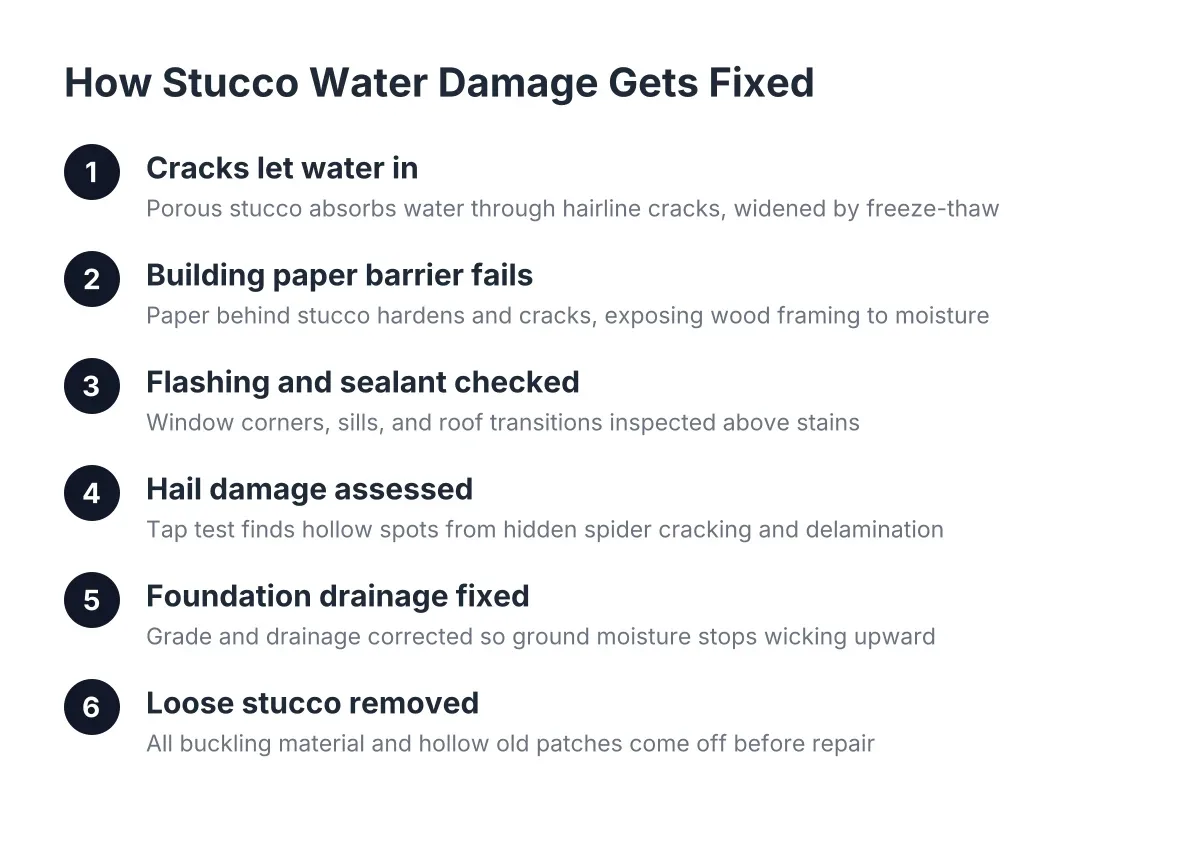
That layered build is why the material lasts as long as it does, and it is also why failures are rarely about the stucco itself. Most serious stucco problems start behind the surface. The paper tears, the lath rusts, or water finds a path through an unsealed crack. The visible stucco just tells the story last.
For a homeowner comparing quotes, this is the first thing to understand. A contractor who talks only about the surface, and never about what is behind it, is quoting a cosmetic job. Sometimes that is all you need. Sometimes it is not, and the difference explains why two quotes for the same crack can be a thousand dollars apart.
How Stucco Durability in Colorado Weather Responds to Specific Climate Challenges
Stucco walls hold up well in Colorado overall, which is part of why builders use so much of it along the Front Range. The material is mineral-based, so it does not rot, warp, or feed insects. It shrugs off UV exposure that fades and chalks painted wood or vinyl. But Colorado throws four distinct stresses at an exterior wall, and stucco responds differently to each one.
Sun and dryness: stucco's best conditions
Our dry climate is friendly to stucco. Cement-based finishes cure hard and stay hard when they are not soaked for weeks at a time, the way they can be in humid coastal regions. UV does not break down cement the way it breaks down vinyl or paint film. In a dry year, a well-built stucco wall in Castle Rock mostly just sits there and does its job.
The one caution is fading. The finish coat carries the color, and decades of high-altitude sun will lighten it. That is cosmetic, not structural, but it matters for repairs. Matching a patch to a 20-year-old sun-faded finish takes real texture matching and color work. A patch that is structurally sound but two shades off will bother you every time you pull into the driveway.
Freeze-thaw cycles: the slow test
Castle Rock winters swing from a 55-degree afternoon to a 10-degree night. Water that gets into a hairline crack expands when it freezes and pries the crack wider. Then more water gets in, and the cycle repeats. This is how a crack you could have sealed for a few hundred dollars in October becomes a spring repair involving loose stucco and damp sheathing. Testing stucco durability in Colorado weather through freeze-thaw cycles shows why fall crack sealing is so important.
Freeze-thaw damage is gradual, which makes it easy to ignore. It is also why fall is a smart time to handle crack repair. Sealing cracks before winter is the single cheapest durability move a stucco homeowner can make.
Hail: the fast test
Hail is where Colorado punishes stucco. A hard-set cement finish resists small hail, but golf-ball hail driven by wind will chip finish coats, punch divots, and crack panels, especially on west- and north-facing walls that take the storm head on. Stucco durability in Colorado weather is tested most severely by major hail events like the state's May 8, 2017 Front Range hailstorm, which caused $2.3 billion in insured damage, still Colorado's costliest catastrophe, according to the National Insurance Crime Bureau.
The financial pressure is real too. Colorado home insurance premiums rose 65% over the last five years, with hail cited as a major driver, according to the National Association of Insurance Commissioners. If a storm has already hit your neighborhood, documenting stucco impact damage quickly and getting a written repair estimate for your adjuster is worth doing while the damage is fresh and obvious.
Wind and wall movement
Homes flex. Wind loads, soil movement, and seasonal expansion all move a wall slightly, and stucco is designed to handle that through control joints and the give in the lath system. Problems show up when movement concentrates at weak points: corners of windows and doors, roof lines, and anywhere the original crew skipped or misplaced an expansion channel. Diagonal cracks running off window corners are the classic sign.
How Long Should Stucco Last on a Colorado Home?
A properly installed cement stucco exterior in Colorado should last 50 years or more, and many last the life of the house. That expectation assumes three things: the wall was built with a sound moisture barrier and lath, cracks get sealed as they appear, and water is kept out of the assembly. Neglect any of the three and the timeline shortens fast.
Here is the part most homeowners never hear. The building paper behind your stucco ages even when the stucco looks fine. Over decades of heat and occasional wetting, that paper turns brittle, similar to material baking and hardening in an oven. On a newer home, the paper still has flex; the wall can move and the barrier moves with it. On an older wall with brittle paper, the same flexing can tear the barrier. At that point a crack that used to be cosmetic becomes a water intrusion path straight to the sheathing.
Therefore, the age of your home changes what the same crack means:
- On a 5-year-old home, a hairline crack is usually a shrinkage or settling crack. Seal it and move on.
- On a 20-year-old home, the same crack deserves a closer look, especially if it has been open through a few winters.
- On a 35-year-old home with cracks that have sat untreated for years, assume the barrier behind them may be compromised until someone checks.
This is also why delaying repair costs more than the repair. A structural crack left open for many years gives the wall time to flex against brittle paper, and once water reaches the sheathing you are paying for stucco water damage repair plus whatever rotted underneath.
What Makes Stucco Walls Hold Up Longer: The Habits That Matter
The stucco walls that hold up for 50 years are not lucky. Their owners do a few unglamorous things on a schedule. None of this requires a contractor, except the crack sealing on older or larger cracks.
- Walk the exterior every spring and fall. Look at window corners, door corners, hose bibs, and the bottom two feet of every wall.
- Seal hairline cracks before winter. Small cracks are cheap; freeze-thaw cycles make them expensive.
- Keep sprinklers off the walls. Repeated soaking at the base of a stucco wall is a slow-motion failure you are paying the water bill to cause.
- Clean gently and regularly. Stucco is porous and absorbs moisture rather than shedding it the way vinyl siding does. Routine light cleaning keeps growth from embedding deep in the surface, which means less aggressive treatment later and a longer-lasting finish.
- Never pressure wash at high pressure. Because stucco is layered, water driven behind the finish under pressure can create larger structural issues over time. Low pressure and a garden hose do the job.
- After any hailstorm, photograph your walls. Even if you see nothing, dated photos give you a baseline if damage shows up later and an adjuster gets involved.
In addition, keep grade and drainage in mind. Soil or mulch piled against the bottom edge of stucco wicks moisture into the wall. Stucco should stop above grade with a clear weep edge.
Reading Repair Quotes Through a Durability Lens
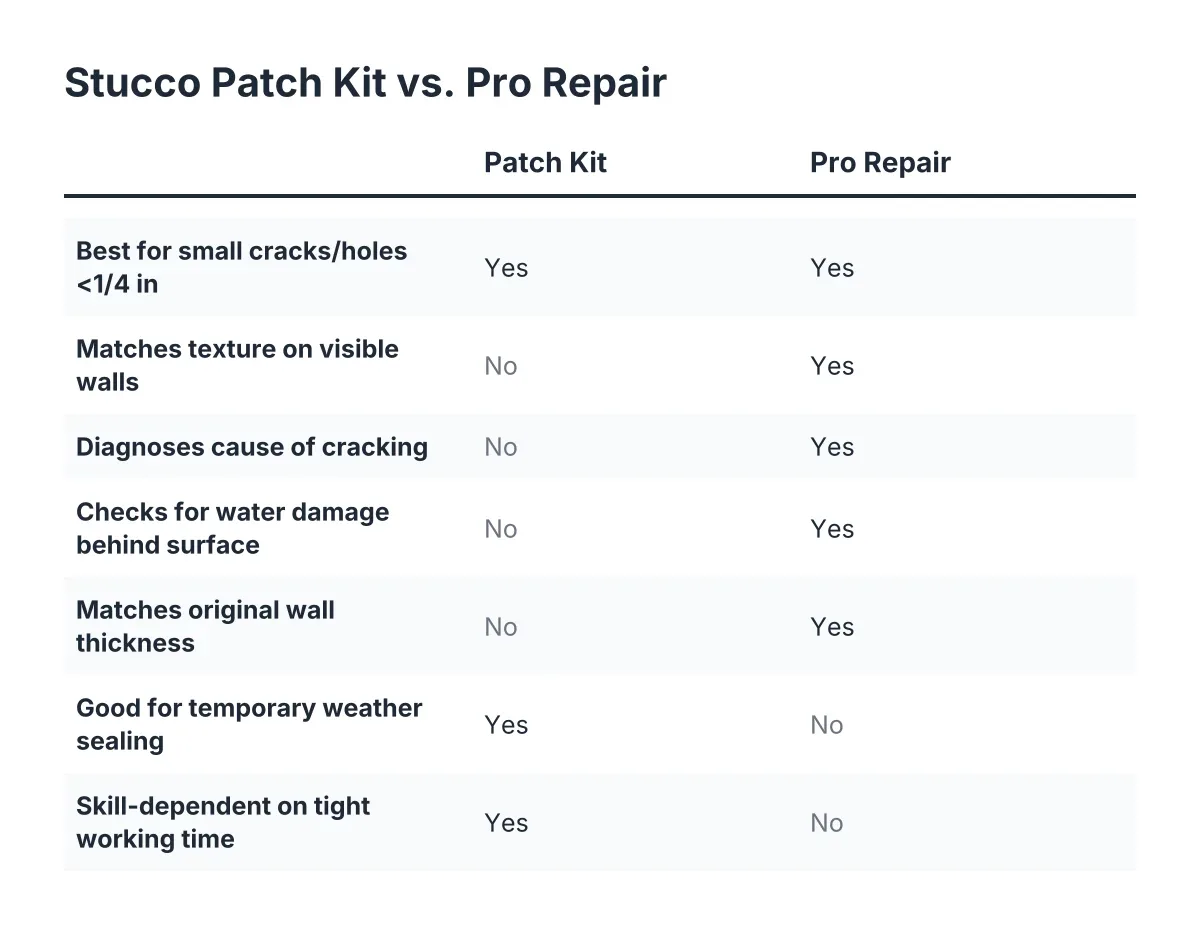
If you are gathering bids right now, durability is the lens that explains most price gaps. Two contractors can look at the same cracked wall and quote wildly different numbers because they are quoting different jobs: one is filling a crack, the other is fixing the reason the crack exists.
Suppose a homeowner in Castle Rock has a 4-foot diagonal crack off a window corner on a 25-year-old home, plus a few hail divots from last summer. One quote comes in around $600 to fill and paint the crack. Another comes in around $2,400 to open the crack, check the lath and paper behind it, patch with a proper base and finish coat, match the texture, and repair the impact spots. Those are illustrative numbers, not real bids, but the pattern is one quote-comparing homeowners see constantly. The low bid is not automatically a scam, and the high bid is not automatically padding. They are different scopes, and your job is to find out which scope the wall needs.
Questions that separate a stucco-focused contractor from a generalist:
- What do you think caused this crack, and how can you tell?
- Will you check the condition of the paper and lath behind the damaged area?
- How will you match the existing texture and color, and can I see the match before you finish?
- What happens to the price if you open the wall and find damage behind it?
- How does the patch handle movement so the crack does not just come back?
On that last point, good repairs account for movement. Properly cured fiber-reinforced patches flex with adjoining materials and resist chipping from everyday impacts, which is what keeps a repaired area from re-cracking the first winter. On wider cracks, a competent crew builds a foundation inside the gap before sealing; backer rod, a closed-cell foam cord, is the standard material for creating that backing before sealant goes in, according to Sika. If a bidder cannot explain their approach to movement in plain language, keep comparing.
Be honest about limits too. A visual inspection cannot see behind an intact wall. If a wall shows staining, soft spots, or a musty smell inside, moisture testing or opening a small section is the only way to know what is happening, and no contractor should promise a firm final price before that. A quote with a clearly stated contingency for hidden damage is more trustworthy than one that pretends hidden damage does not exist.
Stucco vs. Siding: Which Holds Up Better Here?
For durability in Colorado specifically, the honest comparison depends on the threat. Stucco outlasts most siding against sun, wind, and time; hail is where the answer gets more interesting, because different materials fail differently rather than one simply winning.
Vinyl siding cracks and shatters in cold-weather hail, and matching discontinued vinyl profiles years later is a known headache. Fiber cement resists impact well but chips at edges and needs repainting on a cycle. Wood siding takes hail dents and needs the most ongoing maintenance in our dry climate. Stucco chips and divots under hard hail, but a chipped stucco wall is usually patchable in place, with texture matching, rather than needing whole panels swapped.
For anyone weighing new construction stucco and siding options on a build or an addition, the practical Colorado summary looks like this: stucco costs more up front and rewards you with low maintenance and a long life, provided you commit to sealing cracks and keeping water out. Siding costs less up front, and its long-term durability depends heavily on which product you choose and how faithfully you repaint or replace panels after storms. Neither choice removes hail risk. Rocky Mountain Insurance Information Association data shows three Colorado cities, Colorado Springs, Denver, and Greeley, among the top 10 U.S. cities that together represent 10% of total hail loss claims between 2018 and 2020. Whatever is on your walls, hail will find it eventually. The question is how repairable the material is afterward, and stucco scores well on that measure when a crew that knows the material does the work.
The Bottom Line for Castle Rock Homeowners
Stucco walls hold up to Colorado weather better than most exteriors, with one honest asterisk for hail and one for neglect. The material itself is rarely the problem. The layers behind it, and the years a crack sits open before someone seals it, decide whether your wall lasts 20 years or 50.
If you are comparing quotes in 2026, use durability as your filter. Ask each bidder what caused the damage, what is behind it, and how their repair handles future movement and moisture. The contractor who answers those questions in plain terms, and prices the actual scope instead of the cheapest version of it, is the one whose repair will still be invisible ten winters from now. That is the whole point of the quote you are trying to choose.
If you need stucco repair, Castle Rock Stucco Pros can help.
Prefer to talk it through? Call (720) 797-8506 — a quick call is usually the fastest way to get a straight answer for your situation.