Stucco Installation Cost Per Square Foot in Castle Rock: A Full Pricing Breakdown
If you're pricing out a new build or a major exterior job in Castle Rock, the first number you'll chase is stucco cost per square foot. It's the number builders use to compare subs, the number homeowners use to sanity-check bids, and the number that varies the most from one quote to the next. This guide breaks down what sits inside that per-square-foot figure, why two bids on the same wall can land far apart, and how builders and homeowners alike can get consistent quality without paying for surprises.
The people asking this question fall into two camps. Builders and general contractors want a sub who can hold a schedule across ten or twenty homes and deliver the same finish on lot 3 as on lot 17. Homeowners, especially those getting a house ready to list, want a firm number for a defined scope so a stucco line item doesn't blow up a closing timeline. Both camps get burned by the same thing: a per-square-foot quote that leaves out half the work.
What Stucco Cost Per Square Foot Actually Includes
A stucco installation cost per square foot figure should cover everything from the bare sheathing out to the finished color coat. When a bid seems low, the missing pieces are usually hiding in this list. Before you compare two numbers, confirm that both include the full wall assembly.
A complete stucco wall is built in layers, and each layer carries labor and material cost:
- Moisture barrier. Tar paper or a modern weather-resistive barrier goes on first. This layer is what keeps water off your framing, and it's the layer that fails on cheap jobs.
- Lath. Metal lath or wire is fastened over the barrier. The stucco keys into this mesh; without it, the coating has nothing to grip.
- Trim and channels. Edges get expansion and contraction channel, weep screeds, and corner mesh. These details control where the material moves and where water drains out.
- Scratch coat. The first thin coat, scored so the next layer bonds.
- Brown coat. The build coat that establishes a flat, true wall plane.
- Finish coat. The color and texture layer, which is the only part most people ever see.
Therefore, when a bid quotes a per-square-foot price, ask which of these layers it covers. A number that only covers the three coats, with lath and barrier billed separately, will look cheap on paper and expensive on the final invoice. On new construction, also confirm who handles scaffolding, who cleans overspray off windows, and whether penetrations around outlets and hose bibs are flashed by the stucco crew or the framer.
Why Two Bids on the Same House Land Far Apart
Two stucco bids on the same Castle Rock house can differ by 30 to 50 percent, and neither one is necessarily wrong. The gap usually comes from scope assumptions, crew quality, and how each contractor prices risk. Understanding those three drivers tells you which bid to trust.
First, scope assumptions. One contractor might assume the framer leaves clean, flashed openings; the other prices in fixing whatever they find. On a remodel, one might assume the old cladding comes off clean; the other budgets for rotten sheathing behind it. The bid that budgets for reality reads higher but costs less by the end.
Second, crew quality. Applying scratch and brown coats is harder than it looks. A crew that keeps the brown coat flat and cures it properly produces a wall that resists cracking for decades. A rushed crew produces a wall that hairlines within two winters, and in Castle Rock, with freeze-thaw cycles and hard sun, rushed work shows fast. That skill difference is priced into the labor line.
Third, risk. Colorado weather punishes exteriors. According to the Rocky Mountain Insurance Information Association, Colorado had the second-highest number of hail insurance claims in the country from 2013 to 2015, with 182,591 claims. Contractors who work here price in weather delays, protection, and callbacks. A bid from someone who hasn't accounted for Front Range conditions is a bid from someone who hasn't worked through many Front Range seasons.
The Cost Variables That Move Your Per-Square-Foot Number
Beyond the base assembly, a handful of variables push the cost of stucco installation per square foot up or down. None of them are exotic; all of them should be visible in a detailed bid.
Wall Complexity, Height, and Stucco Installation Cost Per Square
A simple one-story rectangle is the cheapest wall there is. Add a second story, gables, pop-outs, arched openings, or lots of windows, and the labor per square foot climbs. Every corner needs trim, every opening needs flashing detail, and every height change means scaffolding time. As a rough illustration, a cut-up two-story elevation can run 20 to 40 percent more per square foot than a plain single-story wall, purely on labor.
Finish texture and color
Smooth finishes cost more than standard textures because they show every imperfection in the brown coat, so the crew has to get the base dead flat. Integral color in the finish coat versus painting afterward also shifts the number. For a pre-listing seller, texture matching matters more than texture choice; a repair or addition that doesn't match the existing wall is exactly the kind of thing a buyer's inspector circles.
Site access and season
Tight lot lines, landscaping to protect, and limited staging room all add time. Season matters too. Stucco needs workable temperatures to cure right, so shoulder-season and winter work in Castle Rock may need tenting and heat, which adds cost, or it waits for a weather window, which adds schedule risk.
Substrate condition
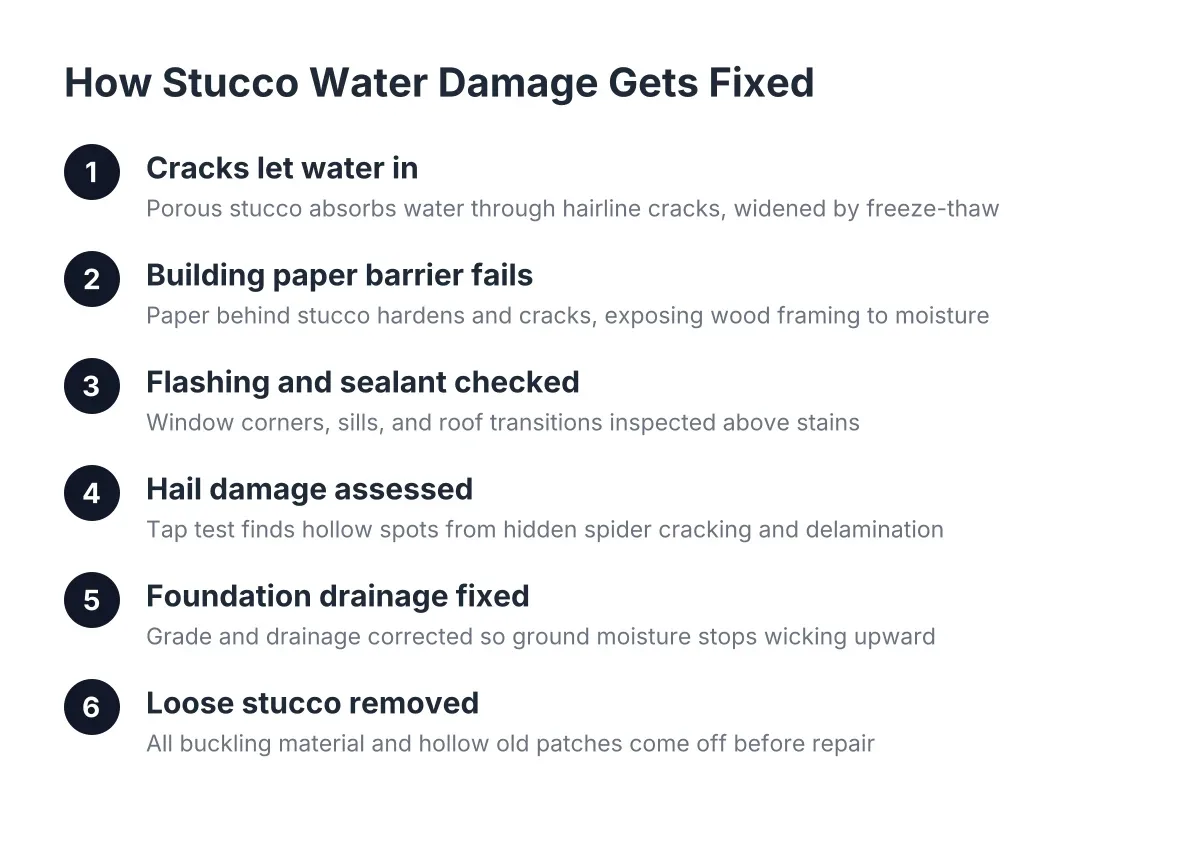
On remodels, this is the wild card. If the crew opens a wall and finds water damage, soft sheathing, or missing barrier, the fix has to happen before any stucco goes on. However, a good contractor will tell you this up front and price a contingency rather than pretending the risk doesn't exist. Be skeptical of anyone who wants to start demo before explaining what they expect to find.
Installation Cost Per Square Foot for Builders: Pricing Across a Subdivision
For a builder or GC, the per-square-foot number matters less than whether it holds across 15 houses and eight months. A sub's installation cost per square foot on a subdivision should be lower than one-off residential pricing, because repetition cuts waste, but only if the crew actually shows up in sequence.
Here is what schedule reliability is worth in real terms. Suppose a builder in a Castle Rock subdivision has framing done on lots 4 through 9 and a stucco sub who no-shows for two weeks. In that scenario, painters stack up behind the stucco, final grading waits, and closings slip. The cheap per-square-foot number just cost more than the expensive one would have.
Consistency is the other half. Buyers walking model homes compare finishes house to house. If lot 6 has a tight sand finish and lot 11 has a wavy one because a different crew rotated in, that inconsistency reads as poor quality even when both walls are structurally sound. A specialist crew that keeps the same hands on the same subdivision delivers a finish that matches from the first home to the last.
When you vet a stucco sub for production work, ask these questions:
- Who is on the crew, and does the same crew stay on my project start to finish?
- What is your realistic production rate per elevation, and what weather buffer do you build in?
- How do you handle cure time between coats when the schedule compresses?
- What is your callback process when a wall hairlines after closing?
- Do you self-perform lath and barrier, or sub it out?
A sub with straightforward answers to all five is worth a premium per square foot. A sub who dodges the crew question is telling you the finish will vary.
Stucco Versus Siding on New Builds
Stucco and siding solve the same problem at different price points and different lifespans, and many new construction stucco and siding packages mix both on the same house. Stucco typically costs more per square foot installed than basic lap siding, because it's a multi-coat, labor-heavy system. In exchange, it handles Colorado sun better than vinyl, doesn't dent the way some panels do in hail, and gives the masonry look most Front Range buyers expect.
Siding wins on install speed and simple repairs; a cracked panel swaps out, while a stucco patch needs color and texture matching to disappear. Fiber cement sits between the two on cost and durability. For a builder, the practical answer is often mixed cladding: stucco on the front elevation where curb appeal earns its cost, siding on the sides and rear where the budget needs relief.
One caution on mixed cladding: the transitions between materials are where water gets in. The flashing detail where stucco meets siding, or where either meets a roofline, needs to be planned, not improvised on the wall. That detail is worth a specific conversation with your sub before lath goes up.
What Homeowners Preparing to Sell Should Take From These Numbers
If you're listing a Castle Rock home in the next 30 to 90 days, you're probably not pricing full stucco installation. You're pricing a repair scope: cracks near windows, a stained patch under a downspout, or a soft spot an inspector flagged. The math works differently at that scale, and mostly in your favor.
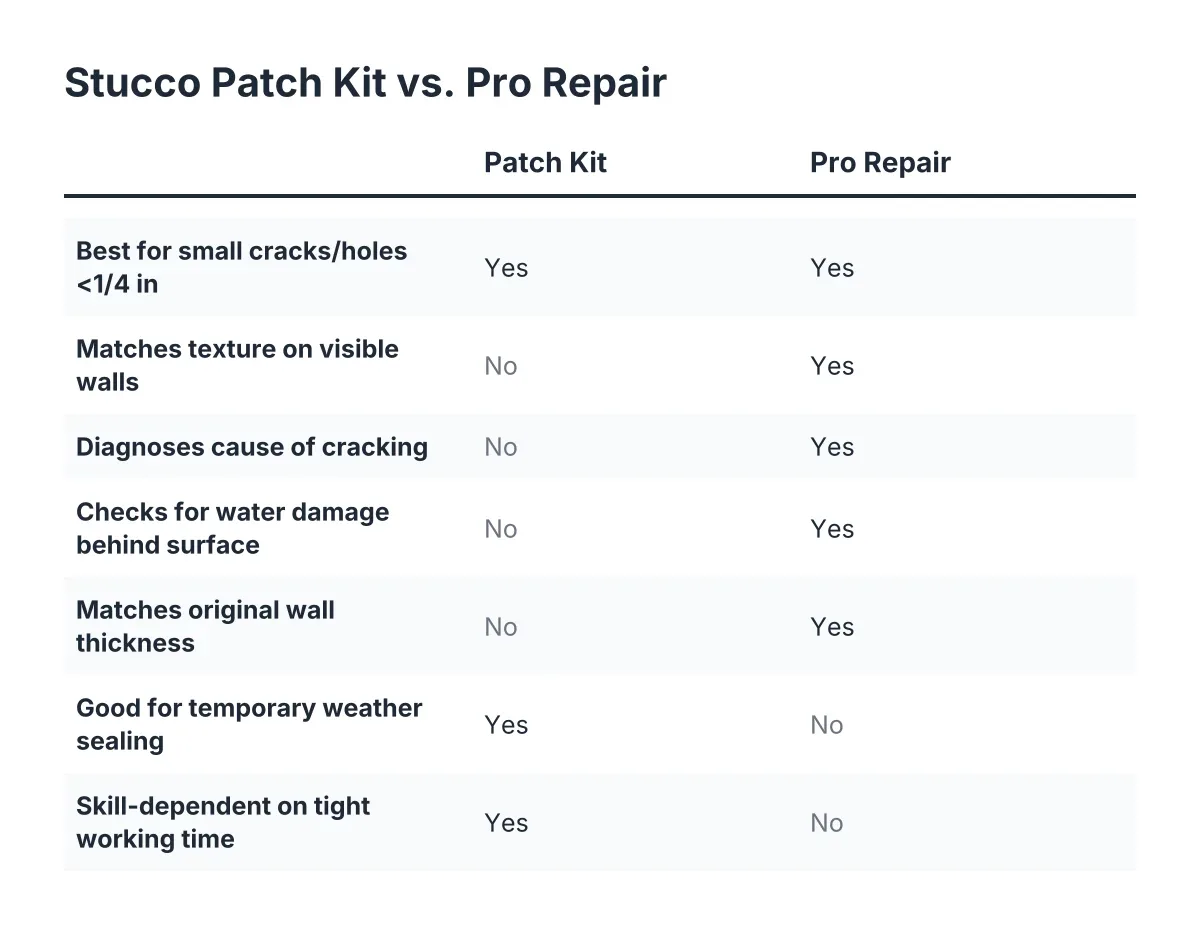
Repairs don't rebuild the whole assembly, so they don't carry full installation cost per square foot pricing. For repair work, polymer-modified products, including rapid set stucco patch materials, can replace the traditional three-coat system in a single application. That cuts days off the timeline, which matters when a closing date is fixed. A defined repair scope, patch the damage, match the texture, blend the color, usually lands in the hundreds to low thousands, not the five figures a full re-stucco commands.
For example, say a homeowner in Castle Pines gets a pre-listing inspection back with two flagged items: a spreading brown stain below a second-story window and a hairline crack running off a corner. In that scenario, the stain is the one that matters. Staining that won't wash off usually means water is getting behind the stucco, and the right move is to open that spot, find the flashing failure, dry it out, and patch it with matched texture. The corner hairline, especially where stucco sits on a harder concrete foundation, is often just the two materials expanding at different rates, a minor fix rather than a structural problem.
One honest caveat: nobody can tell you the full repair cost until the wall is open. If the moisture found rotten sheathing or framing, the scope grows, and a contractor who quotes a firm number before looking behind the stucco is guessing. What you can require is a small exploratory opening first, a clear explanation of what's found, and a firm price before the larger repair starts. If water damage has reached framing or you smell mustiness inside, bring in a professional promptly rather than patching over it; a cosmetic patch over wet framing fails, and a buyer's inspector will find it.
How to Get an Accurate Number Instead of a Guess
Whether you're a builder pricing a subdivision or a homeowner pricing one wall, the path to a reliable number is the same. Vague scopes produce vague prices, and vague prices produce disputes.
Follow these steps before you sign anything:
- Define the scope in writing. Which elevations, which square footage, which finish, and who handles barrier, lath, and flashing.
- Ask what the price excludes. Scaffolding, substrate repair, painting, and cleanup are common exclusions that surface later.
- Get the assembly spec. Barrier type, lath gauge, number of coats, and cure time between them. A contractor who can't state their spec doesn't have one.
- Confirm the crew. Same crew for the whole job, or rotating hands. This predicts finish consistency better than any sample board.
- Pin down the schedule and the weather plan. Start date, duration, and what happens when a cold snap or hailstorm hits mid-job.
In addition, keep the local weather math in mind when you're tempted by the lowest bid. According to the National Association of Insurance Commissioners, Colorado home insurance premiums rose 65 percent over the last five years, with hail cited as a major driver. Your stucco is the layer standing between that weather and your framing. The cheapest wall assembly is the one you'll pay for twice.
The per-square-foot number is a useful starting point, but it's only a summary of decisions underneath it: the assembly, the crew, the schedule, and the plan for what goes wrong. Get those four things in writing and the number takes care of itself. Skip them, and the lowest stucco cost per square foot in the stack becomes the most expensive wall on the street.
If you need stucco repair, Castle Rock Stucco Pros can help.
Prefer to talk it through? Call (720) 797-8506 — a quick call is usually the fastest way to get a straight answer for your situation.