Get a Stucco Repair Estimate in Castle Rock: What a Storm Damage Quote Should Include
A hailstorm rolls through, you walk the house the next morning, and there it is: chipped stucco on the west wall, a crack running off a window corner, maybe a dark stain that was not there last month. Now you need to get a stucco repair estimate, and you need it to be one you can actually trust before the next storm or a closing date forces your hand. This guide walks through what a storm damage stucco quote in Castle Rock should include, what to have ready before the estimator shows up, and how the estimate ties into an insurance claim if you file one.
The stakes here are real. Colorado's May 8, 2017 Front Range hailstorm caused $2.3 billion in insured damage, the costliest catastrophe in state history, according to National Insurance Crime Bureau. Hail is a fact of life along the Front Range, and stucco takes the hit right alongside your roof. A good estimate is the document that turns storm damage into a plan, so it is worth getting right.
Why the Estimate Matters More After a Storm
After a storm, the estimate is doing double duty. It is not just a price. It is the record of what got damaged, how bad it is, and what it takes to fix it, and that record may end up in front of an insurance adjuster, a home inspector, or a buyer's agent.
If you are selling the house in the next 30 to 90 days, this matters even more. A vague one-line quote does nothing for you at the negotiating table. A detailed estimate that names the damaged areas, the repair method, and the texture matching plan gives your realtor something to hand a nervous buyer. It shows the problem was identified and fixed by someone who works with stucco, not patched over.
The estimate also protects you from scope surprises. Storm damage on stucco has a way of being bigger than it looks from the driveway, especially where water has been getting behind the wall. A written scope forces that conversation before demo starts, not after.
What to Do Before You Get a Stucco Repair Estimate
Preparing for a stucco storm damage inspection takes about an hour of your time, and it makes every estimate you collect more accurate. Walk the house, take photos, and write down what you find before anyone shows up with a clipboard. Estimators work faster and quote tighter when the homeowner can point to specific spots instead of saying "somewhere on the back wall."
Here is what to document:
- Date of the storm. Insurance claims hinge on this. Note the date, and if you can, the approximate hail size or wind conditions.
- Photos of every damaged area. Shoot wide to show which wall, then close to show the crack, chip, or stain. Morning or evening light at a low angle shows hail dents on stucco better than midday sun.
- Soft spots and stains. Press gently on any discolored or bubbled areas, especially below windows and near downspouts. If the stucco feels soft or crumbly, mark it. That is a water damage flag, and it changes the repair scope.
- Interior signs. Check inside along the same walls for musty smells, stains on drywall, or damp baseboards. Note anything you find.
- Prior repairs. If a wall has an old patch that does not match the surrounding texture, point it out. It tells the estimator someone worked on that wall before, and it may hide older damage.
In addition, hold off on cleaning or painting over stains until after the inspection and any adjuster visit. A scrubbed wall is a wall with less evidence. If you have a stain that will not wash off no matter what you try, that persistence is itself a clue that the moisture source is behind the stucco, not on the surface.
What Belongs in a Storm Damage Stucco Quote
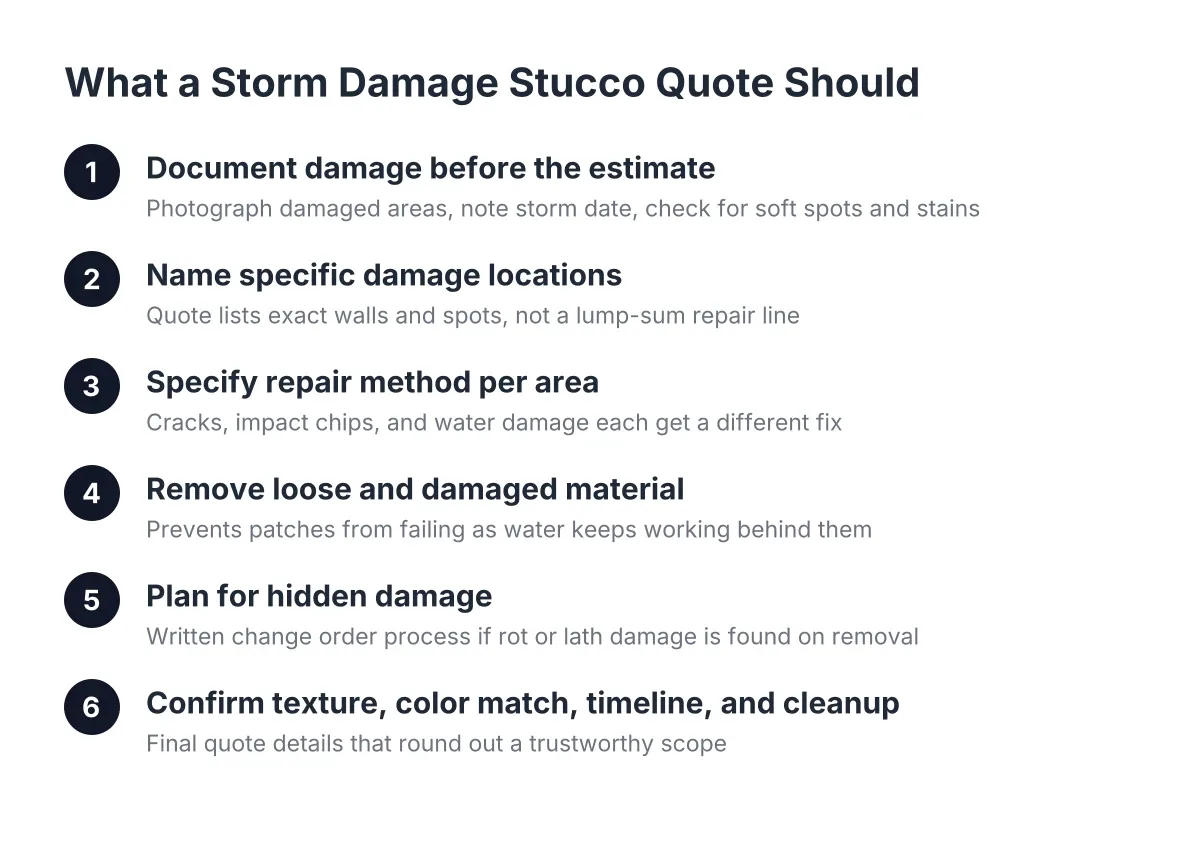
A complete stucco repair estimate for storm damage names the damaged areas, states the repair method for each one, covers removal of loose material, addresses what happens if hidden damage turns up, and spells out the texture and color matching plan. If a quote is missing any of these, ask why before you sign anything.
Let's take each piece in turn.
Specific damage locations, not "stucco repair, lump sum"
The estimate should name walls and spots: "west elevation, three impact points below the kitchen window," not "repair stucco as needed." Specificity matters for two reasons. First, it lets you compare quotes fairly. Second, if you file an insurance claim, the adjuster's scope and the contractor's scope need to line up, and neither can line up with a lump sum.
The repair method for each area
Cracks, impact chips, and water-damaged sections get fixed differently. A hairline crack off a window corner might call for routing and sealing. Deeper cracks sometimes get backer rod, a closed-cell foam cord placed inside the crack to create a backing before sealant goes in, according to Sika. An impact hole needs stucco patching down to sound material. A soft, water-damaged section needs cutting out, drying, and rebuilding in layers. The quote should say which method applies where.
Removal of loose and damaged material
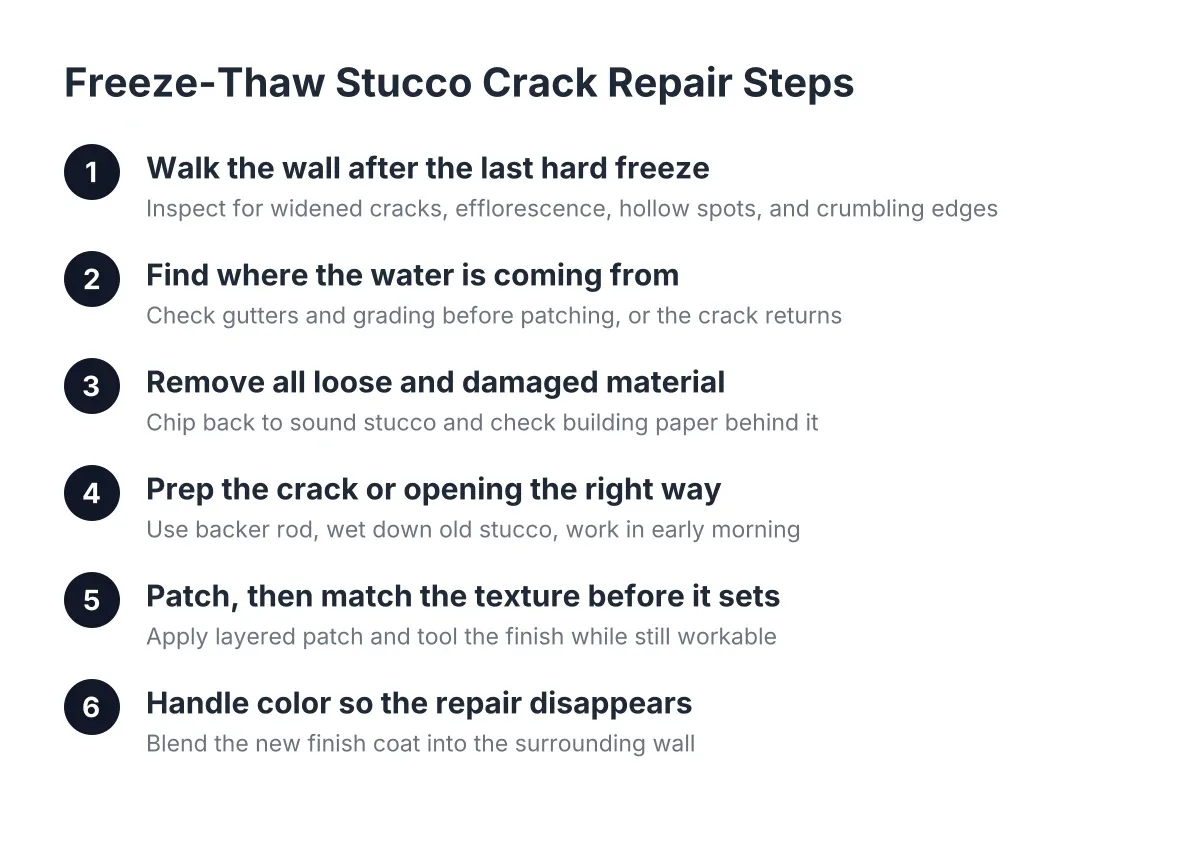
Any competent scope starts with removing loose or buckling stucco. Skipping this step is the most common reason patches fail. Loose material left in place lets rain keep working into the wall, expanding the damage underneath while the new patch hides it. If a quote jumps straight to "apply patch compound," that is a shortcut you will pay for later.
A plan for hidden damage
This is the part that worries most homeowners, and fair enough. Nobody wants a $900 patch to turn into a $4,000 wall rebuild after demo. You cannot eliminate that risk, but a good estimate handles it honestly. Look for language like: "Price assumes sound sheathing behind damaged stucco. If rot or lath damage is found on removal, contractor will stop, photograph, and provide a written change order before proceeding."
That clause protects you. It means no one keeps tearing into your wall and billing you for it without a conversation first. Be wary of anyone who wants to start demo before they have explained what they think is wrong and what the decision points are.
Texture and color matching
In Castle Rock, most stucco finishes are some version of a knockdown or dash texture. Matching it takes skill. A knockdown repair gets sprayed on and then lightly troweled down to blend with the surrounding wall, and even the fineness of the sand in the mix has to match the existing finish. A mismatched patch is the number one tell of a cheap repair, and it is exactly the kind of thing a buyer's inspector circles in red.
The estimate should state how the finish will be matched and whether the repaired area will be blended, or whether a larger wall section will be refinished to hide the transition. On a badly damaged corner, the technically correct fix is often to take the stucco off and repatch the full section from corner to corner rather than spot-patching, so ask which approach the price covers.
Timeline, payment terms, and cleanup
Finally, the basics: when work starts, how many days it takes including cure time between coats, what deposit is expected, and who hauls away debris. If you are on a listing timeline, get the completion date in writing on the estimate itself.
Does Insurance Cover Stucco Storm Damage?
Homeowners insurance in Colorado generally covers stucco damage caused by a specific storm event, such as hail impacts or wind-driven debris, subject to your deductible. It typically does not cover gradual problems like age cracking, long-term water intrusion, or deferred maintenance. The line between the two is where claims get contested, and it is where your documentation earns its keep.
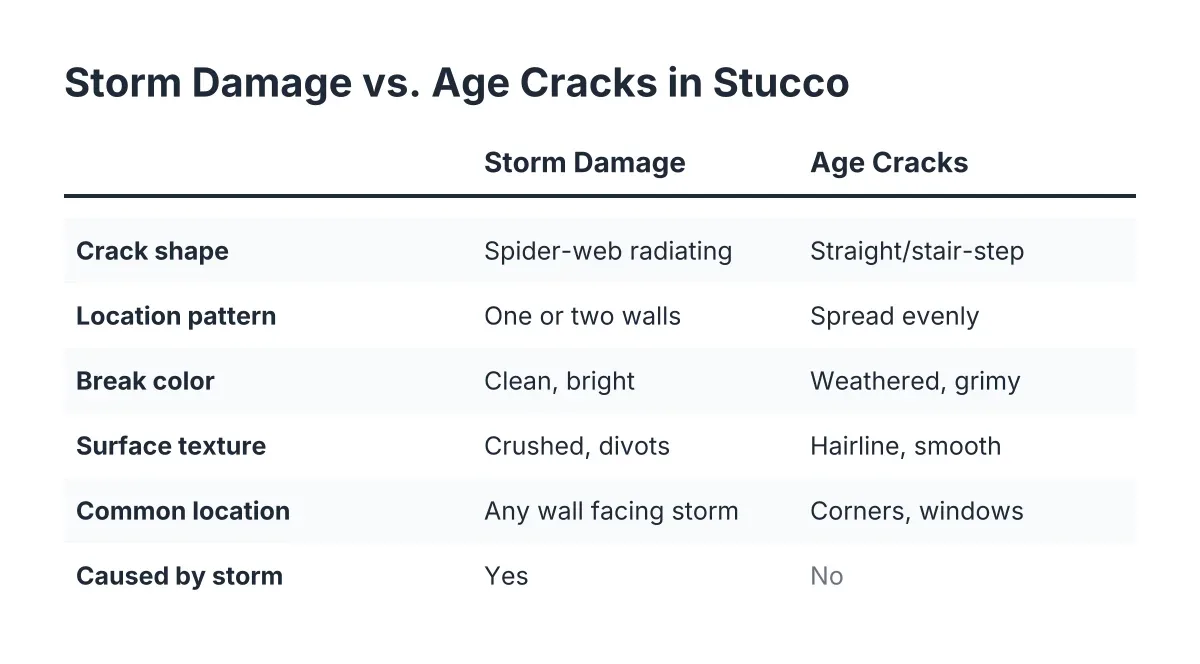
Colorado insurers see a lot of hail claims. The state had the second-highest number of hail insurance claims in the country from 2013 to 2015, totaling 182,591 claims, according to Rocky Mountain Insurance Information Association. Adjusters here know hail damage on stucco when they see it. Fresh impact marks are distinct: crisp-edged chips and crescent-shaped fractures, often concentrated on the wall facing the storm. Old age cracks look different, and adjusters can tell them apart. So can an experienced stucco contractor, which is why having your own detailed estimate before or alongside the adjuster visit helps keep the scope honest in both directions.
A few practical points for the insurance adjuster stucco claim process:
- Report promptly. Most policies require timely notice of storm damage. Waiting months makes it harder to tie the damage to the event.
- Get your contractor's estimate first if you can. An itemized scope from someone who knows stucco gives you a baseline to compare against the adjuster's write-up.
- Ask if the contractor will meet the adjuster on site. Walking the wall together resolves scope disagreements faster than trading paperwork. A contractor who has worked alongside adjusters on Colorado hail claims knows what documentation they need and what a fair line-item scope looks like.
- Weigh the claim against your deductible. With Colorado premiums up 65% over the last five years and hail cited as a major driver, according to the National Association of Insurance Commissioners, a repair that lands near your deductible may be worth paying out of pocket. Run the numbers before you file.
However, do not let the insurance question stall the repair itself. Water does not wait on a claim decision. If stucco is open to the weather or a soft spot is spreading, get the area assessed and at minimum temporarily protected while the paperwork moves.
A Realistic Example: Comparing Two Quotes
Suppose a homeowner in Castle Rock is listing in six weeks. Hail hit the west and south walls in a summer storm, leaving a dozen impact chips, one long crack off the garage window, and a soft, stained patch below a second-story window where a downspout dumps close to the wall.
In that scenario, say two quotes come back. Quote A is one line: "Repair and texture stucco, $1,800." Quote B runs to a page: it lists each impact point, specifies crack repair with sealant on the window crack, calls out removal of the soft section down to sound material with a written change-order clause if rot is found, includes redirecting the downspout, and states the finish will be a sprayed and troweled knockdown blended to the existing texture, with completion in four working days. When you request a storm damage stucco quote, Quote B represents the level of detail that protects you through both the repair and any insurance claim.
Quote B might come in at $2,400, and it is still the better buy. It fixes the cause, not just the symptom; a patch below that window will fail again if the downspout keeps pooling water against the wall. It also gives the seller a document their realtor can show buyers. These numbers are illustrative, not a price list, but the pattern is the one to look for: the cheaper quote is often the one that leaves the cause in place.
Red Flags When You Get a Stucco Repair Estimate
Most stucco crews in the area do honest work. Still, storm season brings out door-knockers, and a listing deadline can pressure you into a bad signature. Watch for these:
- Demo before diagnosis. Anyone eager to start cutting into the wall before explaining what they think is wrong.
- No mention of texture matching. If the quote does not address how the patch will blend, assume it will not.
- "We'll handle your insurance" as the whole pitch. A contractor can and should coordinate with your adjuster, but the person selling the claim harder than the repair is a warning sign.
- No provision for hidden damage. Silence on what happens if rot turns up is how a fixed price turns into an open tab.
- Pressure to skip the written scope. For storm damage stucco repair especially, the paper trail is part of the product. You may need it for the claim, the inspection, or the sale.
One trade-off worth naming: the most thorough scope is not always the one you need. If the house is listing next month and the damage is cosmetic, a well-done partial patch on a corner is a legitimate, cheaper alternative to refinishing the whole wall, provided the underlying cause, like drainage or vibration from a nearby AC unit, gets addressed too. A straightforward estimator will tell you which situation you are in rather than defaulting to the biggest job.
When to Bring in a Professional Assessment
If you have found a soft spot, a stain that keeps returning, or a musty smell inside along an exterior wall, get a professional stucco storm damage inspection rather than probing the wall yourself. Moisture behind stucco can travel well past the visible stain, and judging how far it has gone takes experience with how these wall assemblies fail. The same goes for any damage near windows, where flashing details decide whether a repair holds.
This is also true on the claims side. This article is general guidance, not insurance or legal advice; your policy language controls what is covered, and a public adjuster or attorney is the right resource for a disputed claim.
For everything else, the path is simple. Document the damage while it is fresh, get a stucco repair estimate that itemizes locations, methods, texture matching, and hidden-damage terms, and line that estimate up against your insurance scope and your timeline. In Castle Rock, the next hailstorm is a matter of when, not if. A wall that was repaired right, with the loose material removed and the cause corrected, is the one that comes through it fine.
If you need stucco repair, Castle Rock Stucco Pros can help.
Prefer to talk it through? Call (720) 797-8506 — a quick call is usually the fastest way to get a straight answer for your situation.