7 Signs Your Stucco Siding Needs Replacement, Not Another Patch
Most stucco problems in Castle Rock can be fixed with a patch. That is the honest truth from a repair-first point of view, and it is why we usually talk homeowners out of bigger work, not into it. But there is a line where patching stops making sense, and knowing the signs stucco needs replacement can save you from paying twice: once for a patch that fails, and again for the replacement you needed in the first place.
This matters most if you are getting a house ready to list, or if you are already staring at a patch that does not match and wondering whether another repair on top of it will make things worse. Here are seven signs, in rough order of how often we see them, that a wall section or a full stucco house exterior is past the point where crack repair and patching are the right call.
1. The Wall Sounds Hollow When You Tap It
A solid stucco wall sounds dull and firm when you knock on it with your knuckles. A hollow, drummy sound means the stucco has let go of the wall behind it, often because the bonding layer failed or was never right to begin with.
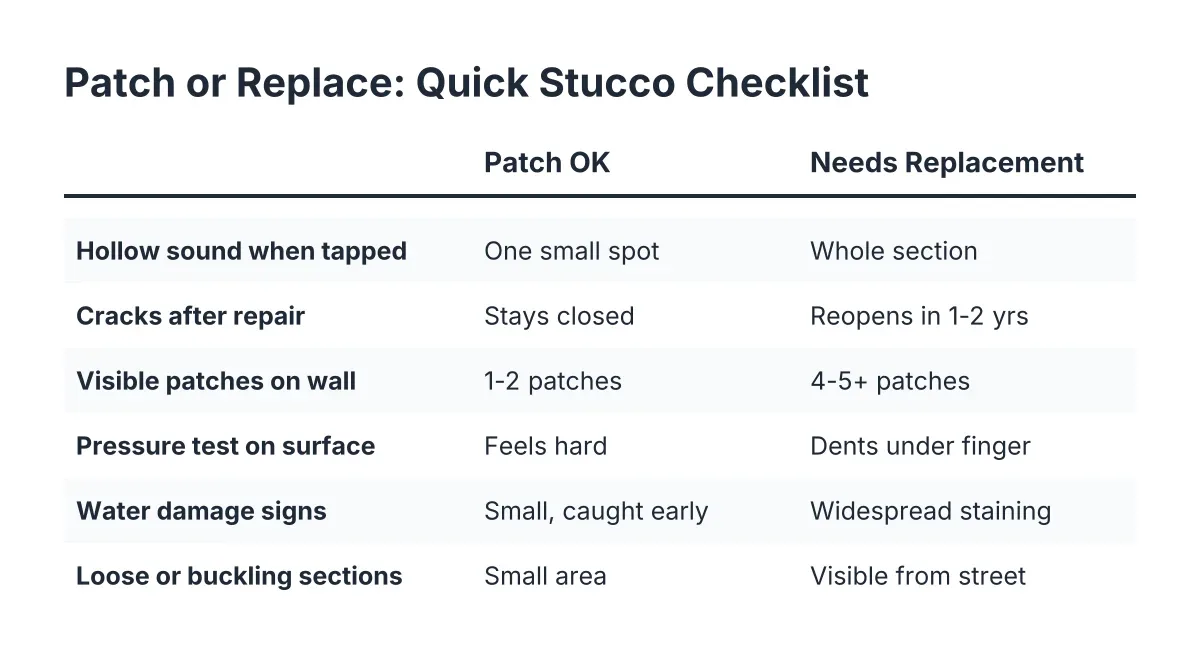
This is the single most useful check a homeowner can do, and it costs nothing. Walk the wall and tap every couple of feet. One small hollow spot can be cut out and patched. However, if you get that hollow sound across a whole wall section, the stucco is detaching as a sheet, and patching one spot just moves the problem sideways. That section needs to come off and be redone.
2. Cracks Keep Coming Back After Repair
A hairline crack that gets repaired once and stays closed is normal wear. A crack that reopens in the same spot within a year or two is telling you the cause was never fixed. Something behind the wall is still moving, whether that is settling, vibration, or framing that flexes with the seasons.
Wider structural cracks are a different animal from hairline ones. They run deeper and need backer rod and sealant, not just paint. Backer rod is a closed-cell foam cord that creates a foundation inside the crack before sealant goes on, according to Sika. If a crack is wide enough to need that treatment and it keeps returning, repeated stucco crack repair is just renting time. At that point, removing the section, fixing what is moving behind it, and replacing the stucco is the honest recommendation.
3. Multiple Patches Show the Stucco Needs Replacement
Here is a sign your stucco siding has quietly crossed the replacement line: you look at a wall and see a map of past repairs instead of a wall. Every patch is a seam, and every seam is a place where texture, color, and age weather differently.
If you are the homeowner who sees that bad patch every time you pull into the driveway, you already know how this feels. A skilled crew can blend one or two repairs into the surrounding texture so they disappear. But once a wall carries four or five visible patches from different hands, the cleanest fix is often to redo the full wall section, corner to corner, so the whole plane cures and weathers as one surface. That is not over-scoping; it is the only way to get a uniform wall back.
4. You Can Push a Dent Into It With Your Finger
Sound stucco is hard. If you can press a thumb or the toe of a boot into a patched area and feel it give, the patch material or the way it was applied has failed underneath the surface. Painting or skim-coating over a soft patch just hides the failure for a season.
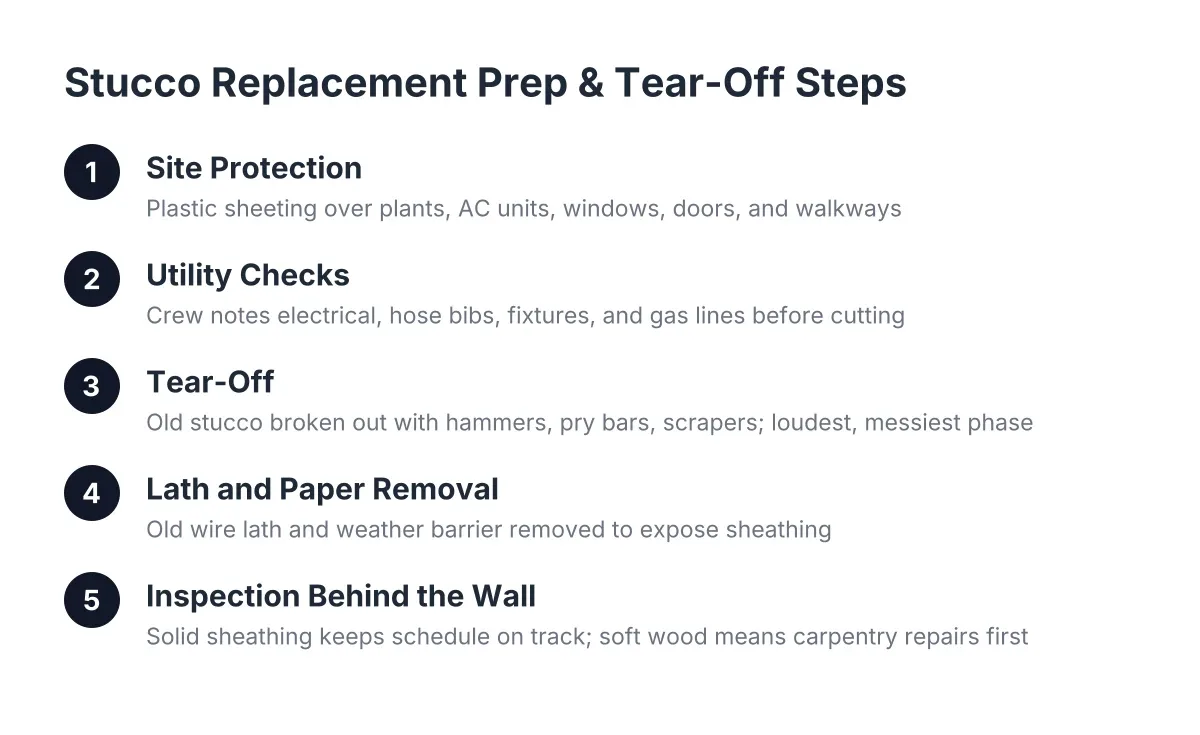
For example, say a homeowner in Castle Pines had a handyman patch a hole near a hose bib two years ago, and now the patch flexes under light pressure and the edges are chalking. In that scenario, the right move is to break out the failed patch entirely, inspect the lath and paper behind it, and rebuild that section properly. If soft spots show up in several places on the same wall, that is a sign the whole wall's base coat is suspect, and replacement of the section beats chasing soft spots one at a time.
5. Signs Your Stucco Siding Is Hiding Water Damage
Water damage is the sign that changes the math fastest. Staining that spreads below windows, a musty smell inside on that wall, bubbling or peeling paint, or stucco that crumbles when touched all point to water getting behind the siding, not just sitting on it.
The dangerous part is what you cannot see. Behind stucco sits a layer of building paper that sheds water off the framing. When a structural crack sits open for years, that paper ages and turns brittle, and normal wall flexing can tear it. Once the paper is torn, water reaches wood, and the repair is no longer a stucco job; it is a stucco, paper, and sometimes framing job. Exterior stucco repair can handle a small, caught-early leak. Widespread staining or soft, rotted sheathing behind the wall means that section must come off completely so everything underneath can be dried, repaired, and rebuilt.
One related note for 2026: Colorado weather is hard on exteriors, and insurers have noticed. Home insurance premiums in the state rose 65% over the last five years, with hail cited as a major driver, according to the National Association of Insurance Commissioners. A stucco house exterior with open cracks takes hail and driven rain worse than a sound one, so deferred damage tends to compound here.
6. Loose or Buckling Sections You Can See From the Street
Stucco that bulges, buckles, or has visibly separated at corners and edges is past patching by definition. Before any repair, all loose material has to come off, because leaving it in place lets rain keep swelling the wood behind it and the damage keeps growing.
Therefore, the practical question is how much comes off once a crew starts removing loose material. Sometimes it is a two-foot square. Often, on an aging wall, the loose area keeps going, and what started as a patch estimate becomes a section replacement. A straightforward local contractor will tell you that up front instead of quoting a small patch and surprising you mid-job. Deteriorated corners are a common example: the technically correct repair is to remove the stucco and redo the full wall section from corner to corner, not to dab mortar on the worst spot.
7. The Texture Can No Longer Be Matched
This one hits the perfectionists hardest, and for good reason. Texture matching works by reading the original finish, the tool marks, the aggregate size, and the application technique, then reproducing them on the patch. A bad previous patch usually means someone skipped that reading entirely.
But matching has real limits, and it is worth being honest about them. On a wall that is decades old, sun-faded, and layered with two or three mismatched patches, even a skilled texture match may read as a slightly different panel in low evening light. Color matching on weathered stucco is harder still, since the original stucco supply and pigments may no longer exist. When a wall reaches that state, replacing the full visible section and finishing it as one continuous surface is the only path to a wall that looks like nothing ever happened. For a pre-listing seller, that uniform wall is what keeps a buyer's inspector and a buyer's eye moving past it.
How to Decide: A Quick Patch-or-Replace Checklist
Use this as a first pass before you call anyone. The signs your stucco siding needs section or full replacement usually stack; one alone rarely settles it, but three or more almost always do.
- Hollow sound covers a broad area, not one spot
- Cracks reopen in the same place after proper repair
- Four or more visible patches on a single wall plane
- Patch material gives under light finger pressure
- Staining, musty smell, or crumbling tied to water damage
- Loose or buckling stucco you can see from the yard
- Texture and color so far gone that blending one more patch is not realistic
Keep the scope honest in both directions. If only one sign shows up in one spot, a targeted stucco patching job with careful texture matching is probably all you need, and anyone pushing full stucco siding replacement off a single hairline crack is over-scoping the work. On the other hand, if the wall fails the tap test broadly or shows water damage, stacking another patch on top under-scopes it and wastes money.
One limitation worth naming: none of these checks replace opening the wall. Moisture behind stucco can only be confirmed by inspection, and if you suspect water intrusion or rot, bring in a professional before deciding anything. A local Castle Rock crew that works in stucco every day can tap-test the walls, cut an inspection opening if needed, and tell you plainly whether you are looking at a repair, a section replacement, or a full redo, so you fix it once and stop looking at it.
If you need stucco repair, Castle Rock Stucco Pros can help.
Prefer to talk it through? Call (720) 797-8506 — a quick call is usually the fastest way to get a straight answer for your situation.