Stucco Siding Replacement Cost: What Drives the Price of a Stucco Wall Redo
If you are comparing quotes for stucco work in Castle Rock, the biggest question is usually the same one: does this stucco wall need a patch, a section replaced, or a full tear-off? The answer drives the price more than anything else. A crack repair might run a few hundred dollars. Full stucco siding replacement on a whole house can run tens of thousands. This guide walks through the decision step by step, from a repair-first shop's point of view, so you can spot when a quote is over-scoped, under-scoped, or about right.
One note before we start. We fix stucco for a living, so our bias runs toward repair when repair will hold. That also means we know exactly where patching stops making sense. Both halves of that matter when you are reading bids.
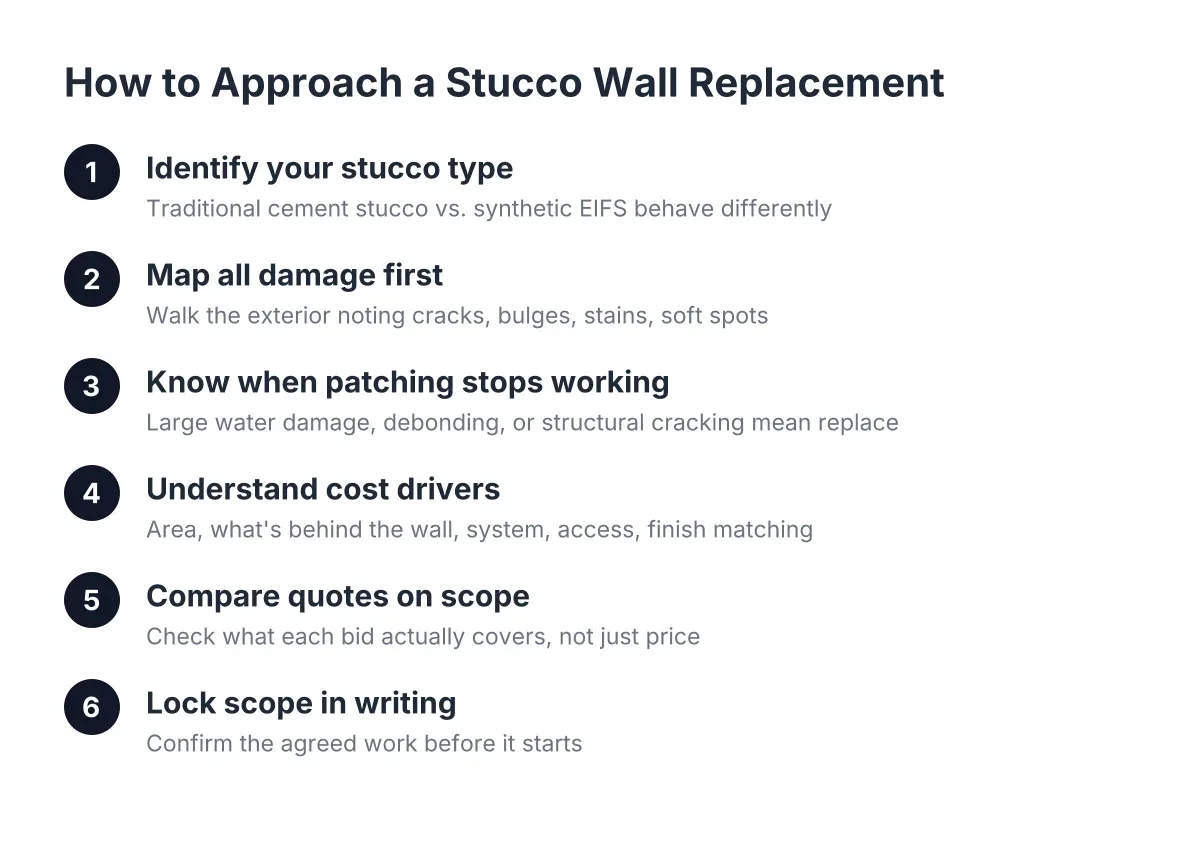
Step 1: Figure Out What Kind of Stucco Wall You Have
Before you can compare quotes, know what is on your house. Contractors price traditional stucco and synthetic stucco differently, and some crews only work with one.
Traditional stucco is a cement-based coating applied in coats over lath. It is hard, breathable, and common on Colorado homes. Synthetic stucco, often called EIFS, is a foam-backed system with an acrylic finish coat. It looks similar from the curb but behaves differently, especially around water damage.
Here is a quick way to tell. Knock on the wall. Traditional stucco sounds and feels like concrete. EIFS sounds hollow and gives slightly under pressure, like knocking on a cooler. If you push a thumbtack into an inconspicuous spot and it slides in, you likely have EIFS.
Why this matters for cost: EIFS repairs often cost more per square foot because the system traps water behind the foam when it fails. A small stain on an EIFS wall can hide a larger soaked area. Traditional stucco tends to fail more locally, which keeps repairs contained and cheaper.
Step 2: Map the Damage Before Anyone Quotes You
Walk the whole exterior with a notepad. Do this before you call anyone, so you can compare quotes against the same list of problems instead of against each other's guesses.
Look for these, and note where each one is:
- Hairline cracks under about 1/16 inch, usually cosmetic
- Cracks wider than a credit card edge, or cracks that step in a stair pattern
- Bulging or drummy spots that sound hollow when tapped
- Staining below windows, at roof lines, or near ground level
- Soft or crumbling stucco you can flake off by hand
- Rust streaks, which can mean the lath behind the wall is corroding
The pattern matters as much as the count. Ten hairline cracks scattered across a sunny south wall is normal aging in Castle Rock's freeze-thaw climate. Three soft spots clustered under one window is a water problem, and the visible damage is usually the small end of it.
If you are selling soon and an inspection flagged the stucco, photograph everything on your list. It keeps the conversation with contractors, and later with buyers, specific instead of vague.
Step 3: Learn Where Patching Stops Making Sense
This is the honest line a repair-first shop draws, and it is the line that explains most of the price gap between competing bids.
Patching makes sense when the damage is local and the wall system behind it is sound. A cracked corner, a hole from a removed satellite dish, or hail dings are all patch jobs. A good crew cuts back to solid material, repairs the underlayment if needed, and rebuilds the coats with texture matching so the patch disappears.
Patching stops making sense in a few specific situations:
- Water has gotten behind the wall over a large area. If the paper or lath behind the stucco has failed across a whole elevation, patching the surface just hides an active problem. That section needs to come off.
- The stucco has debonded. When large areas sound hollow, the coating has separated from the wall. Patching over debonded stucco is throwing money at something that will crack again.
- Cracking is structural. Wide, stair-step, or recurring cracks that come back after repair point to movement in the framing or foundation. A stucco patch treats the symptom.
- The repairs are stacking up. If you have paid for crack repair on the same wall two or three times, the wall is telling you something.
A useful rough rule: when repairing a wall would cost more than about half of replacing that section, replacement usually wins. You pay once instead of twice.
The reverse trap is real too. Some companies quote full replacement for damage a competent patch would handle for a tenth of the price. If one bid says "tear it all off" and another says "patch these four spots," ask each contractor to explain what they found behind the wall that justifies their scope. The one who can point to specific evidence, hollow spots, soft lath, moisture readings, is the one reading the wall instead of the sales script.
Step 4: Understand What Drives Stucco Wall Replacement Cost
Stucco wall costs come down to five main factors: how much area is involved, what is behind the surface, the system going back on, access, and finish matching. Square footage sets the baseline, but the condition of the sheathing underneath is what turns an average quote into a high one.
Here is how each factor moves the number:
- Area. Stucco is priced by the square foot for replacement work. A single 200-square-foot elevation section costs far less than a 2,500-square-foot whole-house tear-off, but the per-foot rate on small jobs runs higher because setup costs stay fixed.
- What is behind the wall. This is the hidden-cost factor that worries every quote-comparing homeowner, and rightly so. If tear-off reveals rotted sheathing or damaged framing, that is carpentry on top of stucco work. A fair contractor prices the stucco firmly and states a unit price for sheathing replacement up front, so you are not negotiating mid-project.
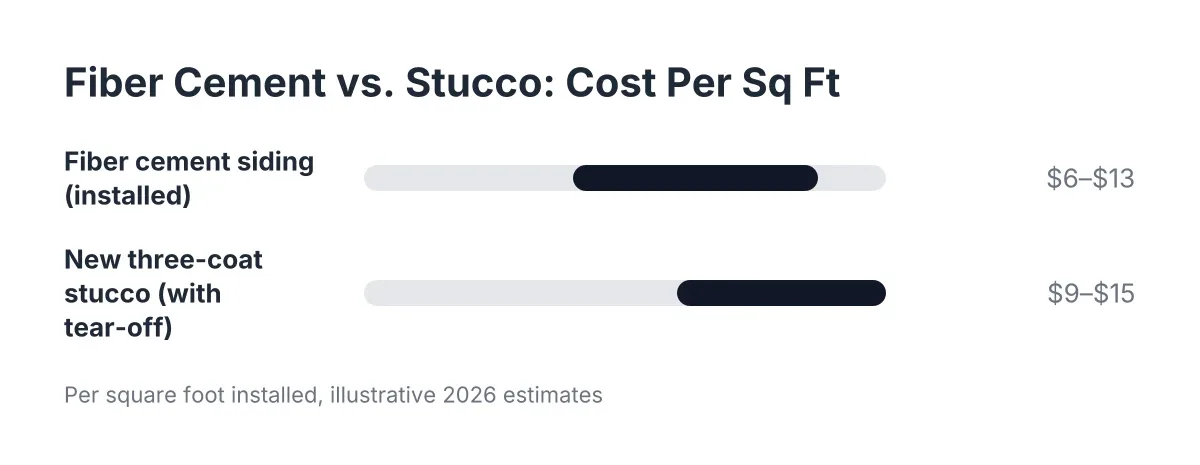
- The system going back on. Traditional three-coat stucco costs more in labor than one-coat systems but tends to last longer. EIFS has its own pricing. Some homeowners at this decision point also price fiber cement siding as an alternative; it changes the look of the house, and vinyl siding costs less up front but reads differently to buyers in a stucco neighborhood.
- Access and height. Two-story walls, steep grades, and tight lot lines add scaffold time. Scaffold time is labor you pay for.
- Texture and color matching. If you are replacing one elevation, the new stucco has to match the other three. Texture matching is skilled work, and crews that do it well charge for it. On a pre-listing repair, it is the difference between a fix a buyer never notices and a patch that draws the inspector's eye.
As an illustrative estimate only: patch repairs commonly land in the hundreds to low thousands, replacing a full elevation section often runs in the low to mid thousands, and full-house stucco replacement typically reaches five figures. Actual 2026 pricing in Castle Rock depends on every factor above, which is why real numbers only come from someone who has looked at your wall.
Step 5: Compare Quotes on Scope, Not Just the Bottom Line
Two quotes that differ by thousands of dollars are usually not pricing the same job. Before you assume the high bid is padding or the low bid is a bargain, line them up item by item.
Ask each contractor these questions:
- Exactly which walls or areas does this price cover?
- Is this a surface patch, a cut-back repair to the lath, or a full tear-off?
- What happens on price if you find rot or water damage once the wall is open?
- Does the price include texture matching and, if needed, color matching or painting the repaired area?
- Who is actually doing the work, your crew or a sub?
That last one matters more than people expect. National operations often route your call through a center and send whichever crew is available. A local stucco contractor answers for the work personally. When you search "stucco contractors near me," you will get both types in the results; the questions above sort them out fast.
Be careful with the lowest bid when the scope is vague. "Repair stucco as needed" on a one-line quote gives the contractor room to do less than you expect, or to add charges once the wall is open. A detailed low bid can be a genuinely good price. A vague low bid is usually the most expensive quote on the table; you just find out later.
Step 6: Match the Scope to Your Timeline and Goals
The right scope depends on what you need the house to do for you. Suppose a homeowner in Castle Rock is listing in 45 days and the pre-listing inspection flagged cracks on two walls plus staining under one window. In that scenario, full stucco siding replacement makes no sense; a targeted repair of the flagged defects, with the texture matched so nothing catches a buyer's eye, protects the sale price for a fraction of the cost and finishes in days instead of weeks.
Now flip it. Say the same homeowner plans to stay ten years, and the tap test finds hollow stucco across most of the south wall with water damage at the base. Patching that wall every spring would cost more over a decade than replacing the section once. Long-term owners should weight durability; sellers should weight speed and appearance.
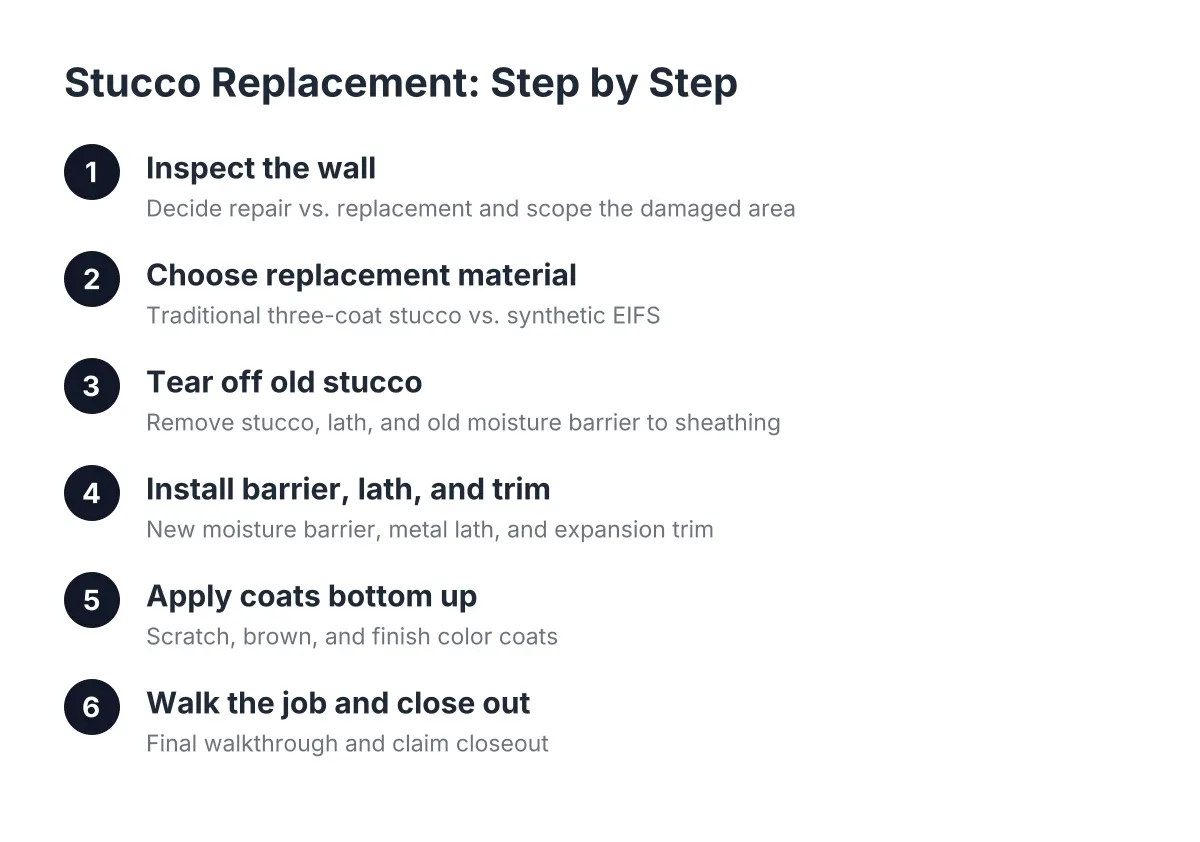
Timeline also matters for the process itself. A patch job wraps in a day or two. Section replacement usually takes several days, plus cure time between coats. Full exterior replacement is a multi-week project with tear-off, moisture barrier and lath installation, three coats, and finish work. Build cure time into any listing schedule; fresh stucco needs it regardless of who does the work.
One honest limitation: no article can tell you whether your specific wall needs a patch or a tear-off. Hidden water damage, structural movement, and failed lath only show themselves up close, and sometimes only after the wall is open. Get eyes on it from someone who does stucco repair specifically, not a generalist who treats stucco as one of twenty services.
Step 7: Lock the Scope in Writing Before Work Starts
Once you pick a contractor, get the agreed scope on paper before anyone mixes a batch. The document should name the walls being worked on, the repair method, how hidden damage gets priced if found, and what "done" looks like, including texture and color matching.
This protects both sides. You avoid mid-job surprises, and the contractor avoids arguments about what was included. Homeowners worried about being upsold once the wall is open should insist on the hidden-damage clause specifically; a fixed unit price for sheathing repair, agreed in advance, removes the incentive to inflate anything.
Finally, keep your damage map, photos, and the final scope document. If you are selling, that paperwork shows buyers the stucco issue was diagnosed and fixed properly, not painted over. That is worth more at the negotiating table than the repair cost itself.
If you need stucco repair, Castle Rock Stucco Pros can help.
Related guide: stucco siding replacement — Complete Guide
Prefer to talk it through? Call (720) 797-8506 — a quick call is usually the fastest way to get a straight answer for your situation.