Fiber Cement Siding as a Stucco Replacement: Durability, Cost, and When It Makes Sense
If your stucco has reached the point where patching one crack just reveals three more, you have probably started looking at other materials. Fiber cement siding as a replacement for failing stucco comes up in almost every one of those conversations, and for good reason. It handles Colorado weather well, it costs less than a full stucco tear-off and re-coat in many cases, and it goes up faster. But it is not the right answer for every house, and it is definitely not the right answer for every budget. Fiber cement stucco replacement is an increasingly common choice when stucco fails completely, though it is not always the best one.
This is a repair-first shop's honest take. We fix stucco in Castle Rock for a living, which means we have a natural bias toward repair. That also means we know exactly when a stucco patch stops making sense, because we are the ones standing in front of the wall telling a homeowner that another patch would be throwing money at a losing fight. This guide walks through when fiber cement is worth considering, what it actually costs compared to stucco, and how to compare quotes without getting burned.
When Stucco Repair Stops Making Sense
Most stucco problems do not require replacing anything. A hairline crack, a hole from a ladder or a hose bib, a chip near the garage, all of that is normal stucco crack repair and stucco patching work. A competent local crew can fix it, match your home's texture, and you move on.
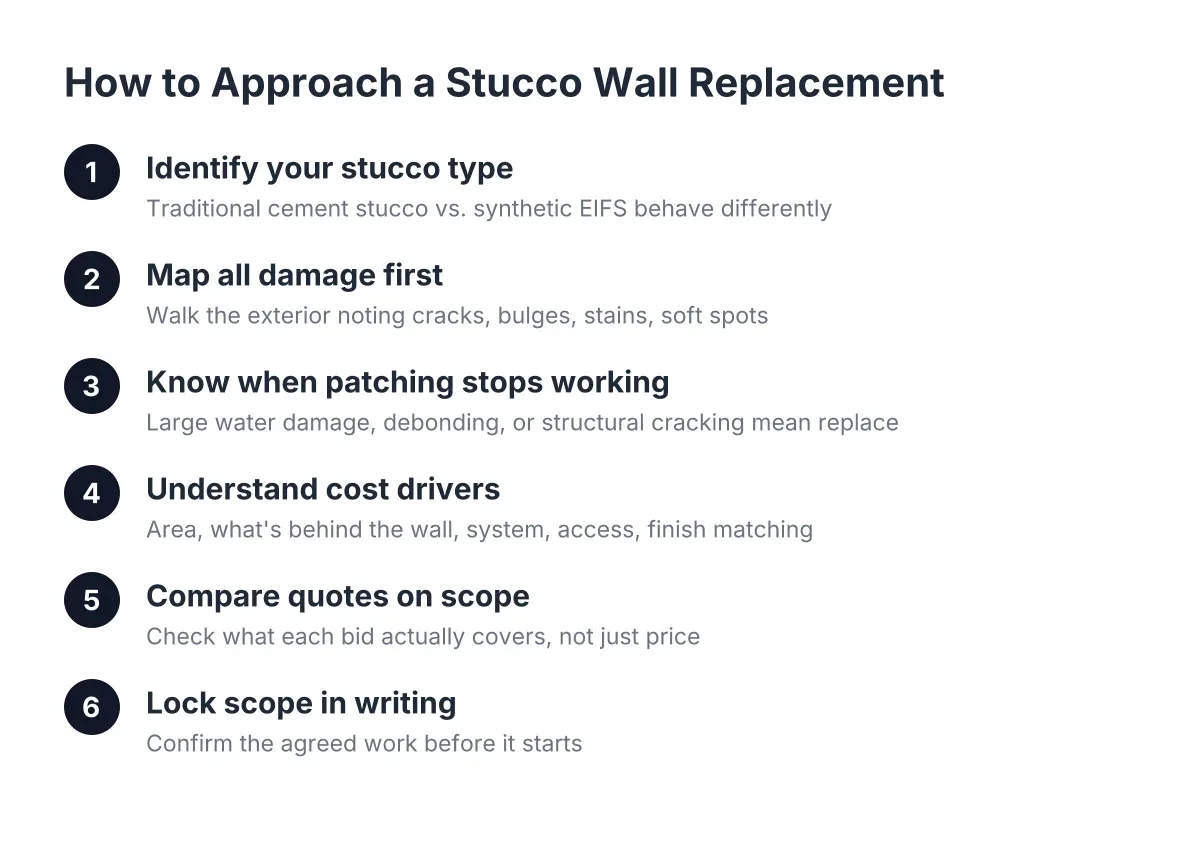
However, there is a tipping point. Stucco repair stops making sense when the problem is systemic instead of local. Here are the signs we look for on a wall before recommending anything bigger than a patch:
- Cracks that keep coming back in the same spots after proper repair, which usually points to movement or a substrate problem
- Soft or spongy areas when you press on the wall, a classic sign of water damage behind the stucco
- Staining, bubbling, or crumbling along the bottom edges of walls, especially near grade or under windows
- Large sections where the stucco has separated from the lath and sounds hollow when you knock on it
- Widespread failure across multiple walls rather than one bad section
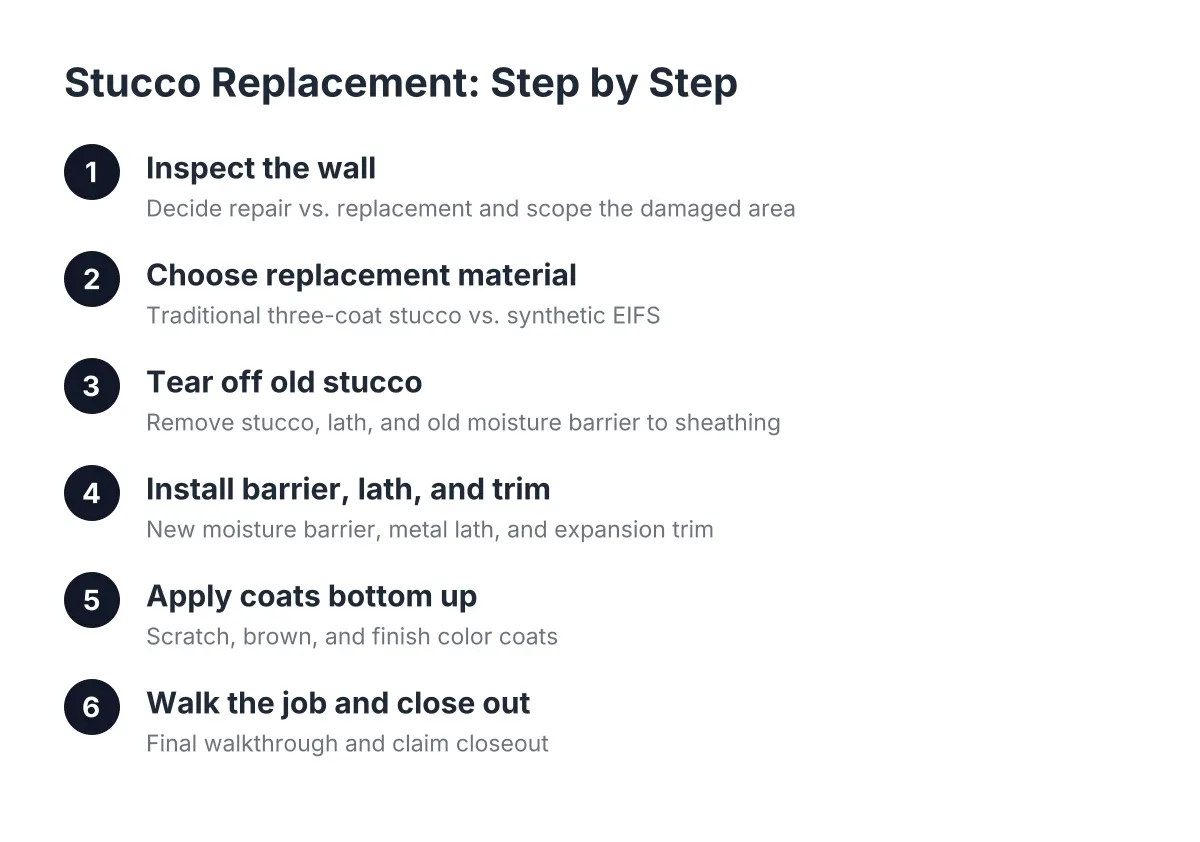
One or two of these on a single wall might still be a repair job. All of them across the whole exterior is a replacement conversation. At that point, you are choosing between full stucco siding replacement, meaning tear-off and new three-coat stucco, or switching materials entirely. That second path is where fiber cement enters the picture.
Why Fiber Cement Siding Replaces Stucco as an Alternative
Fiber cement siding is a mix of cement, sand, and cellulose fibers pressed into boards or panels. It is worth saying plainly, because people search for this: modern fiber cement siding does not contain asbestos. Older cement-asbestos siding from the mid-1900s did, and that association still follows the material around online. Anything manufactured in recent decades is non-asbestos, and if your home is old enough to have the original cement-asbestos product, that is a separate abatement conversation, not a siding choice.
So why does fiber cement come up so often when stucco fails? Three reasons.
First, it handles the same weather stucco struggles with. Castle Rock sits in hail country. Colorado had 182,591 hail insurance claims from 2013 to 2015, the second-highest total in the country, according to the Rocky Mountain Insurance Information Association. Fiber cement takes hail impact well, does not rot, does not burn easily, and does not interest woodpeckers or insects. Those are the same durability arguments people make for stucco, delivered in a board format.
Second, installation is faster and less weather-dependent. Traditional three-coat stucco needs curing time between coats and cooperative temperatures. Fiber cement goes on like siding: nail it up, caulk it, paint it. A full exterior can be done in days instead of weeks, which matters a lot if you are a landlord working inside a vacancy window.
Third, the finished look can stay close to what you have. Fiber cement comes in smooth panels, lap boards, and textured products. Stucco siding panels in fiber cement, meaning large smooth or lightly textured sheets with trim battens or flush joints, can keep a stucco-adjacent look on a modern home. It will not fool anyone standing at the wall, but from the curb it reads similar.
Comparing Fiber Cement Siding and Stucco on Cost
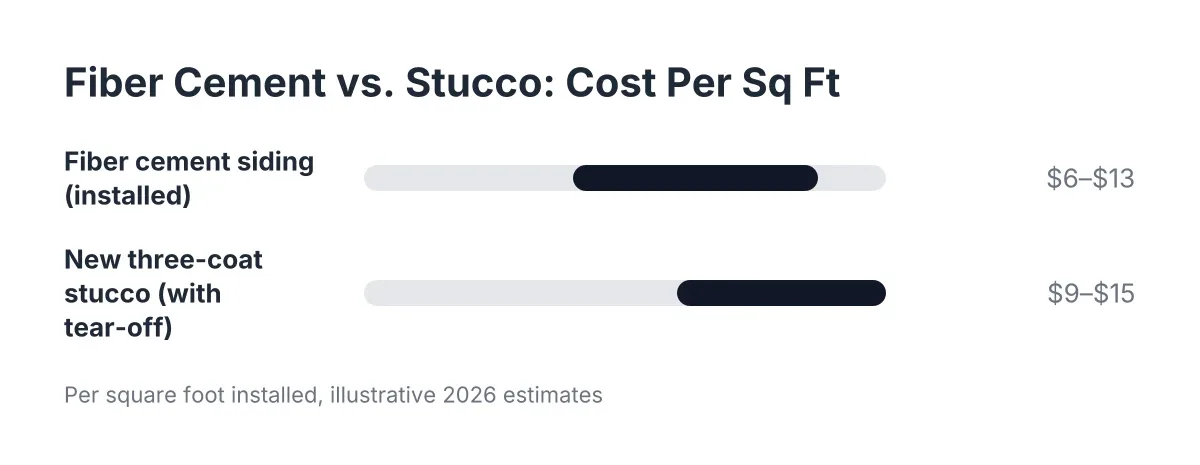
Fiber cement siding as a full-exterior replacement generally costs less installed than tearing off stucco and applying new three-coat stucco, and more than a targeted stucco repair. As a rough illustrative range in 2026, fiber cement siding cost per square foot installed often lands somewhere around $6 to $13, while new traditional stucco frequently runs $9 to $15 or more per square foot once tear-off is included. Those are estimates to frame the comparison, not quotes; your walls, trim, and access will move the numbers.
The more useful way to think about it is in three tiers, from cheapest to most expensive:
- Stucco repair. A stucco patch, crack repair, or one damaged wall section repaired and texture matched. Usually hundreds to a few thousand dollars depending on size and water damage. This is the right answer far more often than replacement.
- Fiber cement replacement. Tear off the failing stucco, fix any sheathing or moisture problems underneath, install new weather barrier and fiber cement. Mid five figures for a full exterior on a typical Castle Rock home is a realistic ballpark.
- Full stucco replacement. Tear-off plus new lath and three-coat stucco. The most expensive path, and the slowest, but it keeps the authentic material.
Notice what drives the difference: labor and time. Stucco is a trade with wet coats, cure times, and finish texturing. Fiber cement is carpentry. Both are legitimate, but they price differently.
There is a hidden variable in every one of these tiers: what is behind the wall. If the reason you are replacing stucco is water damage, budget for sheathing repair. No honest contractor can tell you the exact condition of your sheathing until the old material comes off, so a fair quote will state an allowance or a per-sheet price for replacement rather than pretending the number is fixed.
What the Insurance Picture Means for Your Material Choice
Exterior material choice is no longer just a curb appeal decision in Colorado. Home insurance premiums here rose 65% over the last five years, with hail cited as a major driver, according to the National Association of Insurance Commissioners. The Rocky Mountain Insurance Information Association reports the average Colorado homeowner's premium rate rose 57.9% from 2018 to 2023, well above the 33.8% national average.
That does not mean fiber cement automatically lowers your premium; policies vary and we are not insurance advisors. It does mean impact resistance and fire resistance are worth asking your insurer about before you choose a material. A single storm can be enormous here; the May 8, 2017 Front Range hailstorm caused $2.3 billion in insured damage, per the National Insurance Crime Bureau. If you are replacing an exterior anyway, pick a material that stands up to the next one of those.
Durability: How the Two Materials Age in Castle Rock
On lifespan, both materials are long-haul options when installed correctly. Traditional stucco routinely lasts 50 years or more with maintenance; fiber cement typically runs 30 to 50 years, with repainting needed every 10 to 15 years. Neither is a short-term material. The difference shows up in how they fail and how they get fixed.
Stucco fails in cracks and delamination. Colorado's freeze-thaw cycles work on every hairline crack, and our dry climate plus expansive soils keep homes moving. The good news is stucco repairs locally: you fix the crack, patch the section, match the texture, and the wall is whole again. That is the entire case for repair-first, and it is why we tell most callers searching "stucco repair near me" that they do not need new siding.
Fiber cement fails at joints, caulk lines, and paint. When a board cracks from a hard impact, you replace the board. That is a simpler repair than a stucco patch in some ways, but it depends on paint matching instead of texture matching, and faded paint makes a new board stand out until the next repaint.
Synthetic stucco, or EIFS, deserves its own sentence here because a lot of homes that "have stucco problems" actually have EIFS problems. EIFS is a foam-backed system, and older barrier-style EIFS traps water against the sheathing when the seals fail. Traditional hard-coat stucco breathes and drains better. If your home has EIFS with moisture damage, the replace-versus-repair math shifts hard toward replacement, and fiber cement siding becomes a stronger candidate because it gets you off the failed system entirely. Knock on your wall: EIFS sounds hollow and feels slightly soft, hard-coat sounds solid.
A Realistic Scenario: The Rental With a Failing West Wall
Suppose a landlord owns a duplex near downtown Castle Rock. During a turnover walkthrough between tenants, she finds cracking and staining across the entire west-facing wall, with a soft spot under one window. The unit needs to be re-listed in six weeks, and she has three quotes in hand: a $1,200 stucco patch, a $9,000 wall replacement in fiber cement, and a $30,000-plus full exterior re-side.
In that scenario, the first question is not price, it is diagnosis. If the soft spot is isolated water damage from a bad window seal, a stucco water damage repair plus flashing correction and a patch might genuinely solve it, and the $1,200 quote is not a corner-cut, it is right-sized. If the whole wall sounds hollow and the sheathing is wet across a wide area, the patch is a bandage on a wall that will fail again before the next lease renewal. Then the one-wall fiber cement replacement is the honest middle answer: it fixes the systemic problem, fits a rental budget, and installs inside the vacancy window. The $30,000 full re-side is over-scoped unless the other three walls show the same failure.
That is the pattern to carry into your own quotes. The big spread between bids usually is not one contractor gouging you; it is contractors scoping different problems. Make each one tell you which problem they think you have and why.
How to Compare Quotes Without Getting Burned
If you are gathering bids right now, here is how to read them. This applies whether you are quoting a stucco patch, fiber cement siding as a section replacement, or a full exterior.
- Make every bidder name the cause, not just the fix. "We'll patch it" is not a diagnosis. Ask why the stucco failed. If nobody mentions moisture, flashing, or movement on a wall with recurring cracks, they are quoting the symptom.
- Check that scopes match before comparing prices. A $2,000 quote and an $8,000 quote for "the same wall" almost never describe the same work. One is a surface stucco patch; the other includes tear-off, sheathing, and weather barrier. Line the scopes up first.
- Ask how unknowns are handled. The honest answer to "what if the sheathing is rotten" is a stated allowance or unit price, agreed before work starts. Vague answers here are where mid-job upsells live.
- On fiber cement, ask about clearances and flashing. The most common fiber cement failures come from boards installed too close to roofs and grade, or skipped kick-out flashing. Ask the installer how they handle both; a real answer takes thirty seconds.
- On stucco repair, ask about texture matching. Anyone can fill a crack. Matching your home's existing texture and color so the repair disappears is the skill. Ask to see how they approach it.
- Be cautious with the outlier low bid. Cheap stucco repair near me is a common search for a reason, and price matters, especially on a rental. But a bid far below the others usually means a thinner scope, not a better deal.
A specialist will also tell you when the job is not theirs. A stucco crew that says "this wall is past patching, get siding quotes too" is worth keeping in your phone, because they just proved they scope to the problem instead of the sale.
Where a Repair-First Shop Actually Lands on This
Our honest position, after looking at a lot of Castle Rock stucco: most homes searching for replacement need repair, and a minority of homes getting patched need replacement. Both mistakes cost real money. Under-scoping means paying for a stucco patch every spring on a wall with a moisture problem underneath. Over-scoping means spending five figures on new siding when a $900 crack repair and some flashing work would have held for a decade.
Fiber cement earns its place in that middle ground. When exterior stucco repair genuinely will not hold, when EIFS is failing system-wide, or when a landlord needs a durable wall on a schedule and a budget, fiber cement is often the practical answer over new three-coat stucco. When the damage is one crack, one section, or one bad window flashing detail, repair wins, and it is not close.
The one thing you cannot do from the sidewalk is diagnose the wall. Soft spots, hollow sections, and hidden water damage need hands on the stucco, and sometimes a moisture reading, before anyone should hand you a number. Get someone local who works with the material every day to look at it first. The material decision gets a lot easier once you actually know what is wrong.
If you need stucco repair, Castle Rock Stucco Pros can help.
Related guide: stucco siding replacement — Complete Guide
Prefer to talk it through? Call (720) 797-8506 — a quick call is usually the fastest way to get a straight answer for your situation.