Why Local Stucco Contractors Beat National Franchises on Siding Replacement
If you are weighing a bigger stucco job in Castle Rock, here is the short version: local stucco contractors beat national franchise operations on the two things that decide whether a replacement looks right, matching the texture and showing up when problems appear. That matters most when you have already lived with a bad patch, or when a newer home is cracking earlier than it should and the builder has stopped returning calls.
This guide walks through when patching stops making sense, what full or partial stucco siding replacement actually involves, what drives the cost, and why the person holding the trowel matters more than the name on the truck.
Patch or Replace: Start With an Honest Scope
The first decision is not who to hire. It is how big the job really is. A repair-first shop has no reason to oversell you a full replacement, and no reason to keep patching a wall that is past saving. Both mistakes cost you money, just on different timelines.
Patching makes sense when the damage is contained. A hairline crack from normal settling, a hole from a removed fixture, or a damaged corner can usually be cut out and repaired. The underlying cause still needs attention; a corner that cracked because of poor drainage will crack again if the drainage stays bad.
Replacement of a wall section, or the full exterior, makes sense when the problems are systemic. Watch for these signs:
- Cracks spreading across multiple walls, not just one spot
- Stucco that sounds hollow when you tap it, which points to delamination
- Soft or stained areas near windows and rooflines, a sign of water damage behind the surface
- A patchwork of old repairs in different textures and shades that no longer blends
- Newer construction where large areas cracked within the first few years, often from improper curing or a rushed original application
That last one comes up more than people expect in Castle Rock. Say a homeowner in Stonegate or Meridian bought a home four years ago, started seeing map cracking on the south wall at year two, and got nowhere with the builder after the warranty window closed. In that scenario, patching crack by crack is throwing money at a wall that was never installed right. Replacing the affected sections, with proper lath, paper, and curing, is the repair that actually ends the cycle.
One honest limitation: if your home is still under an active, responsive builder warranty, pursue that first. An independent repair shop can fix the stucco, but it cannot fight the warranty claim for you, and you should not pay out of pocket for work the builder owes you.
What Stucco Siding Replacement Actually Includes
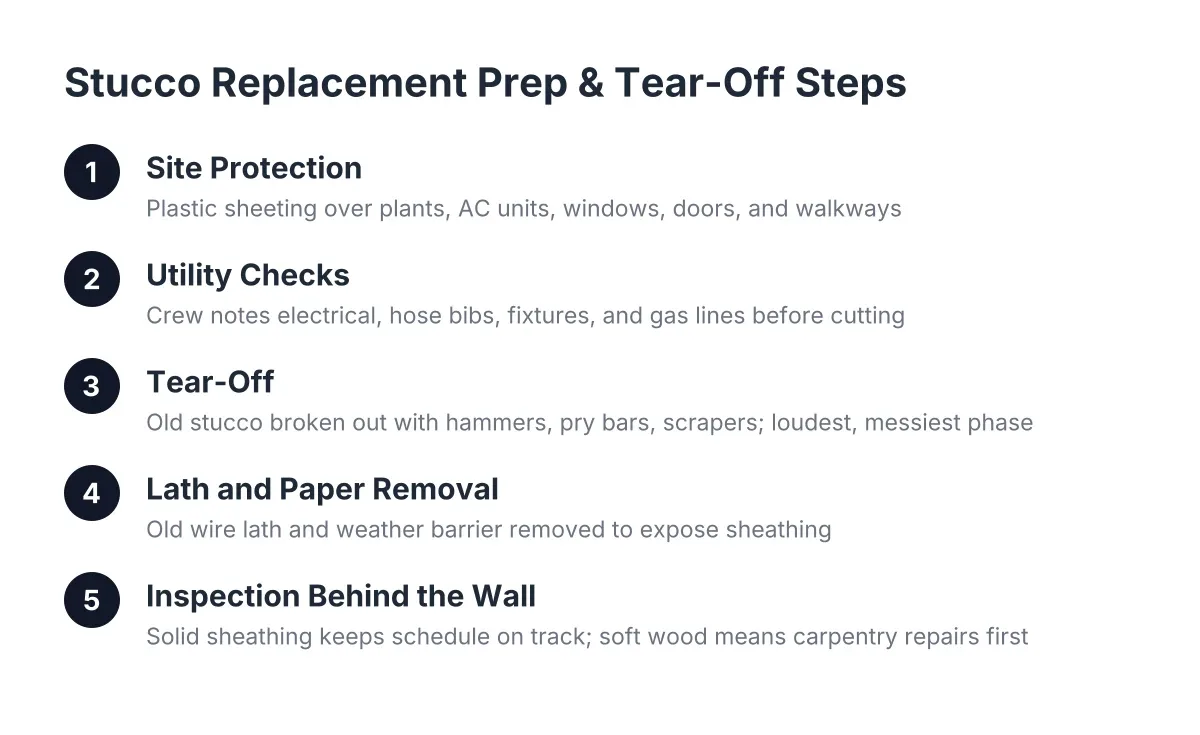
A proper replacement job, whether it is one wall or the whole exterior, covers more than new stucco over old problems. Here is the scope a good crew delivers:
- Inspection and moisture check. Tapping for hollow spots, checking around penetrations, and finding where water got in, not just where the surface failed.
- Tear-off. Removing the failed stucco down to the sheathing in the affected area. On a partial replacement, the technically correct approach is to take a wall section from break point to break point, often corner to corner, rather than cutting a small square in the middle of a field.
- Repairing what is underneath. Replacing rotted sheathing, fixing flashing, and addressing the cause of the failure. This is often the line item that separates a fair quote from a lowball one.
- New weather barrier and lath. The paper and wire behind the stucco do the waterproofing work. The edges where new lath ties into old stucco are where leaks start if the crew rushes.
- Base and finish coats. Traditional three-coat work uses a scratch coat, a brown coat, and a finish coat. For repair-scale work, polymer-modified rapid-setting products can sometimes replace the three-coat system in a single application, which shortens the job.
- Texture and color matching. On a partial replacement, the new section has to match the rest of the house, including how the sun and weather have aged the original finish.
What is usually extra: painting the full exterior to unify color, replacing trim or fascia found rotted during tear-off, and structural repairs beyond the sheathing. Ask any bidder to spell out where their scope stops.
Synthetic vs. Traditional Stucco: Know What You Have
Before anyone quotes a replacement, confirm which system is on your house. Traditional hard-coat stucco is a cement-based product applied over lath in multiple coats. Synthetic stucco, often called EIFS, is a foam-and-acrylic system that looks similar but behaves differently, especially around moisture.
The distinction matters for two reasons. First, repairs and replacements use different materials and methods; patching EIFS with cement stucco is a mismatch that will fail. Second, EIFS that traps water behind it can hide damage that only shows up at tear-off. If you are unsure which you have, press gently on the surface; EIFS gives slightly and sounds hollow, while hard-coat feels like concrete. A pro can confirm in minutes.
Where Local Stucco Contractors Beat the Franchises
Local stucco contractors beat national franchise operations where it counts: the match, the crew, and the follow-up. A franchise runs your call through a call center, dispatches whichever crew is available, and works from a standardized playbook. That model works fine for some trades. It works poorly for stucco, and here is why.
Texture Matching Is a Local Skill
Stucco texture is applied by hand, and every finisher has a technique. When a patched spot does not match the wall around it, the usual reason is simple: a different, less skilled worker did the repair without copying the original technique or finish type. Castle Rock neighborhoods tend to share a handful of common finishes, and a crew that works these streets week after week has applied them hundreds of times. A rotating franchise crew has not.
Matching also means matching weathering. Suppose you had a patch done two years ago, and the color is close but the sheen and texture give it away every time you pull into the driveway. Fixing that does not always mean tearing the patch out. If the base is sound, a skilled finisher can often knock down and scrape the high spots, then refinish the surface to blend with the surrounding wall. That judgment call, blend versus redo, is exactly what you want made by someone who will drive past your house again.
Accountability You Can Reach by Phone
When a franchise job has a problem six months later, you call the call center, explain the issue to someone who has never seen your house, and wait for a crew that may not include anyone from the original job. When a local shop's work has a problem, you call the person who did it. For stucco, where hairline cracks can appear as new material cures, that follow-up is part of the job, not an inconvenience.
Local Conditions Are Not in the Franchise Playbook
Castle Rock stucco deals with intense sun, freeze-thaw cycles, dry air that affects curing, and hail. Colorado's hail problem is well documented; the state recorded 182,591 hail insurance claims from 2013 to 2015, second only to Texas, according to the Rocky Mountain Insurance Information Association. Hail that dents gutters also chips and cracks stucco finish coats, and a local crew knows what hail damage looks like versus a curing failure. That distinction can matter if an insurance claim is on the table, and with Colorado home insurance premiums up 65% over the last five years according to the National Association of Insurance Commissioners, homeowners want that call made correctly.
Curing is the other local factor. Fresh stucco needs moisture to cure properly, and Colorado's dry climate pulls water out of a new coat fast. Crews that work here plan around it, misting coats and timing work to the weather. A playbook written for a national average does not.
What Replacement Costs and How Long It Takes
Nobody can give you a real number without seeing the wall, and this guide will not invent one. What this guide can do is explain what moves the price, so you can read quotes intelligently. As of 2026, the main cost drivers for stucco siding replacement are:
- Square footage replaced. A single wall section is a different job than a full exterior.
- What tear-off reveals. Rotted sheathing, failed flashing, or water damage behind the stucco adds material and labor. Good quotes flag this as a contingency rather than pretending it will not happen.
- System type. EIFS removal and replacement involves different materials and more careful moisture investigation than hard-coat.
- Access and height. Two-story walls, steep grades, and tight lot lines slow the work.
- Finish complexity. Matching an unusual texture or a multi-tone finish takes more finisher time.
Timeline follows the same logic. A partial wall replacement is typically measured in days; a full exterior is measured in weeks, because base coats need cure time between stages before the finish coat goes on. Any bidder promising a full exterior in a weekend is skipping cure time, and skipped cure time shows up later as cracking.
For budget context, the illustrative range many Castle Rock homeowners see for meaningful partial replacement work, as an estimate only, runs from the low thousands up toward the high single-digit thousands depending on the factors above. Treat any quote far below the pack with suspicion; the money usually comes out of the tear-off and weatherproofing steps you cannot see.
What You Can Do Yourself, and When to Call
Homeowners can handle a narrow slice of stucco work safely. Sealing a hairline crack is within reach; for wider cracks, a closed-cell foam cord called backer rod goes into the crack first to create a backing for the sealant, according to Sika. Materials for a small patch, including patch compound, latex additive, and corner mesh, are stocked at general hardware stores.
However, the line arrives fast. Applying scratch and brown coats is harder than it looks and is generally a job to hire out. Texture matching on a visible wall is finisher work, full stop; a DIY patch on the front of the house is how most bad patches got there. In addition, anything involving water damage, hollow-sounding stucco, or lath repair needs a pro, because the fix is behind the surface.
Call now, rather than watching and waiting, if you see:
- Staining or soft spots spreading near windows, doors, or rooflines
- Stucco pulling away from the wall or sounding hollow across a wide area
- Cracks wider than a credit card edge, or cracks that keep growing
- Interior moisture signs on walls that back up to stucco exteriors
One more DIY warning. If you ever cut into stucco yourself to size an opening, resist the urge to make a clean grinder cut. The torn, exposed wire lath at a rough edge is what a repair crew needs to tie the new patch in and weatherproof it properly. A clean cut forces the crew to open up more wall, which adds cost.
How to Pick the Crew, and What a Fair Quote Looks Like
You do not need ten bids. You need two or three questions that separate stucco specialists from generalists who treat stucco as a sideline.
- Ask how they will match your texture and color. A real answer names your finish type, explains whether they will blend or replace, and may include a sample patch in a low-visibility spot before committing to the visible wall. "It'll blend right in" with no method behind it is the answer that burned you last time.
- Ask what happens at tear-off if they find damage underneath. A fair quote states a base scope and explains how hidden damage gets priced, in writing, before work starts. Vague quotes turn into vague invoices.
- Ask who will actually be on your wall. Where local stucco contractors beat the big operations is continuity; the person who scopes the job should be connected to the crew that does it. If your contact cannot tell you who is finishing the wall, the texture match is a coin flip.
A fair quote itemizes tear-off, substrate repair, weather barrier and lath, coats, and finish work. It names the stucco system and products. It gives a realistic timeline that includes cure time. Additionally, it does not promise a perfect invisible match on a weathered wall; on older finishes, an honest contractor will tell you how close is achievable and where the blend lines will fall.
Getting It Fixed Right the First Time
If you have been staring at a patch that does not match, or at cracks a builder walked away from, the path forward is a straightforward one. Confirm whether the problem is contained or systemic. Scope the job honestly, replacement where the system failed, repair where it did not. Then hire someone local who knows the common Castle Rock textures, will put the match method in writing, and answers the phone after the job.
A local Castle Rock stucco repair crew can look at your wall, tell you plainly whether patching still makes sense or replacement is the smarter spend, and show you how the new section will blend before committing to the visible wall. Reach out for an on-site estimate, and bring your questions about texture matching; a good crew will welcome them.
If you need stucco repair, Castle Rock Stucco Pros can help.
Prefer to talk it through? Call (720) 797-8506 — a quick call is usually the fastest way to get a straight answer for your situation.