Stucco Siding Replacement Warranty: What’s Actually Covered in Castle Rock, CO
If you're getting bids to replace a section of stucco, or your whole exterior, the warranty paperwork matters as much as the price. A stucco siding replacement warranty tells you who pays if the new stucco cracks, pulls away from the wall, or lets water in two winters from now. Most homeowners in Castle Rock, CO skim that page, sign, and find out later that the stucco warranty coverage was thinner than they thought. This guide walks through what these warranties actually cover, what they exclude, and how to read one before you sign anything.
We're a repair-first shop, so here's our honest frame for the whole article: a warranty only matters on work that was worth doing in the first place. Part of reading a warranty well is knowing whether you needed full replacement at all, or whether a patch would have done the job. We'll cover both.
Understanding Your Stucco Warranty Coverage
Every stucco siding replacement comes with two separate promises, and homeowners mix them up all the time.
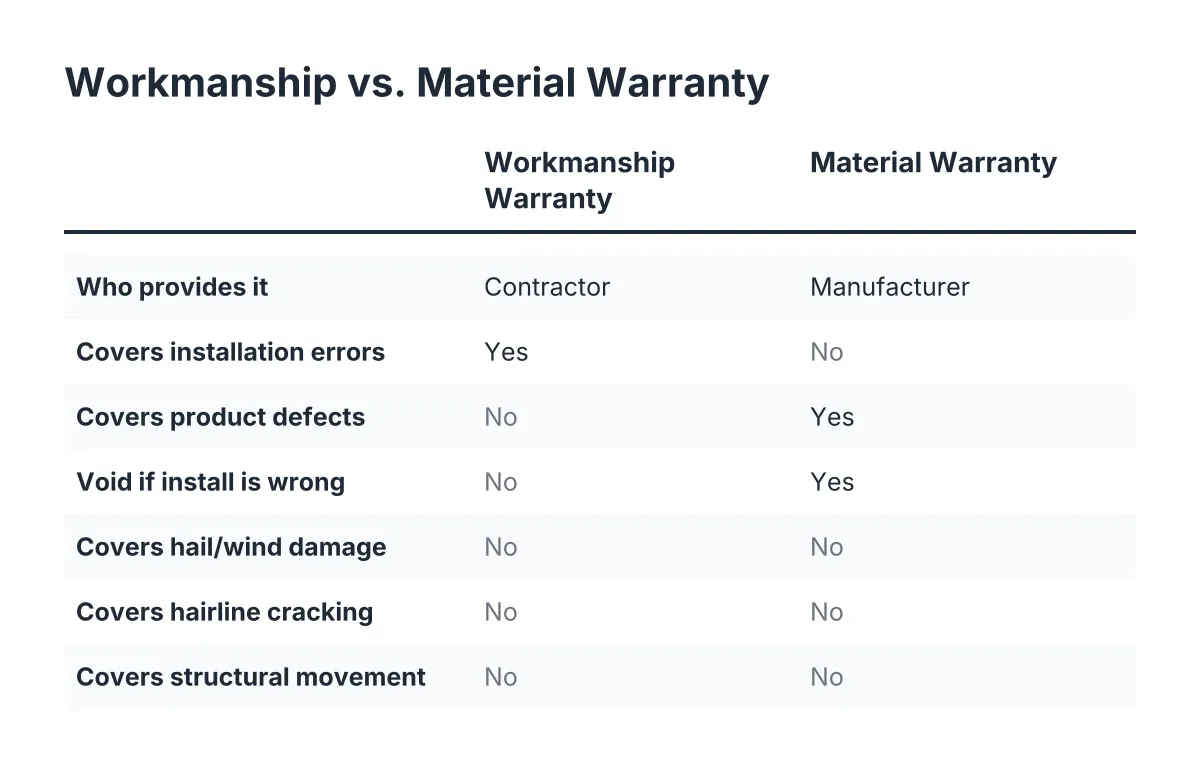
First, there's the workmanship warranty. This comes from the contractor. It covers how the stucco was installed: whether the moisture barrier was lapped correctly, whether the lath was fastened right, whether the coats were applied and cured properly. If the stucco delaminates or cracks because the crew rushed the job, the workmanship warranty is what gets them back to your house.
Second, there's the material warranty. This comes from the manufacturer of the stucco system, the acrylic finish, or the synthetic components. It covers defects in the product itself: a finish coat that fades or chalks far faster than it should, or a synthetic system that fails under normal conditions.
Here's the catch that trips people up. The material warranty is usually void if the installation didn't follow the manufacturer's instructions. So a bad installer can kill both warranties at once. The crew's work is the foundation everything else sits on, which is why who installs the stucco matters more than which brand name is on the bucket.
What a Stucco Siding Replacement Warranty Typically Covers
A standard stucco siding replacement warranty from a contractor covers failures caused by the installation itself, for a defined period after the job is done. In plain terms, it covers things the crew did wrong, not things Colorado weather does to your house afterward. Terms vary, but the coverage usually breaks down like this:
- Cracking beyond normal hairlines. New stucco will develop some hairline cracking as it cures. That's normal and most warranties say so. Wider cracks, cracks that telegraph through the full assembly, or cracking in a pattern that points to bad lath attachment should be covered.
- Delamination. If a coat separates from the one below it, or the whole assembly pulls away from the lath, that's an installation failure.
- Water intrusion at the installed work. If water gets behind the new stucco because flashing or the moisture barrier was done wrong, the workmanship warranty should respond.
- Finish coat defects. Blistering, peeling, or texture that fails to hold, when caused by application rather than impact or weather.
What you'll notice is that all of these are failures of the work, not the house. That distinction drives almost every dispute over warranty claims.
The Wall Assembly: Why Stucco Warranty Coverage Depends on Layers You Can't See
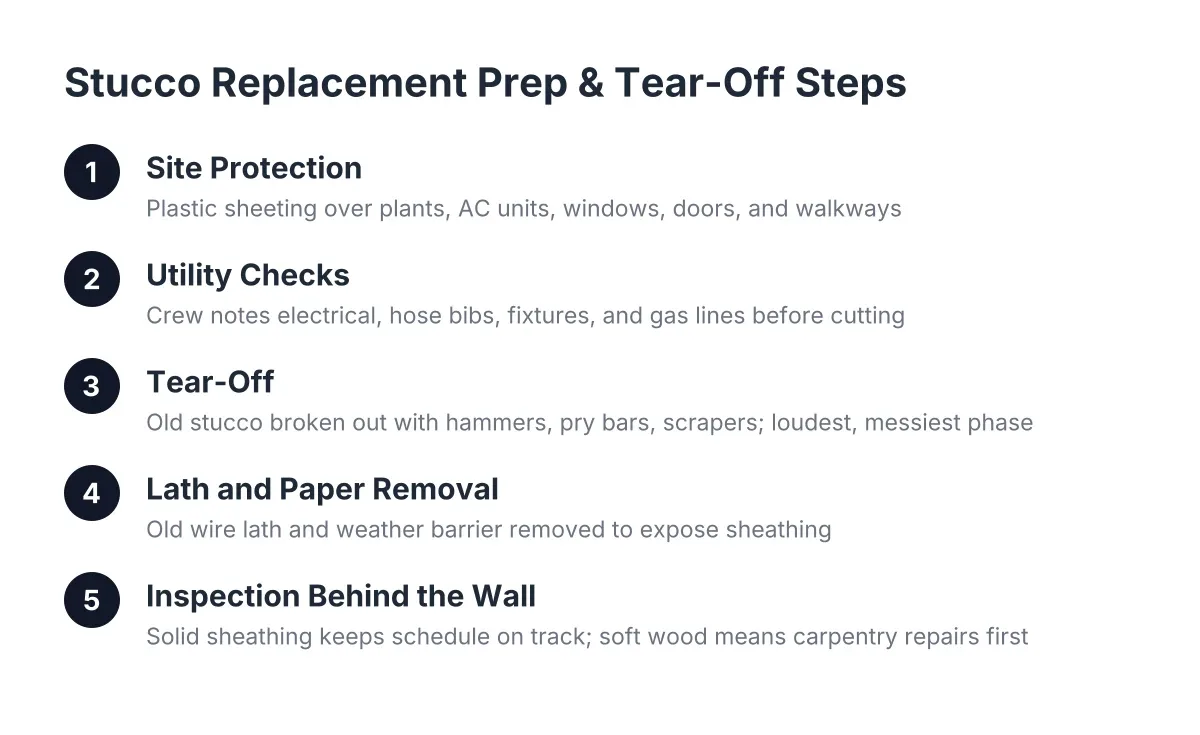
A stucco wall is built in layers. Tar paper or another moisture barrier goes against the sheathing, then metal lath or chicken wire fastened over it, with expansion channel trimming the edges. Traditional stucco then goes on in three coats: a scratch coat that's scored so the next layer bonds, a brown coat, and a finish coat that carries the color and texture.
Most warranty failures start in the layers you never see. A moisture barrier lapped backward sends water into the wall instead of down and out. Lath fastened into nothing but sheathing works loose and the stucco cracks above it. When you read a warranty, you're really asking: if one of those hidden layers was done wrong, will this company come back and open the wall up?
Therefore, ask the contractor to describe the assembly they're installing before you compare warranties. A company that can walk you through barrier, lath, and coats in plain language is a company that knows what its warranty is actually promising.
What These Warranties Exclude, and Why
Exclusions are where warranties earn their reputation for fine print. Most of them are reasonable once you understand the material. Stucco is porous; it absorbs moisture rather than shedding it the way vinyl does, and it moves with the house. No honest contractor warranties against physics.
Common exclusions you'll see on a stucco siding replacement warranty in Colorado:
- Hail and wind damage. Storm impact is an insurance matter, not a warranty matter. More on that below, because in Castle Rock this is the exclusion that matters most.
- Hairline cracking. Minor surface cracks from normal curing and seasonal movement are expected and excluded.
- Structural movement. If the foundation settles or framing shifts and the stucco cracks over it, the warranty doesn't apply. The stucco did its job; the structure moved underneath it.
- Color fade and weathering. Finish coats weather. Most warranties exclude gradual fade, especially on south and west walls that take full Colorado sun.
- Damage from other trades or homeowners. The sprinkler guy who drills through a wall, the ladder that gouges a corner, the pressure washer held too close.
- Unaddressed moisture sources. If a gutter dumps water onto a wall and the homeowner never fixes it, water damage at that spot is typically excluded.
None of these exclusions are tricks. The trick, when there is one, is a warranty so short or so narrow that the exclusions swallow the coverage. A one-year workmanship warranty on full stucco replacement tells you something; serious installation defects often take two or three freeze-thaw cycles to show themselves.
Hail, Insurance, and Where the Warranty Stops in Castle Rock, CO
This deserves its own section because it's the number one point of confusion for homeowners along the Front Range. If hail chips and cracks your new stucco, your warranty does not cover it. Your homeowner's insurance does, subject to your deductible.
The scale of hail risk here is not hypothetical. Colorado's May 8, 2017 Front Range hailstorm caused $2.3 billion in insured damage, based on roughly 167,000 auto and 100,600 homeowners claims, according to the National Insurance Crime Bureau. Hail is also a major reason Colorado home insurance premiums rose 65% over the last five years, according to the National Association of Insurance Commissioners.
For example, say a homeowner in Castle Rock had full stucco replacement done in spring, then a June storm leaves impact marks and spider cracking across the west wall. In that scenario, the path is an insurance claim, not a warranty claim. The contractor can still help: a written estimate and photos documenting the damage are what the adjuster needs, and a crew that knows stucco can tell impact damage from curing cracks, which matters when the adjuster asks.
One caution for the insurance route. Between 2018 and 2020, hail claims across the U.S. rose 2% while questionable claim submissions rose 34%, according to Rocky Mountain Insurance Information Association data. Adjusters know this, so clean documentation from a local contractor who will stand behind the estimate carries weight. Avoid anyone who promises to "get the whole wall covered" before they've looked at it.
Traditional Stucco vs. EIFS: How Material Choice Changes Warranty Terms
The material you choose changes what the warranty has to protect against. Traditional three-coat stucco is cement-based, hard, and breathable. Synthetic stucco, usually EIFS (exterior insulation and finish system), layers an acrylic finish over foam insulation board. Both can work in Colorado, but they fail differently, and stucco warranty coverage reflects that.
With traditional stucco, the warranty risks are cracking and delamination. The material is rigid, so movement shows up as cracks. A good warranty on traditional stucco speaks clearly about what crack width and pattern it covers.
With EIFS, the dominant warranty risk is moisture. If water gets behind the foam and can't drain, it stays there and rots the sheathing quietly. Modern drainable EIFS systems address this, but the warranty language around water intrusion, drainage, and inspection requirements is where EIFS warranties live or die. Some EIFS manufacturers also require trained installers for the material warranty to apply at all, which again ties material coverage back to who does the work.
Lifespan factors into this too. Well-installed traditional stucco can last decades in our climate with periodic sealing and crack maintenance. That's far longer than any workmanship warranty, which is the honest point: the warranty protects the first few years, and installation quality protects the rest.
When You Don't Need the Replacement Warranty at All
Here's the repair-first part, and it may save you more money than any warranty clause. A warranty on full replacement is worthless if you didn't need full replacement. Plenty of Castle Rock homes get quoted a tear-off when stucco crack repair or stucco patching would have solved the actual problem.
Patching makes sense when:
- Cracks are isolated, and the stucco around them is sound and tight to the lath.
- The damage is localized impact: a hail strike zone, a hole from a removed fixture, a corner clipped by a lawn mower or trailer.
- The moisture barrier behind the damaged area is intact, or the opening is small enough to repair the barrier properly.
- There's no soft, bulging, or hollow-sounding stucco spreading beyond the visible damage.
Modern polymer-modified patch products can do in one application what the old three-coat process required, so a repair done right is not a second-class fix. Structural cracks, the wider and deeper ones, get backer rod and sealant rather than paint; backer rod is a closed-cell foam cord that gives the sealant a proper backing inside the crack, according to Sika. Then texture matching brings the patch back to the look of the wall around it.
Replacement starts making sense when the damage is systemic: water staining across multiple walls, stucco that sounds hollow over large areas, lath rusting through, or a moisture barrier that has failed broadly. At that point patching is just chasing symptoms, and a full section or full exterior replacement, with its warranty, is the honest call.
One more repair-side detail that affects future warranty work. When stucco gets cut open, a torn edge that leaves the lath exposed gives the next crew something to tie the new moisture barrier into. A clean grinder cut forces them to open up more wall, which adds cost. Small things like this are why stucco-focused crews and general handymen produce different results on the same wall.
How to Read a Stucco Replacement Warranty Before You Sign
Reading a stucco replacement warranty takes about fifteen minutes and comes down to six questions. Get the answers in writing, in the contract, before work starts. Verbal assurances about coverage are worth exactly what they cost.
- How long is the workmanship coverage, and when does it start? Longer terms on full replacement suggest the contractor expects the work to hold through several freeze-thaw cycles.
- What counts as a defect? Look for specifics: crack width, delamination, water intrusion at the installed work. Vague language like "defects in workmanship" with no definitions favors whoever wrote it.
- What's the remedy? Repair of the defective area, full redo of the wall section, or a refund? Does the remedy include matching the texture and color so the fix doesn't look like a scab?
- Is it transferable? If you might sell within the warranty period, a transferable warranty has real value to the next buyer.
- What maintenance does it require of you? Some warranties require you to seal cracks promptly or keep sprinklers off the walls. Fair terms, but you need to know them.
- Who actually answers the phone? A warranty from a national operation that routes calls through a call center and rotates crews is a different thing from a warranty held by a local company you can reach directly. The paper might read the same; the follow-through won't.
In addition, keep your own file: the signed contract, the warranty page, photos of the finished work, and dated photos of any later damage. If you ever file either a warranty claim or an insurance claim, that file does half the work.
Warranty Terms Worth Comparing on a Castle Rock Bid
When two bids land in your inbox for a stucco house renovation in Castle Rock, don't compare price alone. Compare what happens after the trucks leave. Suppose one bid is $2,000 cheaper but carries a one-year workmanship warranty with no written defect definitions, and the other costs more but spells out coverage, remedy, and transferability over a multi-year term. The cheaper bid may be the more expensive one over five Colorado winters.
The same logic applies across the south metro area. Whether you're comparing stucco installation in Lone Tree, CO or replacement bids in Castle Rock, the warranty questions don't change: who holds it, what it defines as a defect, and whether the company will still be reachable when you need them.
There are limits to what any article can tell you about your specific wall. If you're seeing bulging stucco, widespread staining, or cracks spreading from window corners, have someone who knows the material put eyes and hands on it before you decide between a patch and a tear-off. A ten-minute look at the wall settles questions that no warranty document can.
The bottom line is simple. A stucco siding replacement warranty is only as good as the installation behind it and the company standing behind the paper. Get the scope right first, repair what can be repaired, replace what can't, and then make sure the warranty you sign actually says what the salesperson said it says.
If you need stucco repair, Castle Rock Stucco Pros can help.
Prefer to talk it through? Call (720) 797-8506 — a quick call is usually the fastest way to get a straight answer for your situation.