Emergency Water Damage Response for Stucco: 7 Steps Castle Rock Owners Should Take Fast
When water gets behind stucco, the damage keeps growing until someone stops it. A fast, organized emergency stucco water response is the difference between a patch job and tearing open a whole wall section. This guide walks Castle Rock homeowners and small landlords through seven steps to take when you spot stains, soft spots, or bubbling stucco after a storm, from the first hour to the finished texture match. It is straight talk on what is cosmetic and what means opening the wall, from the perspective of a crew that inspects before quoting instead of selling a scope sight unseen.
Colorado weather makes this urgent. The May 8, 2017 Front Range hailstorm caused $2.3 billion in insured damage and remains the state's costliest catastrophe, according to the National Insurance Crime Bureau. Hail cracks stucco, wind drives rain into those cracks, and the clock starts.
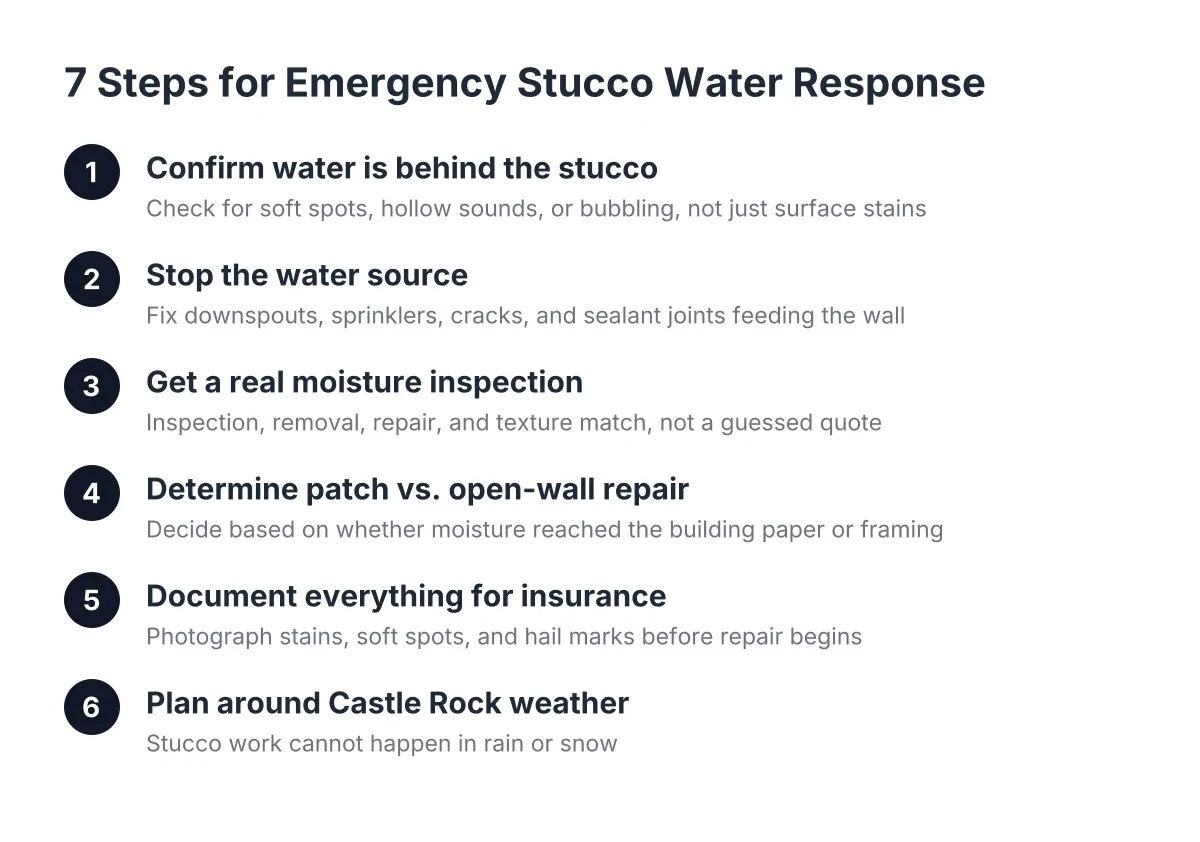
1. Confirm You Actually Have Water Behind the Stucco, Not Just a Surface Stain
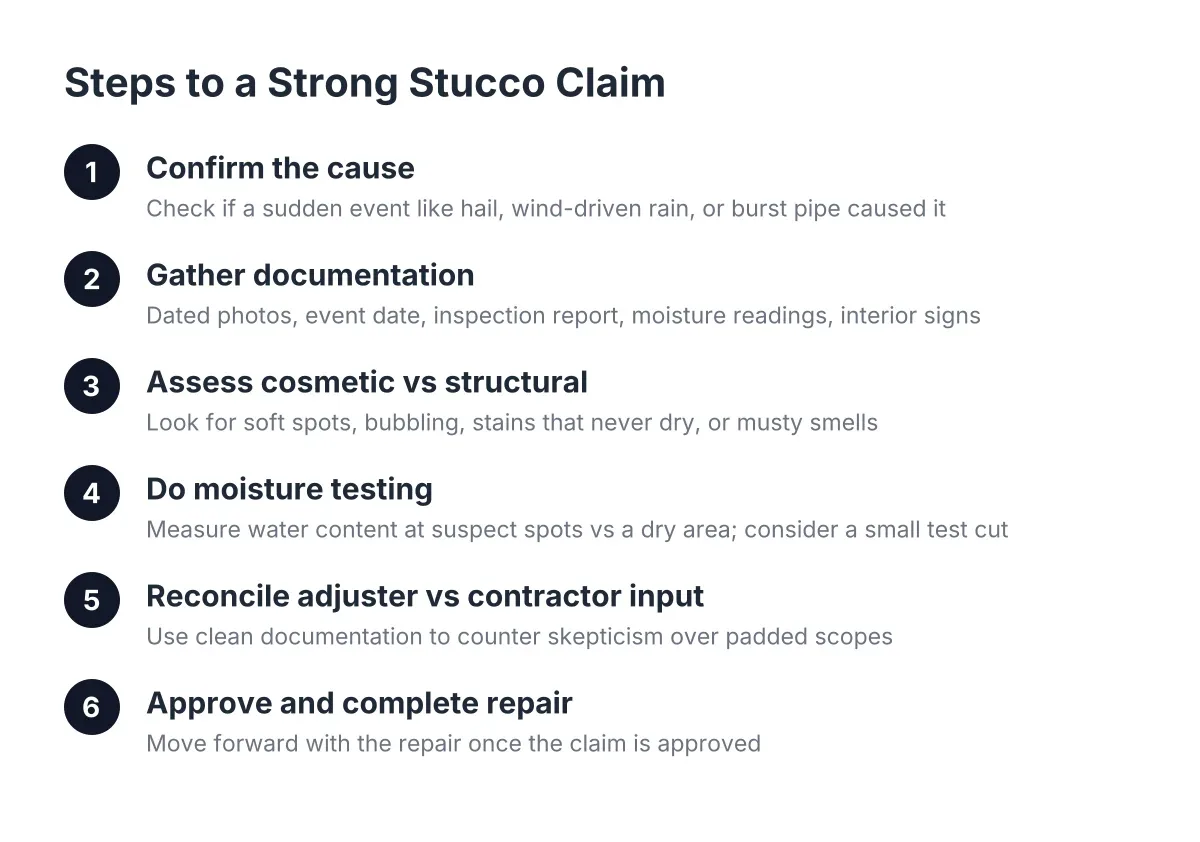
Start by separating cosmetic marks from real water intrusion. A surface stain that dries out after a day of sun and does not return is usually cosmetic. A stain that stays dark, grows after each storm, or sits below a window corner or roofline is a sign water is getting behind the wall.
Press on the stucco around the stain with your palm. Solid stucco feels like concrete. A soft spot in a stucco wall, anything that gives, flexes, or sounds hollow when you knock, means the layers behind the surface have taken on moisture. Bubbling or bulging stucco is the same story; water is pushing the finish coat away from the wall.
For a rental owner doing a turnover walkthrough, this check takes five minutes per wall and can save you from re-listing a unit with an active leak behind it.
2. Stop the Water Source Before Anyone Touches the Stucco
No repair holds if water keeps feeding the wall. Before scheduling stucco repair, find and cut off the source. The usual suspects in Castle Rock homes are:
- Cracks at window corners and door frames where storm water drives in
- Failed caulk or sealant joints around penetrations like hose bibs and light fixtures
- Gutters and downspouts dumping water against the wall or foundation
- Grading that lets rain pool next to the house
- Sprinkler heads spraying the wall daily
Downspouts and sprinklers you can fix yourself the same day. Cracks and sealant joints need a proper repair, but you can slow the bleeding with a temporary measure like redirecting a downspout or shutting off a sprinkler zone. Pooling water near the foundation deserves attention too; repeated heavy rain gathering at the base of a wall can cause slight settling that cracks stucco corners and finishes.
3. Know What Emergency Stucco Water Response Actually Includes
A real emergency stucco water response covers four things: a moisture inspection, removal of loose and saturated material, repair of the damaged layers, and a finish coat matched to your existing texture. If a contractor quotes you a price without looking behind the surface, they are guessing, and you will pay for the guess one way or another.
Here is what the inspection stage should look like. The crew checks moisture at the stain and in a grid around it, because water travels sideways and down behind stucco. They probe soft spots to see whether the damage stops at the stucco layers or reaches the building paper, lath, and sheathing underneath. Stucco moisture testing is what separates a $900 patch from a $4,000 wall opening, and you want to know which one you have before work starts, not after.
What is usually extra: interior drywall repair, mold remediation if growth is found inside the wall, and repainting beyond the repaired section. Ask up front so the scope is clear.
4. Understand the Line Between a Patch and Opening the Wall
The decision comes down to what the moisture reached. If the water damage stops at the stucco layers themselves, the fix is stucco patching: cut out the damaged section, repair the surface, and blend the texture. If moisture soaked through to the building paper or framing, the wall has to come open so the rot can be cut out and the paper and lath replaced.
One rule a good crew never skips: all loose or buckling stucco comes off first. Leaving it in place lets every rain keep expanding the wet wood behind it, and the damage you patched over comes back worse. This is also why delay is expensive. A structural crack left alone for years lets the building paper behind it turn brittle; once wall flexing tears that paper, water gets a direct path to the framing, and stucco rot behind the wall becomes the real project.
Suppose a landlord in Castle Rock finds a soft patch under a second-story window during a tenant turnover. If the moisture reading stops at the stucco, that could be a one-day patch in the low hundreds to around a thousand dollars as a rough illustrative range. If the probe finds wet sheathing, the illustrative range jumps to several thousand because the crew is now replacing paper, lath, and possibly framing. Same stain on the surface, different job entirely. That is why inspection comes before the quote.
5. Document Everything Before and During the Repair for Your Insurance Claim
Storm-driven stucco water damage is often claimable, so build your file before anyone removes material. Photograph the stains, soft spots, and any hail impact marks from several angles, with a wide shot showing where on the house they sit. Note the storm date. Colorado sees heavy hail activity; Colorado Springs, Denver, and Greeley rank among the top 10 U.S. cities for hail loss claims between 2018 and 2020, according to the Rocky Mountain Insurance Information Association, so adjusters in this region see these claims constantly.
Keep documenting as the wall comes open. Photos of wet building paper, rotted sheathing, or saturated lath are what prove hidden damage to an adjuster who only saw a stain. Clean documentation also protects you from scrutiny; RMIIA data shows questionable hail claim submissions rose 34% between 2018 and 2020 while actual claims rose only 2%, so adjusters look hard at claims without evidence. A crew that photographs its tear-out as standard practice makes your claim easier.
6. Plan Around Castle Rock Weather, Because Stucco Work Cannot Happen in Rain or Snow
Stucco patch and paint work stops when precipitation starts. A full day of rain or snow means a full work stoppage, and fresh base coats and finish coats need dry conditions to cure right. In practice, that means the window between a late-summer hailstorm and the first hard snow is when this work needs to get scheduled.
Therefore, if you find water damage in September or October, call early. Crews along the Front Range book up after every major storm, and waiting until the stain spreads means competing for the same calendar slots with worse damage. For a landlord with a vacancy window, a weather delay can push a two-day repair into a two-week gap, so build slack into your re-listing date.
A local crew helps here in a practical way: they can slot you in around weather breaks instead of routing you through a call center queue three states away.
7. Insist on Texture Matching, or the Repair Will Announce Itself Forever
A structurally sound patch that does not match the wall still looks like damage. Texture matching is the last step of exterior stucco repair and the one most often rushed. On a knockdown dash finish, for example, the crew sprays finish coat onto the patched area and then lightly trowels it down so it blends into the surrounding wall. Done right, you have to hunt for the repair. Done wrong, every visitor sees it from the driveway.
For a rental owner, perfect blending may matter less than speed and price, and that is a fair trade-off to make on purpose. Say so up front and the crew can quote a straightforward patch. For a homeowner planning to stay or sell, ask the contractor how they match texture and finish, and whether paint over the patch is included or separate.
How Fast Should Emergency Stucco Water Response Begin?
Start your response the day you find the problem; the professional repair can follow within days or weeks depending on severity. The urgent part is stopping the water source and getting an inspection scheduled, not getting stucco mixed that afternoon. Water behind stucco does damage over weeks and months, so a wall that gets dry stays stable while you line up the work.
However, three signs mean call a pro now rather than watching and waiting:
- A soft spot that is spreading or a bulge that is growing
- Water staining appearing on interior drywall below an exterior stucco stain
- A musty smell inside the room behind the damaged wall
Those point to active moisture reaching the framing or the interior, and every storm makes it worse. One honest limitation: if you find significant mold inside the wall cavity, or the rot has reached structural framing, stucco repair alone is not the full answer; that situation calls for remediation and possibly an engineer before the wall gets closed back up.
Choosing a Crew for Stucco Water Damage Repair in Castle Rock
Three questions sort serious contractors from the rest. First, ask whether they inspect and test for moisture before quoting; a fixed price given over the phone for water damage is a red flag. Second, ask how they match your home's existing texture and whether they show you a test patch. Third, ask what their quote includes and excludes, especially interior repairs and paint.
A fair quote names the scope in plain terms: what gets removed, what gets replaced behind the stucco, how the finish gets blended, and what happens to the price if the tear-out finds more damage than expected. A contingency clause is normal; a vague lump sum is not.
Also worth knowing in 2026: homeowner's insurance premiums in Colorado rose 57.9% from 2018 to 2023, well above the 33.8% national average, according to the Rocky Mountain Insurance Information Association. With premiums that high, documented, properly scoped repairs protect both your house and your claims history.
If you are looking at a stain, a soft spot, or hail-cracked stucco in Castle Rock right now, get it inspected before the next storm adds to the bill. Reach out to a local stucco repair crew, describe what you see, and ask for an on-site moisture inspection and a written estimate. The sooner someone looks behind the surface, the smaller the job stays.
If you need stucco repair, Castle Rock Stucco Pros can help.
Prefer to talk it through? Call (720) 797-8506 — a quick call is usually the fastest way to get a straight answer for your situation.