Stucco Water Damage Claims: Insurance Coverage and Documentation That Holds Up
After a Front Range hailstorm, a lot of Castle Rock homeowners find themselves staring at stained, cracked, or soft stucco and wondering two things: is there hidden damage behind the wall, and will insurance pay for it? This FAQ covers stucco water damage claims in plain terms, including what insurance usually covers, what documentation adjusters want to see, and how to tell cosmetic damage from the kind that means opening the wall. Managing stucco insurance claim documentation properly before anyone quotes you a scope is essential, and do not let anyone sell you a repair sight unseen.
Does homeowners insurance cover stucco water damage?
Homeowners insurance generally covers stucco water damage when a sudden, specific event caused it, such as a hailstorm, wind-driven rain through storm damage, or a burst pipe. It generally does not cover damage from slow leaks, poor original installation, or deferred maintenance. The cause of the damage decides the claim, not the damage itself.
This distinction matters because water behind stucco often builds up over months or years. If an adjuster can point to a long-term leak or an installation defect, the claim gets harder. If you can tie the damage to a dated storm event, it gets easier.
For owners of newer homes in neighborhoods like Stonegate, Meridian, or Carriage Club, there is a second wrinkle. If the stucco was installed wrong during construction, that is usually a builder warranty issue, not an insurance claim. Insurance covers events; warranties cover defects. Sort out which one you have before you file anything.
What stucco insurance claim documentation do water damage claims need?
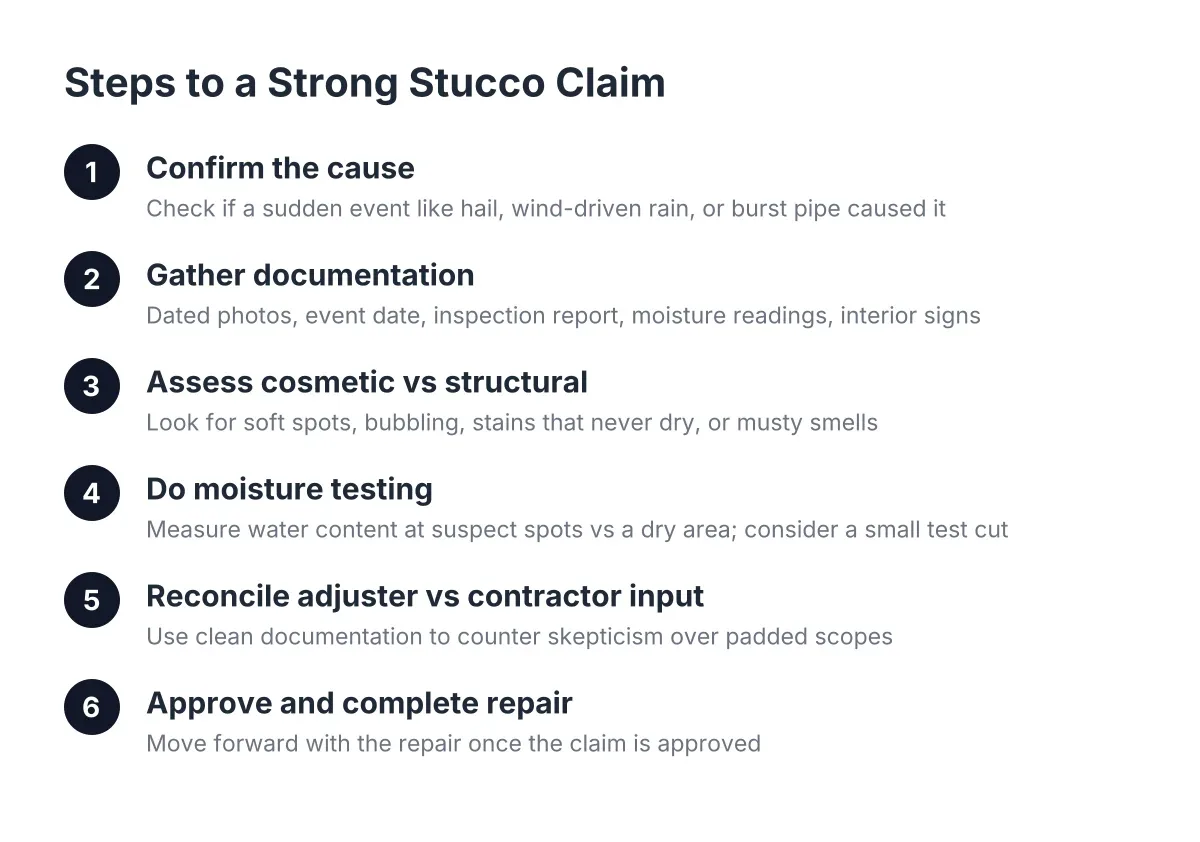
Strong stucco water damage claims rest on three things: proof of the event, proof of the damage, and proof the two are connected. That means dated photos, a written inspection report, and moisture readings taken before any repair work starts. Thin documentation is the most common reason these claims stall or come back underpaid.
Here is what to gather before you call your insurer:
- Dated photos of all damage, wide shots and close-ups, including stains, cracks, and dents
- The date of the storm or event, plus any local news or weather records that confirm it
- A written inspection report from a stucco repair contractor describing what was found and the likely cause
- Moisture meter readings at damaged areas and at a dry section of wall for comparison
- Photos of any interior signs, such as stains on drywall or baseboards near the exterior wall
- Receipts or records of past stucco repair and maintenance, if you have them
In addition, keep a simple log of every call with your insurer: date, who you spoke with, and what was said. Claims drag out, and memory is unreliable six weeks in.
How do I know if the damage is cosmetic or means opening the wall?
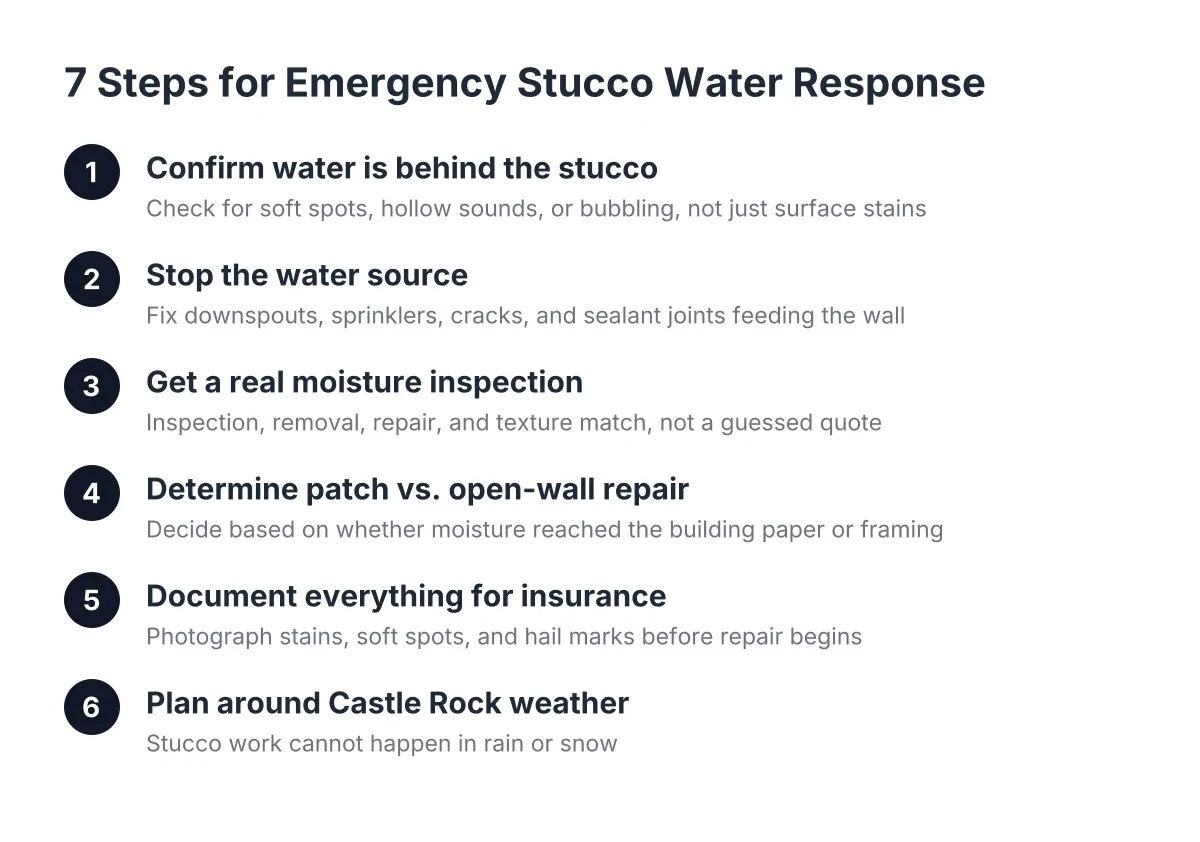
Cosmetic stucco damage sits in the finish coat: hairline cracks, chipped texture, and surface staining that dries out after rain. Damage that means opening the wall shows up as soft spots you can press in, bubbling or bulging stucco, stains that never dry, or a musty smell indoors near an exterior wall. A soft spot in a stucco wall almost always means the layers behind it have taken on water.
Stucco is porous. It absorbs moisture instead of shedding it the way vinyl siding does, so water that gets past the finish can sit against the building paper and sheathing. Left alone, that is how stucco rot behind the wall starts, and it spreads wider than the visible stain suggests. The stucco insurance claim documentation you've gathered—photos, moisture readings, and inspection notes—becomes your proof that water penetrated beyond the cosmetic finish.
This is why a crew should inspect before quoting. A contractor who prices a wall opening from a photo, or from the curb, is guessing. Moisture testing and a hands-on inspection tell you whether a patch will do the job or whether the sheathing underneath needs replacing. The scope should come from what the wall shows, not from a sales script.
What does stucco moisture testing involve?
Stucco moisture testing uses a moisture meter to measure water content in the wall at suspect spots and at a known dry area for comparison. Elevated readings at a stain or soft spot confirm active moisture, not just an old cosmetic mark. Those readings, written down with locations and dates, become some of the strongest evidence in your claim file.
Some inspections also include a small test opening, a few inches of stucco removed to look at the paper and sheathing directly. That sounds drastic, but a small, documented test cut is cheaper than guessing wrong in either direction.
Why do adjusters and contractors give conflicting advice?
Adjusters and contractors disagree because they answer different questions. The adjuster asks what the policy owes for the covered event. The contractor asks what it takes to fix the wall correctly. Both can be right at the same time, and the gap between those two answers is where most homeowner frustration lives.
Colorado insurers also scrutinize hail claims closely. Between 2018 and 2020, hail-related insurance claims across the U.S. rose 2% while questionable claim submissions rose 34%, according to Rocky Mountain Insurance Information Association data. As a result, adjusters push back on scopes that look padded. Clean documentation from a focused local stucco contractor, with photos and moisture readings, is the best counter to that skepticism.
Be cautious with any contractor who promises to handle the fight with your insurer for you, or who writes a scope before touching the wall. A repair contractor's job is to inspect, document, and fix. The claim itself is between you and your insurer.
Why are stucco water damage claims so common in Colorado?
Colorado's hail exposure drives a steady stream of stucco water damage claims along the Front Range. The state had the second-highest number of hail insurance claims in the country from 2013 to 2015, with 182,591 claims, according to the Rocky Mountain Insurance Information Association. One storm alone, the May 8, 2017 Front Range hailstorm, caused $2.3 billion in insured damage, according to the National Insurance Crime Bureau.
Hail cracks the finish coat, and then every storm after that pushes water deeper. A crack that sat open through two or three wet seasons can let the building paper behind it turn brittle and tear, which turns a surface repair into a water intrusion problem. That is the hidden-damage risk behind storm-cracked stucco, and it is why dating the damage matters for your claim.
Rising premiums raise the stakes too. The average homeowner's insurance premium rate in Colorado increased 57.9% from 2018 to 2023, well above the national average, according to the Rocky Mountain Insurance Information Association. Filing a small cosmetic claim may not be worth it; a real water intrusion claim usually is.
Should I file a claim or pay for the stucco repair myself?
File a claim when the repair cost will clearly exceed your deductible and you can tie the damage to a covered event. Pay out of pocket when the damage is cosmetic, small, or hard to connect to a specific storm. An inspection and a repair estimate first give you the numbers to make that call.
For example, suppose a Castle Rock homeowner finds hairline cracks and one soft spot below a window after a June hailstorm. In that scenario, an inspection might show the cracks are cosmetic, say a few hundred dollars of crack repair and patching as a rough illustrative range, while the soft spot reveals wet sheathing that pushes the full repair into the $3,000 to $6,000 range. With a $2,500 deductible, the claim makes sense for the window wall but not for the hairline cracks alone. Those are illustrative numbers, not quotes; your wall and your policy will set the real figures.
One honest limitation: no contractor can tell you what your policy covers. Policy language, endorsements, and deductibles vary, and for a large or disputed claim it is worth talking to your insurer directly or consulting a licensed public adjuster or attorney.
What should the repair itself look like once the claim is approved?
A proper stucco water damage repair starts by removing all loose and buckling material, because anything left in place lets the next rain keep expanding the damaged wood behind it. The crew then replaces rotted sheathing and torn building paper, patches in layers from the bottom up, and finishes with texture matching so the repair blends with the rest of the wall.
Texture matching is where storm repairs most often disappoint homeowners. Castle Rock stucco finishes vary by neighborhood and builder, and a patch with the wrong texture or color reads as a scar from the street. Ask any contractor you are considering how they match texture and color, and ask to see the approach before the finish coat goes on.
Finally, keep your documentation after the repair. Photos of the opened wall, the replaced sheathing, and the finished work close the loop on your claim file in 2026 and give you a baseline if the next storm rolls through.
If you need stucco repair, Castle Rock Stucco Pros can help.
Prefer to talk it through? Call (720) 797-8506 — a quick call is usually the fastest way to get a straight answer for your situation.