Delayed Stucco Water Damage: What Waiting Really Costs Castle Rock Homeowners
A stain under a window, a soft spot you can press with your thumb, a patch of stucco that bubbles after rain. Most homeowners notice these things and decide to deal with them later. That is how delayed stucco water damage turns a few hundred dollars of patching into a wall that needs to be opened up, dried out, and rebuilt. This guide covers what happens behind stucco when water sits, how to tell cosmetic damage from the kind that means opening the wall, and what the repair actually looks like and costs for homeowners in Castle Rock, CO. Understanding the cost of waiting with stucco deterioration is what separates minor repairs from major reconstruction.
The short version: stucco almost never fails all at once. It fails in stages, and every stage you wait through costs more than the one before it. A crew that inspects before quoting can tell you which stage your wall is in. A crew that quotes a scope sight unseen cannot, and that difference matters more with water damage than with any other stucco repair.
How Water Gets Behind Stucco in the First Place
Stucco is a layered system, not a solid shell. The cement coats sit over a weather barrier, usually building paper or a house wrap, which sits over the wood sheathing and framing. The stucco itself is not fully waterproof and was never meant to be. Additionally, the paper behind it is the real defense; the stucco takes the weather, and the paper sheds whatever gets through.
That design works until something breaks the chain. In Castle Rock, the usual entry points are hail impacts that crack the finish, wind-driven rain pushed through cracks around windows and doors, failed caulk at trim and penetrations, and snow piled against the bottom edge of a wall. High-pressure washing can also force water behind the layers, which is why pressure washing stucco is a bad idea even when it looks dirty.
Here is the part that makes delay expensive. Building paper ages. A crack that opens today lets a small amount of water reach paper that is still flexible and still sheds it. Leave that same crack for years and the paper behind it dries out and turns brittle. Normal wall flexing, from wind, temperature swings, or even a nearby air conditioning unit vibrating against the wall, can tear brittle paper. Once the paper tears, water stops running down the drainage plane and starts soaking into the wood. That is the moment a cosmetic problem becomes a structural one, and nothing on the surface tells you it happened.
Early Warning Signs of Water Damage in Stucco Walls
The signs show up in a rough order, and the order tells you how far along the damage is.
- Hairline cracks and spider cracking. Common, often cosmetic, and cheap to fix. They become a problem when they widen past about the thickness of a credit card or run from a window corner.
- Staining and discoloration. Dark streaks below windows, at wall bases, or under rooflines mean water is moving through the stucco regularly. Stains that stay damp days after a storm point to trapped moisture, not surface wetting.
- White chalky deposits (efflorescence). Minerals left behind as water migrates through the cement. This is proof water is passing through the wall, not just over it.
- Bubbling or blistering finish. Moisture behind the finish coat pushing outward. The bond is failing from the back side.
- A soft spot in the stucco wall. Press near stains or cracks. Solid stucco feels like concrete. If it gives, flexes, or crumbles, the base layers or the sheathing behind them have been wet long enough to break down.
- Musty smell or interior drywall stains on the same wall. By this point water has crossed the entire assembly. This is no longer a stucco question; it is a wall question.
The first two or three signs usually mean repair. The last three usually mean opening the wall. Where your home falls on that list is exactly what an in-person inspection answers, and it is why a phone quote for water damage is worth about as much as the call costs.
What Delayed Stucco Water Damage Does to the Wall Behind the Finish
Delayed stucco water damage works in stages, and each stage multiplies the cost of the one before it. First the stucco itself wicks moisture and begins to lose bond. Next the building paper degrades, tears, and stops shedding water. Then the wood sheathing stays wet, swells, softens, and rots. Each stage is hidden behind the one before it.
The expansion problem makes waiting worse in a specific way. Wet wood swells. Swollen sheathing pushes against the stucco, which opens the cracks wider, which lets in more water each storm. Loose or buckling stucco left in place acts like a funnel; rain keeps reaching the wood and keeps expanding it. This is why any honest repair starts by removing every piece of loose material before anything new goes on. Patching over buckled stucco locks the water in and restarts the clock.
Rot is the stage that changes the math entirely. Stucco rot behind the wall does not stay where it started. It travels along sheathing seams, down to the sill plate, and into framing members. A soft spot the size of a dinner plate on the surface can sit over several square feet of compromised sheathing. Once framing is involved, the job stops being stucco repair and becomes carpentry with a stucco finish on top, and the price reflects that.
Mold is the other cost of waiting. Wet wood and paper in a dark wall cavity grow mold, and when growth has had years in a shaded, damp wall, it becomes thick and deeply embedded. At that point one cleaning treatment rarely handles it, and remediation adds its own line to the bill.
Cosmetic or Structural: How to Tell What Your Wall Needs
A cosmetic stucco problem lives in the finish layers and repairs from the outside; a structural one has reached the paper or wood and requires opening the wall. The honest answer is that you can narrow it down from the surface, but you cannot always confirm it without testing or removing a section. Here is how a careful inspection sorts it.
Signs that usually mean surface repair. Hairline cracks with no staining around them. Stains that dry fully within a day or two of weather. Small impact chips from hail that did not go through to the base coat. Stucco that sounds and feels solid when tapped around the damage. These fall under stucco crack repair and stucco patching, the routine end of the trade.
Signs that usually mean opening the wall. Soft or spongy areas. Cracks wider than a credit card, especially stair-step cracks or cracks running off window corners. Bubbling finish. Stains that stay dark between storms. Efflorescence that keeps coming back after cleaning. Any interior sign, like damp drywall or a musty room, on the same wall.
What moisture testing adds. Stucco moisture testing uses probe meters or scanning to read moisture levels in the sheathing without tearing off large areas. Readings around windows, at wall bases, and below rooflines map how far water has traveled. For a pre-listing seller, a moisture map is worth having before the buyer's inspector makes one for you; it tells you whether you are pricing a patch or a remediation before you set a list date.
One caution on testing: meter readings taken right after a storm read high on walls that are fine. Timing matters, and interpreting readings is a judgment call. If a wall shows mixed signals, soft in one spot, solid two feet away, a small exploratory opening settles the question for less than the cost of guessing wrong in either direction.
The True Cost of Waiting on Stucco Water Damage Repair
The cost of waiting when repairing delayed stucco water damage depends almost entirely on how many layers the water reached before someone stopped it. As a rough 2026 illustration, not a quote: surface crack repair and patching on a typical Castle Rock home might run a few hundred dollars. A localized tear-out with new paper and sheathing in one section often lands in the $1,500 to $4,000 range. Multi-wall remediation with framing repair and mold treatment can run well into five figures. Treat those as ballparks; your wall sets the real number.
Notice what moves the price. It is not the size of the visible stain. It is paper condition, sheathing condition, and framing condition, and none of those are visible from the driveway. Two homes with identical-looking cracks can be a $400 job and a $6,000 job. The difference is usually time: how many seasons of freeze-thaw and monsoon rain passed between the first sign and the repair. The cost of waiting compounds as seasons pass, since repeated wetting and drying cycles accelerate the stucco's deterioration and increase repair complexity.
For sellers, the timing math is blunt. A visible stucco defect flagged in a pre-listing walkthrough is a known cost you control. The same defect found by a buyer's inspector becomes a negotiation point, and buyers do not price unknowns kindly. Suppose a homeowner in Castle Pines is listing in six weeks and the realtor flags staining and a hairline crack network below two windows. Inspected early, that might be a two-day patch, texture match, and paint blend, done before photos. Discovered during the buyer's inspection instead, the same wall invites a moisture test, a repair credit demand, and sometimes a renegotiated price that exceeds the repair several times over.
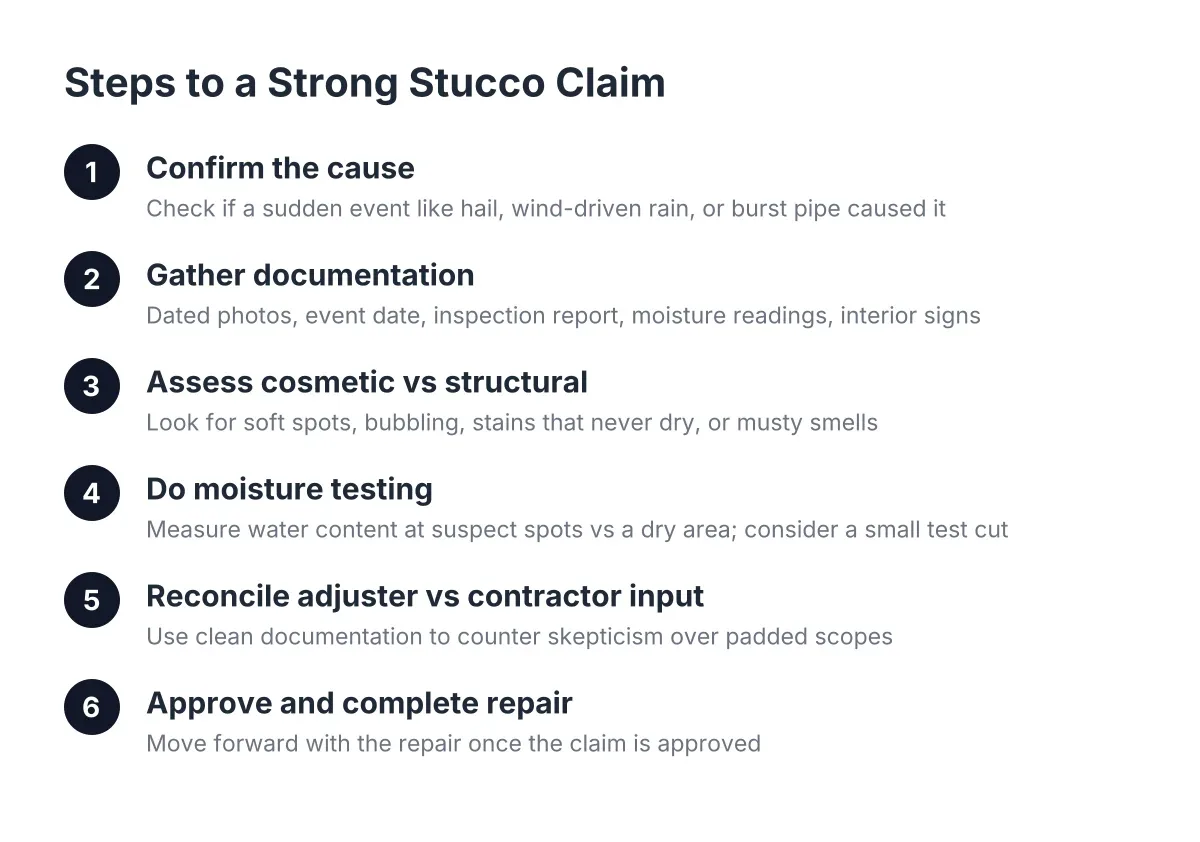
Storm damage adds an insurance clock on top. After a hailstorm, cracked stucco is often claimable, but delayed stucco water damage that develops months later gets harder to tie to the storm, and insurers scrutinize hail claims closely. The Rocky Mountain Insurance Information Association reports that between 2018 and 2020, hail claims nationally rose 2% while questionable claim submissions rose 34%, which is part of why documentation standards have tightened. Colorado knows the stakes; the May 2017 Front Range hailstorm caused $2.3 billion in insured damage, the costliest catastrophe in state history, according to the National Insurance Crime Bureau. Document hail damage to your stucco siding promptly, with dated photos, while the cause is still obvious.
There is also a quieter cost to all of this. Colorado home insurance premiums rose 65% over the last five years, with hail a major driver, according to the National Association of Insurance Commissioners. Homeowners here are already paying more to insure against exactly this kind of damage. Letting a known, fixable problem ripen into a large claim, or into uncovered rot, wastes money on both ends.
What the Repair Process Looks Like When You Stop Waiting
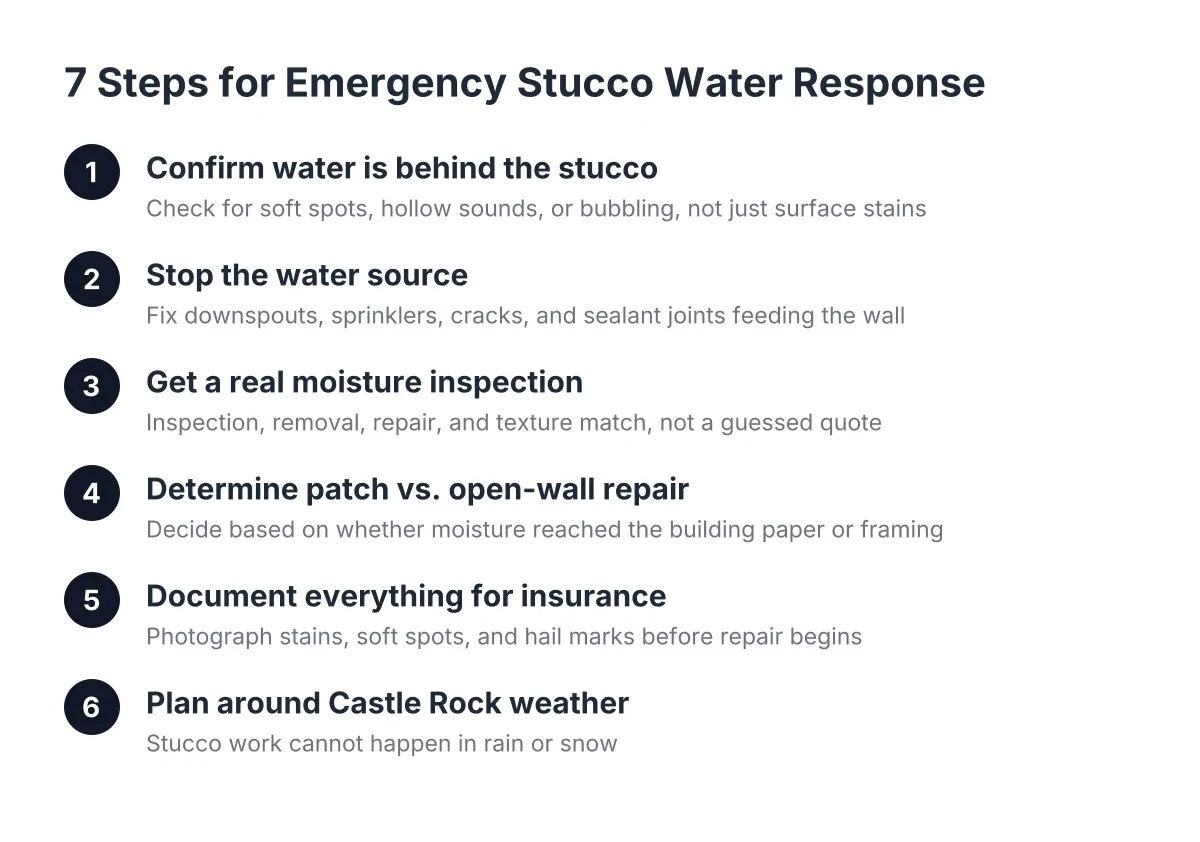
Exterior stucco repair for water damage follows a sequence, and the sequence matters more than speed. A typical crew handling a water-damaged section in Castle Rock works through these steps:
- Inspect and map the damage. Visual check, tap testing, and moisture readings to find the edges of the wet area. The quote comes after this, not before.
- Remove all loose and damaged material. Every buckling or soft piece of stucco comes off, back to solid material. Leaving loose stucco in place lets the next rain keep feeding the wood underneath.
- Open to the real extent. The tear-out follows the damage, not the stain. If sheathing is soft at the edge of the opening, the opening grows until it reaches sound wood.
- Repair the structure. Rotten sheathing comes out, damaged framing gets sistered or replaced, and new wood gets time to set properly before the wall closes. Wood repairs bonded with construction adhesive need about 24 hours to cure before further work on the joint, per Loctite, which is one reason real remediation is never a same-day job.
- Rebuild the weather barrier. New paper lapped correctly into the existing barrier, with flashing restored at windows and penetrations. This layer is where the original failure usually happened, so this step gets the most care.
- Re-stucco in coats. Scratch coat, brown coat, and finish coat, each with cure time. Wider cracks adjacent to the repair get backer rod, a closed-cell foam cord that creates a backing inside the crack before sealant goes in, as described by Sika. Large caulked crack repairs go in during cool morning hours, since hot afternoon sun makes caulk cure poorly.
- Match color and texture. The finish coat gets worked to match the surrounding wall's texture, then painted or fog-coated to blend. On an older wall with faded color, blending sometimes means painting a larger natural break of the wall, corner to corner, so the repair disappears instead of reading as a patch.
Weather drives the schedule. Rain or snow stops stucco and paint work cold; a full day of precipitation is a full day lost. For storm-damage homeowners trying to close out repairs before winter, that argues for scheduling in early fall rather than hoping for a dry window in November.
One more thing a good crew checks before closing the wall: why the water got in. A patch over a wall with no gutters, or with grading that pools water at the foundation, will crack again. Repeated heavy rain collecting at a foundation can cause slight settling that damages stucco corners, and vibration from equipment like an AC unit mounted near a corner does the same. Fix the drainage or the vibration along with the stucco, or budget to fix the stucco again.
Why Local Matters for Stucco Water Damage in Castle Rock, CO
Stucco water damage is a local problem shaped by local weather, and Castle Rock's pattern is specific: hail in late spring and summer, monsoon downpours, then months of freeze-thaw cycling that pries open every crack the storms started. Water that enters in July freezes in November, expands, and widens its own entry point. A crack that was stable in September is wider by March. That cycle is why the same crack costs more to fix every year it waits.
A local crew that works this material in this climate knows which wall faces take the worst hail, how fast paper fails behind south-facing walls, and when the caulking window closes for the season. A call-center operation dispatching a rotating crew does not carry that context, and with water damage the context is most of the diagnosis. The practical test is simple: does the person quoting your job stand at your wall first, or does the number arrive before anyone has pressed a thumb against the soft spot?
A fair limitation to state plainly: no contractor can tell you the full extent of hidden water damage from the surface, and any firm total quoted before the wall is opened carries some risk of change orders. What an honest inspection does is narrow the range, flag the walls that need testing, and keep you from paying remediation prices for a patch job, or patch prices for a wall that needed remediation.
The Bottom Line on Waiting
Stucco water problems only move in one direction. Stains become soft spots, soft spots become rot, and rot becomes carpentry. The repair that costs a few hundred dollars this season can cost thousands after two more winters, and the damage that drives the price is the part you cannot see.
If your wall is showing stains that linger, cracks that are growing, or any spot that gives under your thumb, get it inspected before the next storm season, and before a buyer's inspector finds it first. The inspection tells you which stage you are in. Acting on it decides which stage you pay for.
If you need stucco repair, Castle Rock Stucco Pros can help.
Prefer to talk it through? Call (720) 797-8506 — a quick call is usually the fastest way to get a straight answer for your situation.