Hiring a Stucco Repair Contractor: 8 Questions to Ask Before You Sign a Water Damage Quote
Stains spreading below a window. A soft spot you can press with your thumb. Bubbling or chalky patches near the foundation. When Castle Rock homeowners spot these signs, the first search is usually for a water damage restoration company near me, and the results are a wall of franchise names and directory listings that all say the same thing. Here is the problem: stucco hides damage. What looks like a cosmetic stain can be exactly that, or it can mean wet framing behind the wall. The only honest way to know is to open a small section and look, which is why the questions you ask when hiring a stucco repair contractor matter more than the logo on the truck.
This article walks through eight questions worth asking any company before you sign a quote for stucco water damage work. They separate crews who inspect before pricing from crews who sell a scope sight unseen.
1. What to Expect When Hiring a Stucco Repair Contractor for Inspection
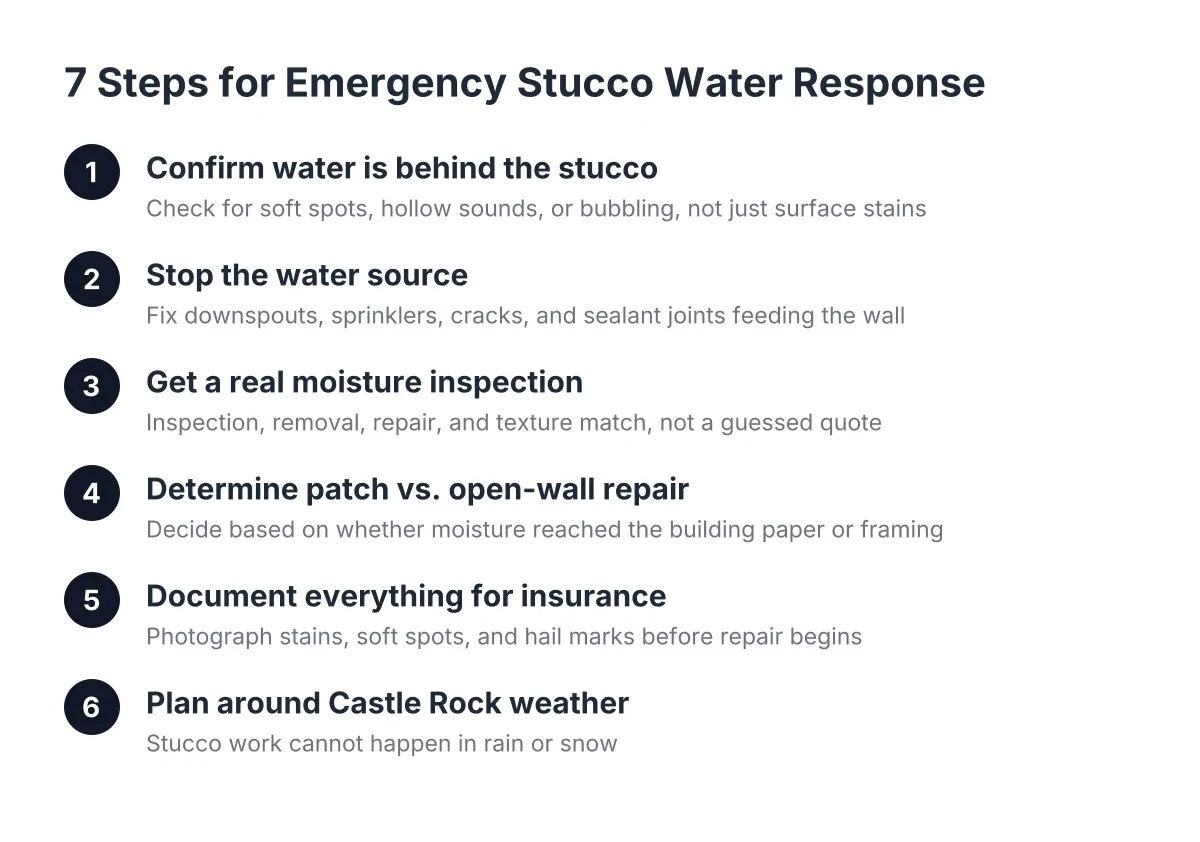
A trustworthy stucco contractor inspects before quoting, because surface symptoms do not tell you how far water traveled behind the wall. A quote written from a photo or a quick walk-around is a guess, and guesses turn into change orders once the wall opens up.
Stucco is a layered system: finish coat, base coats, metal lath, and a water-resistive paper over the sheathing. Water that gets behind the paper can rot sheathing and framing while the surface still looks mostly fine. A stain might mean a slow leak at a window flashing, or it might mean nothing more than splashback from a downspout.
Ask directly: do you probe soft spots, do you do any stucco moisture testing, and will you open a small test section before writing the full scope? If the answer is "we can tell from looking," keep comparing quotes.
2. Does the Stucco Repair Contractor You're Hiring Specialize in This Work?
This is the question most quote-comparing homeowners skip, and it explains most of the price gaps they cannot make sense of. A general water damage restoration company is built around drying out interiors: extracting water, running dehumidifiers, and cutting out wet drywall. That is real work, but it is not the same trade as repairing the exterior stucco system that let the water in.
If the exterior is not fixed correctly, with the lath tied in, the paper lapped right, and the texture matched, the water comes back and you pay twice. A crew that does stucco repair every week will talk comfortably about lath, building paper, scratch and brown coats, and texture matching. A generalist will talk about square footage and drying equipment.
For example, suppose a homeowner in Castle Rock gets two bids after a storm: one at $2,800 from a stucco-focused crew and one at $7,500 from a national restoration outfit. The gap is often scope, not greed. One priced an exterior stucco repair; the other priced interior demolition, drying, and a subbed-out patch. Neither number means anything until you know what is behind it.
3. How do you decide what is cosmetic and what means opening the wall?
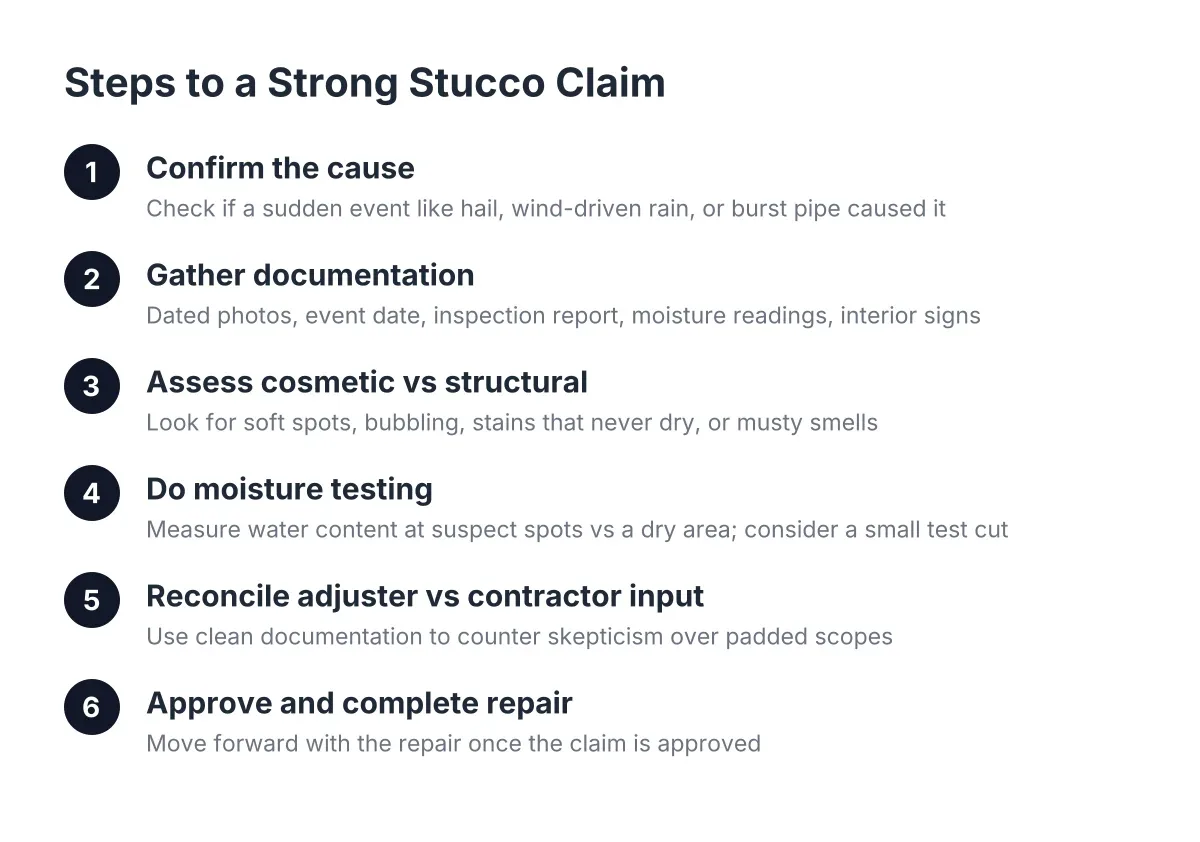
Good contractors sort stucco damage into cosmetic and structural before pricing, using a few clear signals rather than a sales pitch. Hairline surface cracks, light staining from sprinkler overspray, and minor chipping are usually cosmetic. Soft spots, bulging sections, cracks that run through the wall at corners or windows, and stains that keep growing after dry weather point to water behind the system.
A straightforward crew will explain the line in plain terms. When hiring a stucco repair contractor, cosmetic work means crack repair, stucco patching, and refinishing the surface. Water damage work means removing the damaged stucco back to sound material, checking the sheathing and framing, replacing rotted wood, installing new paper and lath, and rebuilding the coats.
Be cautious of two extremes. A company that calls everything cosmetic may be underbidding to win the job. A company that calls everything structural may be building a scope you do not need. The honest answer to "which is it" before inspection is "we need to look."
4. What is included in the scope, and what costs extra once the wall is open?
A complete stucco water damage repair scope covers removal of damaged material, repair or replacement of rotted sheathing and framing, new water-resistive paper and lath, base coats, finish coat, and color and texture matching. Anything missing from that list is a gap you will pay for later or a corner that got cut.
However, no contractor can see through a wall, so hidden rot is the one legitimate unknown. The fair way to handle it is in writing: the quote states a base scope, plus a clear unit price or hourly rate for wood replacement beyond what the inspection found. That protects you from the open-ended "we found more damage" call, the thing quote-comparing homeowners fear most.
Ask these specifics before signing:
- Does the price include replacing rotted wood, or only the stucco itself?
- How is extra hidden damage priced if the opening reveals more rot?
- Is texture matching to the existing wall included, or billed separately?
- Who handles haul-away of the old material?
- Is any interior drywall or insulation work included, or is that a separate trade?
5. Will the repair match my home's existing texture and color?
Texture matching is the difference between a repair you forget about and a patch you see every time you pull into the driveway. Stucco finishes vary widely: sand float, lace, dash, smooth troweled. Matching one takes practice, and it is where generalist crews most visibly fall short.
Ask to see how the company handles color and texture matching. A stucco-focused crew will explain that even a well-matched patch can read differently until it cures and weathers, and that sometimes refinishing a full wall section from corner to corner gives a cleaner result than a spot patch. On corner damage in particular, the technically correct fix is often taking the section back to the corners rather than patching a small square in the middle.
That trade-off should be your choice, made with honest information, not something you discover after the scaffolding comes down.
6. Will you find and fix the cause, or just the symptom?
A repair that ignores the water source fails on schedule. Water gets behind stucco for predictable reasons: failed flashing at windows and rooflines, grade or drainage that lets water pool against the foundation, missing or clogged gutters, cracks left open for years, and vibration from nearby equipment like an air conditioning unit working on a wall corner.
Drainage deserves special attention in this area. Repeated heavy rain and snowmelt pooling near a foundation can cause slight settling, which cracks stucco at corners and finishes. Patch the corner without correcting the drainage and the crack returns. Similarly, a structural crack left open for many years lets the building paper behind it turn brittle; once the paper tears, water intrusion gets worse fast.
So ask the question plainly: what caused this, and does your scope address it? A good answer names a specific source. A vague answer means you are buying a patch, not a fix.
7. How do you handle insurance documentation after a storm?
If a hailstorm or wind event cracked your stucco, you need a written, itemized estimate your adjuster can work with, and you need it before the claim stalls. This is routine in Colorado. The state logged 182,591 hail insurance claims from 2013 to 2015, second only to Texas, according to the Rocky Mountain Insurance Information Association. The May 8, 2017 Front Range hailstorm alone caused $2.3 billion in insured damage, according to the National Insurance Crime Bureau.
Those storms have consequences for homeowners beyond the damage itself. The average homeowner's insurance premium rate in Colorado rose 57.9% from 2018 to 2023, well above the 33.8% national average, driven partly by catastrophic hail losses, according to the Rocky Mountain Insurance Information Association. Insurers also watch claims closely; RMIIA data shows hail claims nationwide rose 2% between 2018 and 2020 while questionable claim submissions rose 34%.
The practical takeaway: hire a company that documents damage honestly and itemizes the estimate clearly. Adjusters respond to specifics. A line-item scope that separates stucco removal, wood repair, lath and paper, coats, and finish work moves a claim faster than a lump sum, and it protects you if questions come up later.
8. Can I reach the people doing the work, or just a call center?
When a wall is open on your house and weather is coming, you want a direct line to someone who knows your job. National operations route calls through intake centers and rotate crews between jobs, which works fine for scheduling software and less well for a half-finished wall before a storm. A local Castle Rock crew answers for its own work because the next referral depends on it.
This is also where quote comparison gets easier. Call each company with one technical question, something like "how will you tie the new lath into the existing wall?" The answer tells you quickly whether you reached a stucco person or a dispatcher reading a screen.
What a homeowner can check before calling anyone
You do not need a contractor to do a first-pass check, and doing one makes every quote conversation sharper. Walk the exterior after a dry stretch and note what you find:
- Press gently on stained or bubbled areas; soft or spongy spots suggest wet material behind the surface.
- Look at cracks: hairline and random is usually cosmetic, while cracks radiating from window corners or running at wall corners deserve a professional look.
- Check where downspouts discharge and whether soil slopes toward the house.
- Note any stucco within a few inches of grade, where splashback and pooling do the most harm.
Leave two things alone. First, do not pressure wash stucco to clean up stains; because stucco is layered, blasting water into it can push moisture behind the system and create larger problems over time. Second, do not caulk over a soft spot or seal a growing crack to make it disappear; trapping moisture behind the surface speeds up rot in a stucco wall and hides the evidence an inspector needs. If you suspect rot behind the wall, or if interior drywall is staining, bring in a professional rather than opening the wall yourself; structural wood repair and moisture assessment are not weekend projects.
The bottom line for Castle Rock homeowners comparing quotes
Stucco water damage rewards the homeowner who asks sharp questions and punishes the one who hires on price alone. The eight questions above come down to three things: inspect before quoting, fix the cause along with the symptom, and put the scope and the unknowns in writing. A quote you can explain line by line is worth more than a cheaper one you cannot.
Whether you end up hiring a stucco repair contractor or a broader water damage restoration company, insist on the inspection first. If you are in Castle Rock or a nearby area and you are seeing stains, soft spots, or cracks you cannot explain, reach out for a look at the wall and a written estimate. An honest inspection costs you a phone call. Guessing wrong about what is behind your stucco costs a great deal more.
If you need stucco repair, Castle Rock Stucco Pros can help.
Prefer to talk it through? Call (720) 797-8506 — a quick call is usually the fastest way to get a straight answer for your situation.