Cost to Repair Water Damage in Stucco: What Drives the Price Up or Down
You noticed a stain that will not dry out, or a spot on the wall that gives a little when you press it. Now you are trying to figure out what the stucco repair cost factors actually look like before you call anyone. That is the right instinct. The honest answer is that price depends on what is happening behind the wall, and nobody can tell you that from a photo or a phone call. This guide walks through what drives the cost repair water damage jobs actually carry, what is cosmetic versus what means opening the wall, and how to avoid paying for a scope you do not need.
One thing up front: any contractor who quotes you a firm number for water damage without looking at the wall in person is guessing. Sometimes they guess high to cover themselves. Sometimes they guess low to get the job, then hit you with change orders. A crew that inspects before quoting is not being slow. They are being honest about how this kind of repair works.
Why Water Damage Pricing Is Different From Crack Repair Pricing
A simple stucco crack repair is mostly predictable. The crack is visible, the length is measurable, and the work is on the surface. Water damage is different because the visible symptom, a stain or soft spot, is usually the last thing to show up, not the first.
Stucco is a layered system. There is the stucco itself, then building paper or a weather barrier behind it, then sheathing, then framing. Water that gets past the outer layer can travel down and sideways before it shows on the surface. By the time you see a stain at eye level, the moisture may have started two feet higher at a window corner.
That is why two soft spots that look identical from the sidewalk can cost wildly different amounts to fix. One might be surface moisture that dries once the entry point is sealed. The other might have wet sheathing and softened framing behind it. The stucco water damage you can see is a symptom; the cost lives in what you cannot see yet.
What Factors Drive Stucco Repair Costs for Water Damage
Several factors move the price on a stucco water damage repair, and they matter far more than square footage alone. Understanding the specific factors influencing stucco repair costs helps homeowners budget appropriately. Here are the ones that make the biggest difference:
- How far the water traveled. A leak contained to one small area near its entry point costs a fraction of one that ran down inside the wall for a season or two.
- What is behind the stucco. If the building paper is intact and the sheathing is dry, the repair stays on the outside. If the paper is torn or brittle and the wood is soft, the wall has to come open.
- How long the damage sat. A crack or gap that leaked for one wet spring is a different job than one that leaked through several winters. Older damage often means brittle building paper that tears when the wall flexes, which lets in even more water over time.
- The entry point itself. Fixing a failed sealant joint around a window is cheaper than correcting a flashing problem or a drainage issue at the foundation.
- Texture and color matching. A patch that matches your home's existing texture takes skill and time. A patch that does not match is cheaper, and it looks like a patch from the street.
- Access. Ground-floor wall sections cost less to work on than second-story gables or areas that need scaffolding.
Notice that none of these factors is visible from the curb. This is why the inspection matters more than the initial phone estimate.
Small Repairs: When the Damage Stays on the Surface
Suppose a Castle Rock homeowner spots a faint stain below a window after spring snowmelt. The crew presses the wall and finds it firm, checks moisture readings, and traces the stain to a failed sealant joint at the window frame. In that scenario, the fix is resealing the joint, letting the wall dry, and patching and blending the stained area.
That is the low end of the range. As a rough illustrative estimate, jobs like this often land in the low hundreds of dollars, because the water never got past the outer layers. The stucco patching itself is straightforward when the substrate is sound.
Mid-Range Repairs: Opening a Section of Wall
Now suppose that same stain came with a soft spot the size of a dinner plate. Pressing on it, the stucco flexes. That usually means the layers behind it have taken on water. The crew cuts out the damaged section, removes anything loose or buckling, replaces torn building paper, lets the sheathing dry or replaces it if it is soft, then rebuilds the stucco in layers and matches the texture. The stucco repair cost factors in this scenario include labor for removal, substrate replacement, and careful finishing work.
All loose material has to come out first. Leaving buckling stucco in place lets rain keep expanding the wet wood behind it, and the problem returns worse than before. As an illustrative range, opening and rebuilding one wall section often runs from several hundred dollars to a couple thousand, depending on size, height, and how much substrate needs replacing.
Larger Remediation: When Rot Has Spread
The expensive scenario is rot that spread through sheathing and into framing. This happens when water damage sat unaddressed for years. At that point the job shifts from stucco repair to structural remediation, and a stucco crew may need to bring in or defer to a general contractor for the framing work before the stucco goes back on.
On corners, the technically correct repair is often larger than the visible damage. A deteriorated corner is properly fixed by removing the stucco and repatching the full wall section from corner to corner, not just the damaged spot. A partial patch is quicker and cheaper, and it can be a reasonable choice, but the trade-off is a higher chance the crack returns if the underlying cause is not addressed.
Cosmetic Damage vs. Opening the Wall: How a Crew Decides
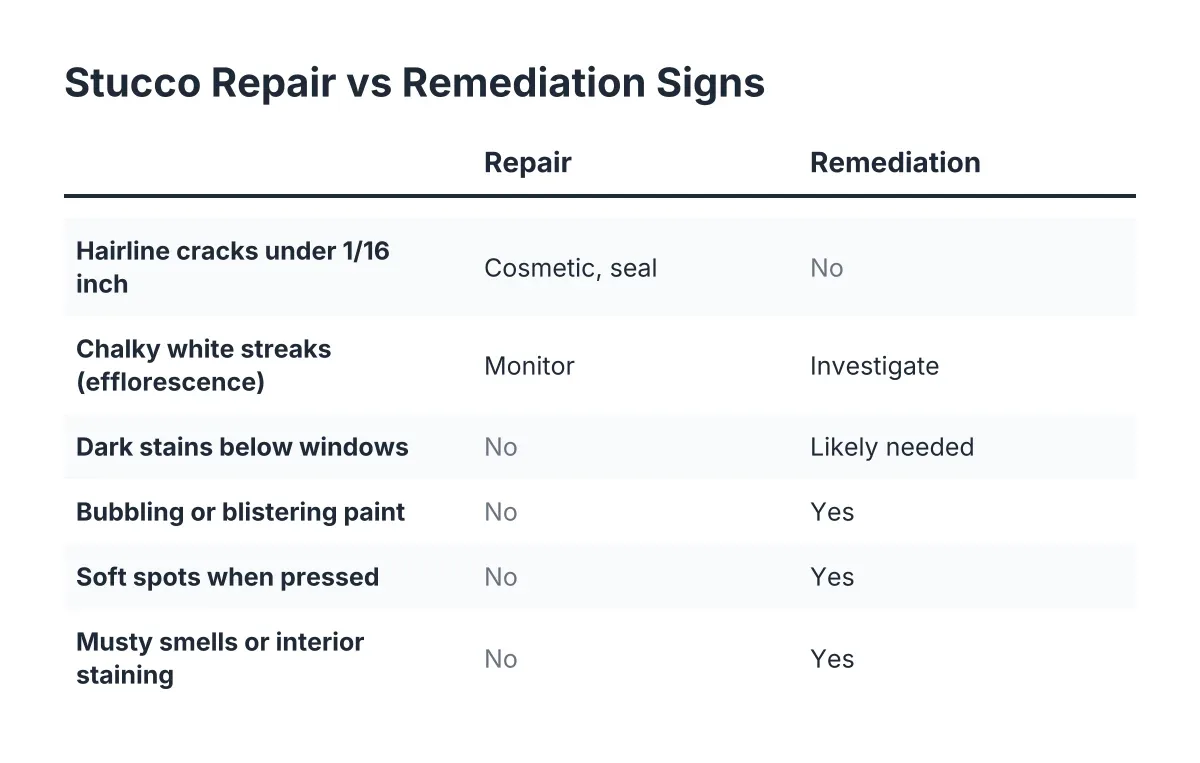
An honest inspection separates cosmetic problems from structural ones before anyone talks price. The decision usually comes down to three checks: does the wall feel solid when pressed, do moisture readings show water behind the stucco, and can the entry point be identified and fixed.
If the wall is firm and dry and the stain traces to a fixable entry point, the repair is cosmetic. Seal the entry, clean or patch the stain, blend the texture. If the wall is soft, or moisture readings stay high after dry weather, the wall needs to open. There is no reliable way to fix wet substrate from the outside.
Stucco moisture testing is the piece most homeowners skip when they self-diagnose. A stain that looks harmless can sit over wet sheathing, and a dramatic-looking stain can sit over a dry wall. Surface appearance is a poor guide to cost. This is also where a second opinion earns its keep; if one contractor says the whole wall must come off and another finds dry readings, get a third look before committing to the bigger scope.
Signs That Point to Higher Repair Costs
Certain warning signs tend to predict a bigger job. If you see these, budget toward the higher end of the range and expect the wall to open:
- Soft spots you can press in. A soft spot in a stucco wall almost always means wet material behind the surface, not just on it.
- Bubbling or bulging stucco. Water trapped behind the finish pushes it outward. The bulge itself has to come out.
- Stains that return after drying. A one-time stain from a storm can be cosmetic. A stain that keeps coming back means an active water path.
- Cracks spreading from window or door corners. These often trace to flashing or sealant failures, which are common entry points.
- A musty smell near the wall, inside or out. Odor suggests sustained moisture and possible stucco rot behind the wall.
- Damage low on the wall near downspouts or grade. Water pooling at the foundation can cause slight settling over time, which cracks corners and finishes and keeps feeding moisture into the wall.
One more pattern worth knowing: corner damage near an air conditioning unit is common. Vibration from the equipment travels into the wall, and combined with poor drainage it cracks the corner and opens a path for water. Fixing the stucco without fixing the drainage means paying for the same repair again in a few years.
What a Fair Estimate Should Include
When you get a quote for stucco water damage repair, the estimate should reflect an actual look at the wall, not a price per square foot pulled from a chart. In 2026, with material and labor costs varying widely, a useful estimate spells out the scope in plain terms. Look for these items:
- The suspected entry point and how it will be fixed, not just the visible damage
- Whether the wall will be opened, and how the crew will handle it if the substrate is worse than expected
- Removal of all loose and buckling material, not patching over it
- Replacement of torn or brittle building paper in the opened area
- The stucco rebuild applied in layers from the bottom up, which is the correct sequence for this work
- Texture matching to your home's existing finish, and color matching or a plan for blending
The texture matching line matters more than it sounds. A poor texture match is the most visible sign of a rushed repair; it usually means someone patched the wall without matching the original technique or finish type. If you are a pre-listing seller, a mismatched patch can draw a buyer's eye straight to the repair you paid to hide. For a home listing in the next 30 to 90 days, an invisible repair on the two or three visible defects is usually a better spend than a larger scope nobody will notice.
Where DIY Fits, and Where It Stops
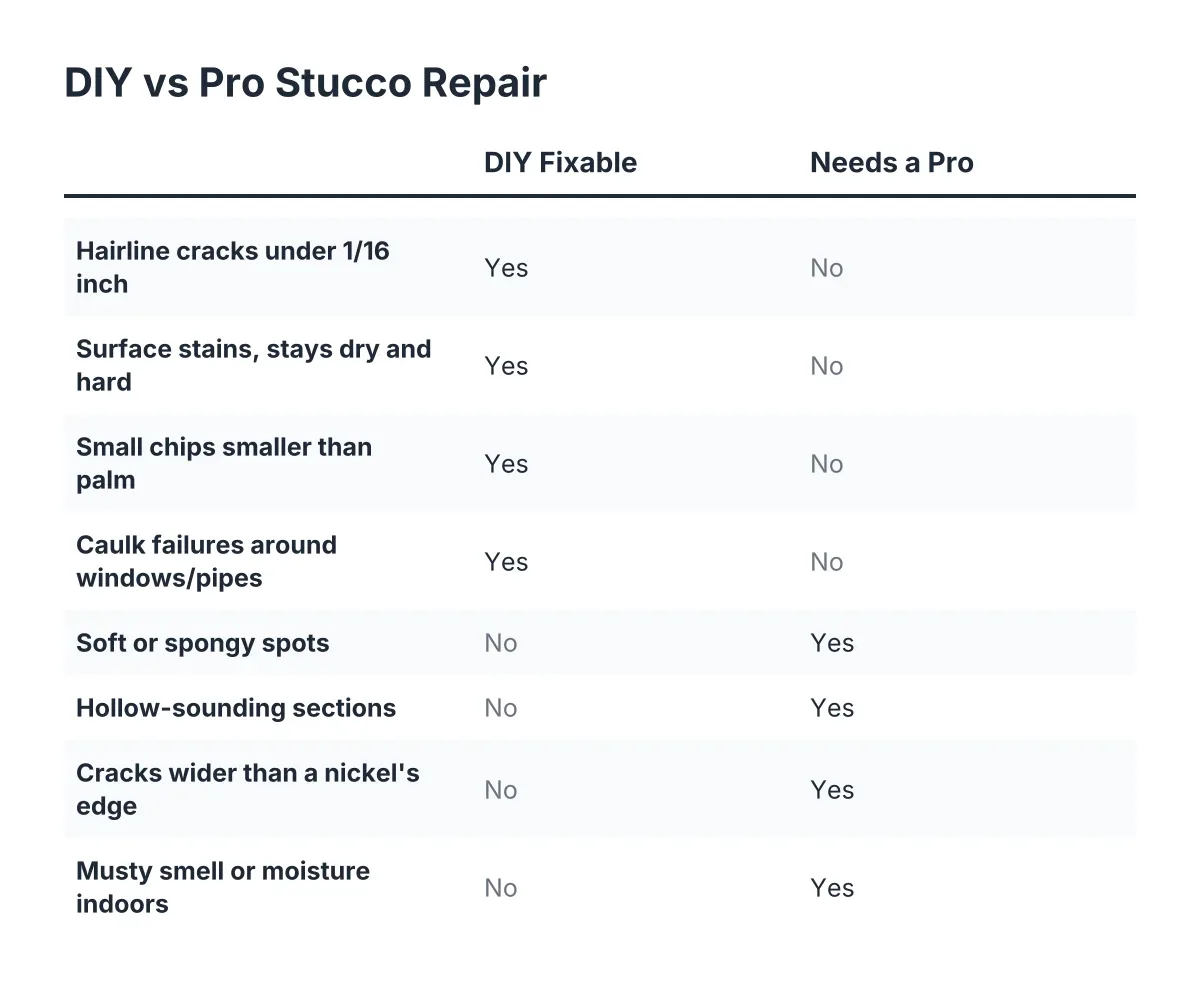
For a true hairline crack with no moisture behind it, a homeowner-grade product is a reasonable stopgap. People search for quikrete stucco crack repair for exactly this situation, and for a dry, stable hairline crack, a sanded acrylic caulk or crack sealant can keep water out for a while. On wider cracks, a backer rod, which is a closed-cell foam cord, is used to create a backing inside the crack before sealant goes in, according to Sika.
However, DIY stops at moisture. If the wall is soft, stained, bulging, or the crack keeps growing, sealing the surface traps water inside the wall and makes the eventual repair bigger. The same caution applies to pressure washing; because stucco is layered, moisture forced behind it under high pressure can create larger structural issues over time. If there is any sign of water behind the stucco, bring in someone who works with the material, and if rot has reached framing, that work belongs with a professional regardless of your comfort with tools.
Keep the goal in mind. You are not trying to hide the symptom. You are trying to stop water from getting in, dry or replace what got wet, and rebuild the surface so it matches. DIY handles the first step in limited cases and none of the rest.
Why Waiting Raises the Cost to Repair Stucco Damage
The costs of stucco repair and water damage rise together with time, and the increases come in steps rather than gradually. A sealant fix this year can become an open-the-wall job next year and a framing repair the year after. The building paper behind old, unrepaired cracks becomes brittle over time; once normal wall flexing tears it, water moves from occasionally touching the wall to regularly soaking it.
Colorado weather does not help. Freeze-thaw cycles push water deeper into cracks each winter, and hail keeps punishing exteriors along the Front Range. According to the National Insurance Crime Bureau, Colorado's May 2017 hailstorm caused $2.3 billion in insured damage, still the state's costliest catastrophe. Home insurance costs have followed; the National Association of Insurance Commissioners reports Colorado premiums rose 65% over five years, with hail a major driver. Small out-of-pocket repairs done early are one of the few exterior costs you can actually control.
For the crack-watcher staring at a stain, the practical takeaway is simple. You do not need to panic, and you do not need to accept a large scope sight unseen. You need someone local to press on the wall, take moisture readings, find the entry point, and tell you which of the three cost tiers you are in. In Castle Rock, where most stucco damage traces to snowmelt, hail, and drainage, that inspection usually takes less time than you have already spent staring at the wall wondering.
Get the read first. Then decide what to spend.
If you need stucco repair, Castle Rock Stucco Pros can help.
Prefer to talk it through? Call (720) 797-8506 — a quick call is usually the fastest way to get a straight answer for your situation.