Water Damage Behind Stucco: 8 Warning Signs and How Fast You Need to Act
That dark stain on your stucco wall that won't wash off is not dirt. In most cases it is the first visible sign of water damage behind stucco, and by the time you can see it from the driveway, moisture has usually been working on the wall for months. Colorado storms make this worse. Hail bruises the finish coat, wind-driven rain finds every crack, and freeze-thaw cycles pry small openings wider every winter.
This matters more here than in most places. Colorado's May 8, 2017 Front Range hailstorm caused $2.3 billion in insured damage, according to National Insurance Crime Bureau, and it remains the state's costliest catastrophe. Hail and storms hammer Castle Rock walls regularly, and stucco takes those hits differently than other siding. It rarely fails all at once. It fails slowly, behind the surface, where you cannot see it.
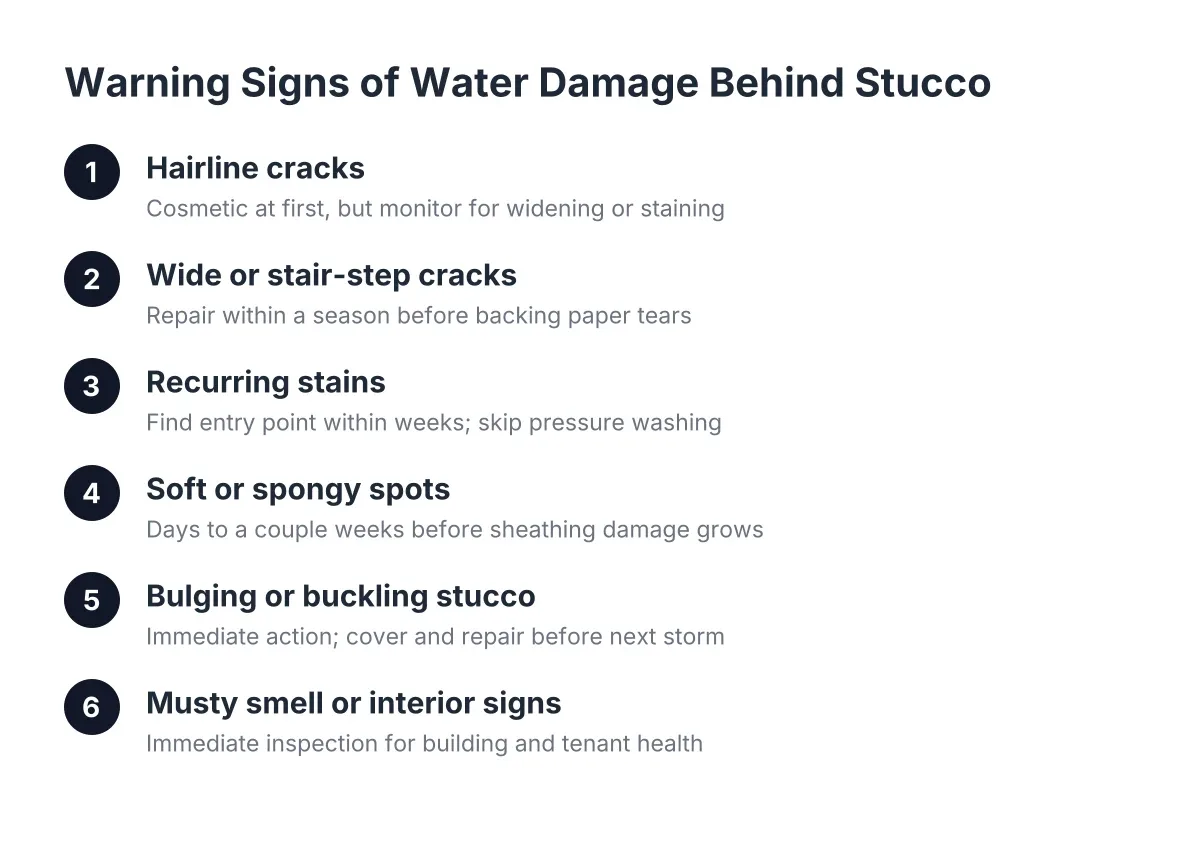
Below are eight signs that water has gotten behind your stucco, roughly in order from "watch it" to "deal with it now," along with an honest timeline for how urgent each one is. Whether you live in the house or rent it out, the goal is the same: catch the problem while it is still a stucco patching job, not a framing job.
1. Hairline cracks: watch them, but do not panic yet
Fine cracks under about the width of a credit card edge are common on stucco and usually cosmetic. Stucco is a rigid material over a house that flexes with temperature and settling, so small cracks come with the territory.
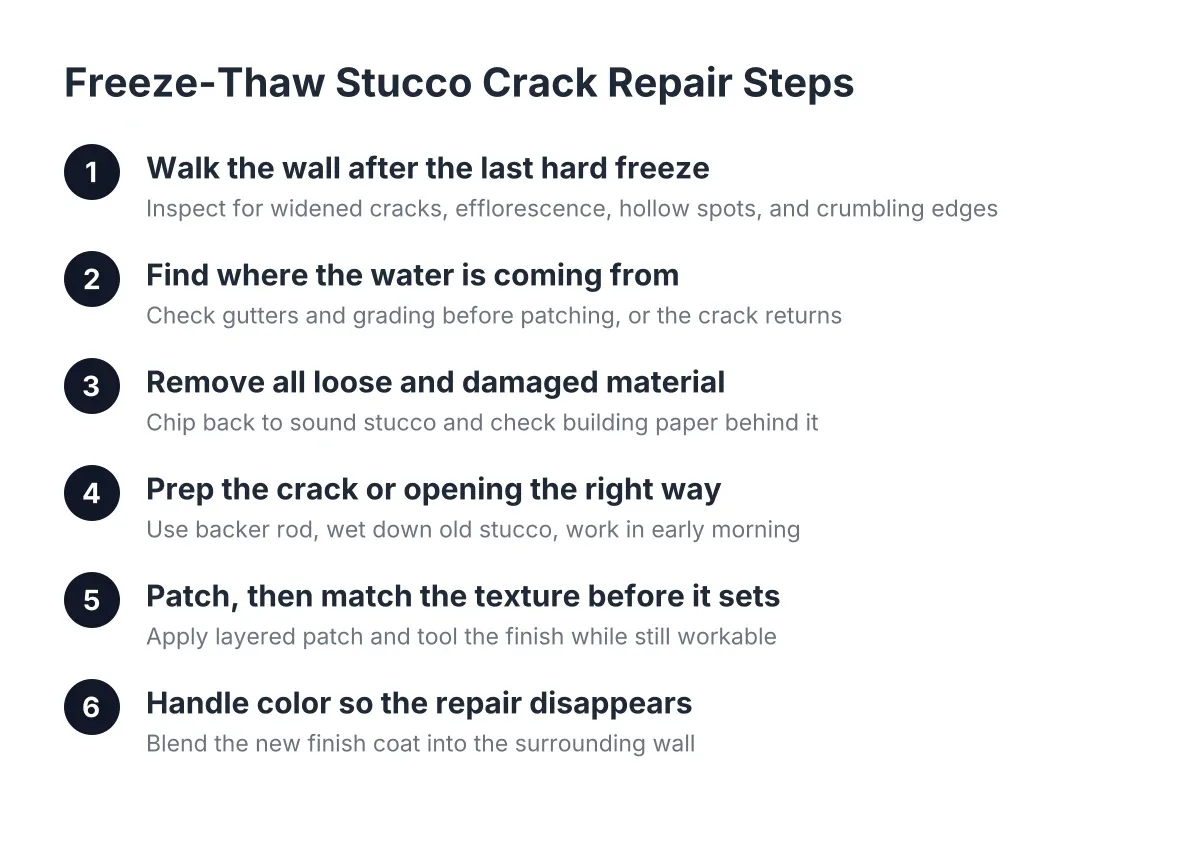
However, hairline cracks are how the clock starts. Can stucco cracks cause water damage? Yes, over time. Wind-driven rain works into even small cracks, and Castle Rock's freeze-thaw cycles expand them a little each winter. Urgency: monitor with photos every few months, and schedule stucco crack repair if a crack widens, lengthens, or starts to stain.
2. Cracks wider than a nickel's edge, or stair-step cracks
Wider cracks, especially ones that run diagonally from window corners or step along the wall like stairs, mean the wall is moving more than it should. These openings let real water volume through, not just mist.
There is a hidden cost to waiting on these. Behind your stucco is a layer of building paper that sheds water. That paper gets brittle with age, like something baking in an oven, and years of wall flexing around an unrepaired crack can tear it. Once the paper tears, water hits bare wood. Urgency: get crack repair on the calendar within a season, not within a few years.
3. Stains that come back after you clean them
A brown or gray stain that returns after every wash is a message from inside the wall. Water is passing through the stucco, picking up minerals and tannins, and carrying them back to the surface as it dries. Cleaning removes the evidence, not the source.
Look at where the stain sits. Stains below window sills, at wall corners near downspouts, or in horizontal bands often trace directly back to a specific entry point. Urgency: within weeks, have someone find the entry point. Also, skip the pressure washer. High-pressure water forces moisture behind the layered stucco system and can turn a surface stain into the exact structural problem you are trying to avoid.
4. Soft or spongy spots: the wall is telling you the sheathing is wet
Press gently on the stucco near the stain, especially under windows. Healthy stucco feels like concrete. If a spot gives under your thumb, crumbles at the edge, or sounds hollow when you knock, the material behind it has been wet long enough to break down.
This is the sign that scares homeowners most, and fairly so. What happens when water damage occurs behind stucco is different from a surface soak: the moisture sits against sheathing and framing with nowhere to go. Urgency: days to a couple of weeks. A soft spot the size of your palm is still a manageable exterior stucco repair. A soft spot you ignored for a year can involve sheathing replacement.
5. Bulging, buckling, or stucco pulling away from the wall
When a section of stucco bulges outward or a chunk breaks free, the bond between the stucco and the wall behind it has failed, almost always because of trapped moisture. At this point the stucco is no longer protecting the house; it is holding water against it.
One thing any competent repair crew will do here, and you should expect it: remove all the loose and buckling material before patching anything. Skimming new stucco over a failed section traps the moisture and lets rain keep expanding the wet wood underneath. Urgency: immediate. Cover exposed areas before the next storm and get repairs moving.
6. Musty smell or interior signs on an exterior wall
Sometimes the first clue shows up inside. A musty smell near an exterior wall, bubbling paint on the interior side, or baseboards that look swollen all point to moisture that has traveled the full depth of the wall assembly.
For landlords, this is often how the problem surfaces at all. Suppose a tenant in a Castle Rock rental mentions a damp smell in a bedroom during a lease renewal walkthrough. Outside that same wall, there is a stain under the window that has been there since spring. In that scenario, the smell is not a housekeeping issue; it is water damage behind stucco announcing itself, and mold becomes a real risk with an occupied unit. Urgency: immediate inspection, both for the building and for the tenant relationship.
7. Identifying water damage clustering at structural weak points
Water damage behind stucco is rarely random. It clusters at the weak points where water concentrates or the wall takes stress:
- Window and door corners, where flashing gaps let water in behind the finish
- Below downspouts, where splashing keeps one patch of wall wet for days after a storm
- Wall corners near AC condensers, where equipment vibration works cracks open over time
- The bottom few feet of wall, where poor drainage lets water pool against the foundation
That last two points matter for repair planning. Repeated heavy rain pooling near a foundation can cause slight settling, which cracks corners and finishes. Therefore, a patch alone may not hold if a missing gutter or a vibrating condenser caused the damage. A good local crew will point out the cause, not just quote the patch. Be wary of anyone who wants to start demo before they have explained what is wrong.
8. Fresh hail or wind damage: the countdown starts before winter
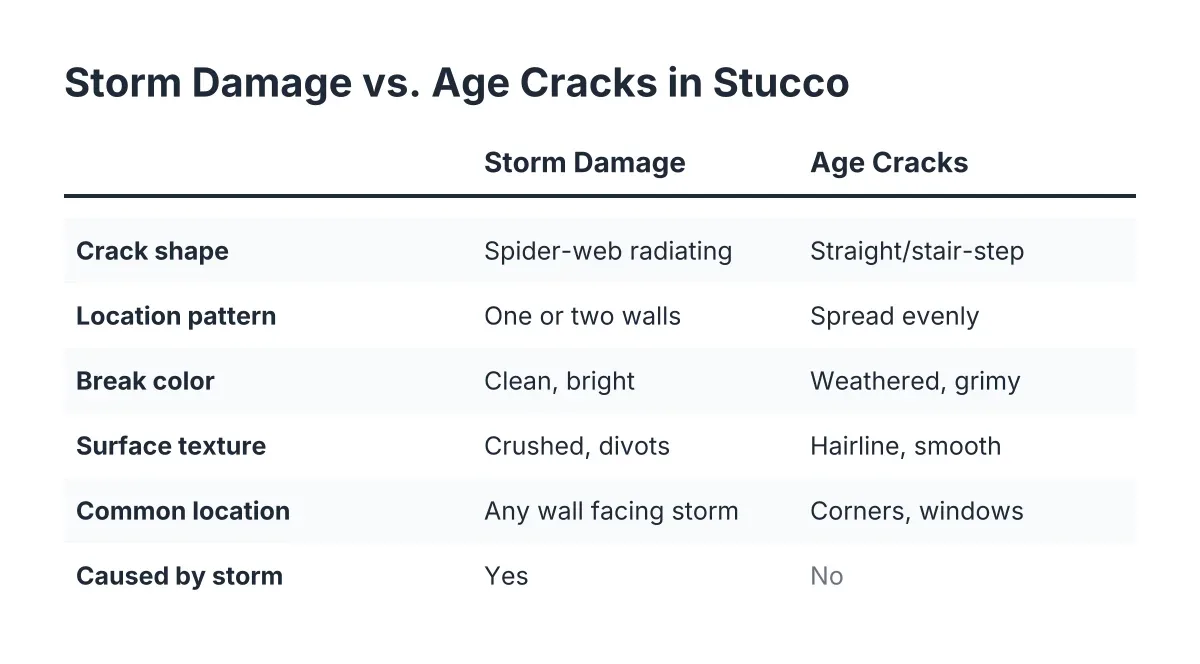
After a hailstorm, walk the house and look for circular chips, dents in the finish coat, cracked spots where hail hit at an angle, and damage concentrated on the storm-facing side. Hail damage stucco signs are easy to dismiss because they look cosmetic. The problem is what each chip becomes after a Castle Rock winter of freeze-thaw cycles: an open path for water.
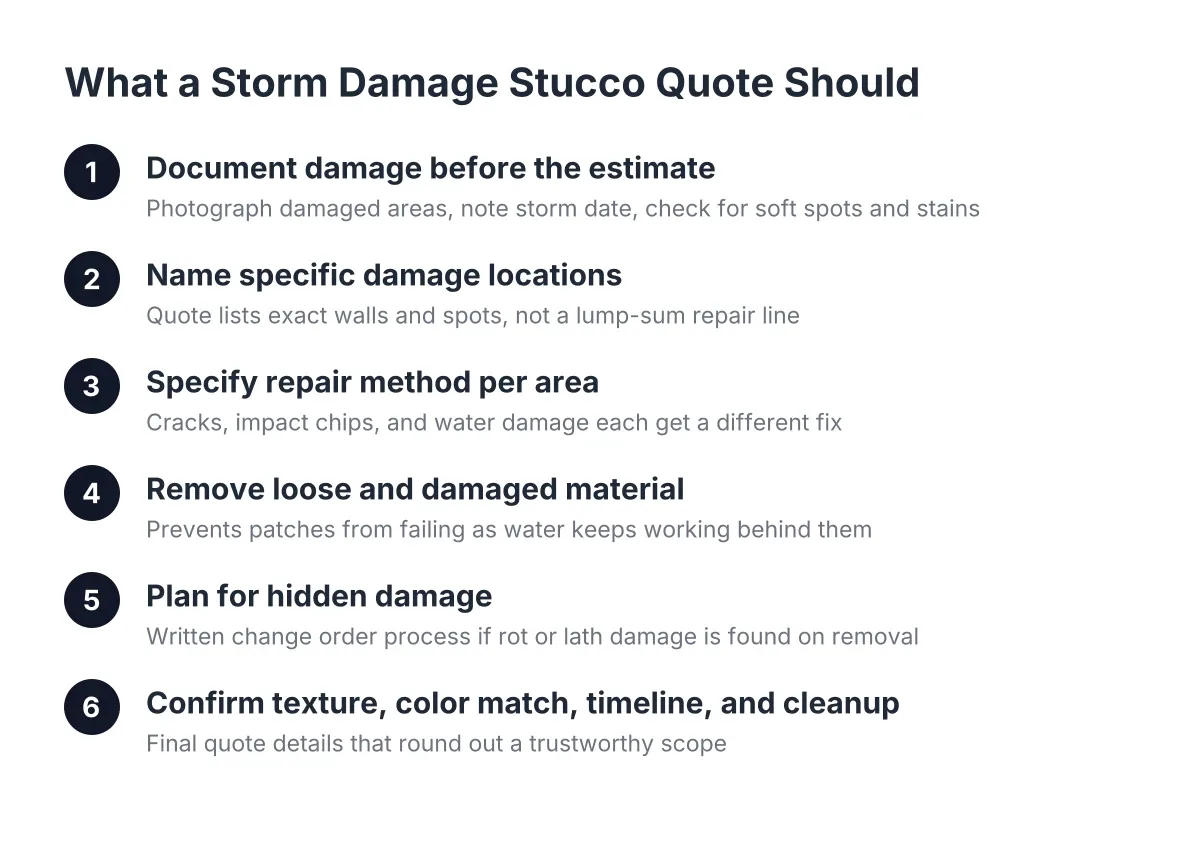
Storm damage also raises the insurance question, and the honest answer is that timing and documentation drive the outcome. Photograph everything with dates before any repair work starts, note which walls faced the storm, and report promptly. Insurers scrutinize hail claims closely; between 2018 and 2020, hail claims nationally rose 2% while questionable claim submissions rose 34%, according to Rocky Mountain Insurance Information Association. Clean, dated documentation puts you on the right side of that scrutiny. Urgency: document within days, repair before the first hard freeze.
How fast does water damage behind stucco actually spread?
Water damage behind stucco typically develops over months, not days, but it accelerates once the layers behind the finish start to fail. A hairline crack can weep for a year with little harm. Once building paper tears or sheathing stays wet, damage compounds with every storm, and repair scope grows with it.
Here is a plain-spoken urgency timeline to work from:
- Hairline cracks, no staining: monitor, repair within the year, ideally before winter.
- Wide or stair-step cracks: schedule crack repair within the season.
- Recurring stains: find the entry point within a few weeks.
- Soft spots or hollow-sounding areas: inspection and repair within days to two weeks.
- Bulging stucco, interior smells, or fresh storm damage before winter: act now.
Does water damage stucco itself? Yes, but the stucco is the cheap part. The sheathing, framing, and drywall behind it are where a $900 patch grows into a $5,000 open-the-wall job. That range is illustrative, not a quote; every wall is different, and nobody can price hidden damage honestly without seeing it.
What a straightforward repair looks like for water damage behind stucco
A proper stucco water damage repair follows the same rough sequence, whether it is a small patch under a window or a full wall section. Knowing the steps helps you judge whether a crew knows the material.
First, the damaged and loose stucco comes off, all of it, down to solid material. Next, the crew inspects the paper and sheathing, replaces what is wet or rotted, and lets any repaired wood dry and cure properly before closing the wall. Then new layers go on, working from the bottom of the repair upward, followed by texture matching so the patch reads as part of the wall instead of a scar. A poorly matched patch is usually the fingerprint of someone who did not match the original technique.
One trade-off worth naming: for a rental where the vacancy window is tight, a partial corner patch is a legitimate, cheaper alternative to re-stuccoing a whole wall. It works, but only if the underlying cause, such as a missing gutter or pooled drainage, gets fixed too. Otherwise the same crack returns in a year or two. On the insurance side, storm damage stucco repair scope should be settled with the adjuster before work starts, since repairs done first can complicate a claim. If you find widespread soft spots, interior mold, or damage near electrical penetrations, bring in a professional rather than probing further yourself; opening a wet wall wrong can spread the problem.
The bottom line for Castle Rock walls
Stucco fails quietly. The stain, the soft spot, and the musty bedroom are late chapters of a story that started with a small crack or a hailstorm two seasons ago. The homeowners and landlords who get off cheap are the ones who treat a returning stain as a deadline, not a nuisance.
You do not need to know what is behind the wall to act. You need dated photos, a walk around the house after every major storm, and a local stucco repair crew who will explain what they find before they open anything up. Catch water damage behind stucco while it is still a patching job, and it stays one.
If you need stucco repair, Castle Rock Stucco Pros can help.
Prefer to talk it through? Call (720) 797-8506 — a quick call is usually the fastest way to get a straight answer for your situation.