How Water Penetrates Stucco, Causes Rot, and What Repair Really Takes
You noticed a stain under a window, a soft spot near the foundation, or a patch of stucco that sounds hollow when you tap it. Now you want to know two things: is there damage behind the wall, and how big is the fix. Understanding the difference between stucco repair vs remediation is the first step, because the visible symptom is almost never the whole story. Some of these problems are cosmetic and cost a few hundred dollars to patch. Others mean opening the wall. This guide walks through the difference, in plain terms, the way a crew that inspects before quoting would explain it on your porch.
That distinction matters most if you are getting a house ready to list. A stained or bubbling stucco wall shows up in listing photos, and it shows up again in the inspection report. Knowing whether you are looking at a two-day patch or a section of wall that needs attention changes your timeline and your budget before you go to market.
Why Stucco and Water Are a Bad Match
Stucco itself is not waterproof. It never has been. Traditional cement stucco absorbs water when it rains, then dries out when the sun comes back. That cycle works fine as long as two things are true: the water can drain out, and the layers behind the stucco stay intact.
Behind the stucco you should have a weather-resistive barrier, usually building paper or house wrap, plus flashing around windows, doors, and rooflines. That barrier is the actual waterproofing. The stucco is the armor; the paper is the raincoat. When the raincoat has a hole, or the water has no path to drain, moisture sits against the wood sheathing and framing. That is where rot starts.
Colorado weather makes this worse in a specific way. We get hard, wind-driven rain and hail in the spring, then freeze-thaw cycles through the winter. Water that gets into a hairline crack in September can freeze in November, expand, and turn that hairline into a wider crack by March. Hail matters here too. According to the Rocky Mountain Insurance Information Association, Colorado Springs, Denver, and Greeley rank among the top 10 U.S. cities for hail loss claims, together representing 10% of total hail claims between 2018 and 2020. Castle Rock sits in that same corridor. Hail chips and cracks stucco, and every chip is a new entry point.
How Water Penetrates Stucco and Causes Damage Behind the Wall
Water gets behind stucco through predictable weak points, then damages the wall from the inside out. The most common entry points are unsealed cracks, failed caulking around windows, missing or misinstalled flashing, and stucco that runs too close to the ground. Once inside, water rots sheathing and framing long before you see it on the surface.
Here is the typical sequence when water penetrates stucco, causes hidden rot, and finally shows on the outside:
- Water finds an entry point. A crack wider than a credit card edge, a gap where caulk pulled away from a window frame, or a spot where a deck ledger or light fixture punched through the barrier.
- The barrier fails or gets overwhelmed. Building paper tears during installation, laps the wrong way, or simply cannot handle the volume coming through a bad flashing detail.
- Moisture sits against the sheathing. With no drainage path, the wood stays wet. Wet wood plus time equals rot, and in some cases mold on the interior side of the wall.
- Symptoms finally reach the surface. Stains bloom below windows, the stucco softens or bubbles, and cracks widen as the wall behind them loses strength.
The frustrating part is step four. By the time you can see or feel the damage, the water has usually been working for months or years. That is why a crew that only quotes what it can see from the driveway is guessing.
The Weak Points That Fail First
Windows are the number one trouble spot. Water runs down the wall, hits the top of the window, and needs flashing to steer it back out. If that flashing is missing or installed backward, water rides the window frame straight into the wall. Diagonal cracks running from window corners and stains directly below the sill are the classic tells.
In addition, watch the bottom of your walls. Stucco needs a weep screed at the base, a metal strip that lets absorbed water drain out. When landscaping, concrete, or mulch buries that screed, water wicks upward instead of draining down. Stucco that touches soil or sits below grade almost always shows moisture damage eventually.
Other common failure points include roof-to-wall intersections without kickout flashing, penetrations like hose bibs and light fixtures sealed with nothing but a bead of old caulk, and horizontal surfaces like parapet caps and wall tops that collect standing water.
Reading the Signs: Cosmetic Damage Versus Serious Water Intrusion
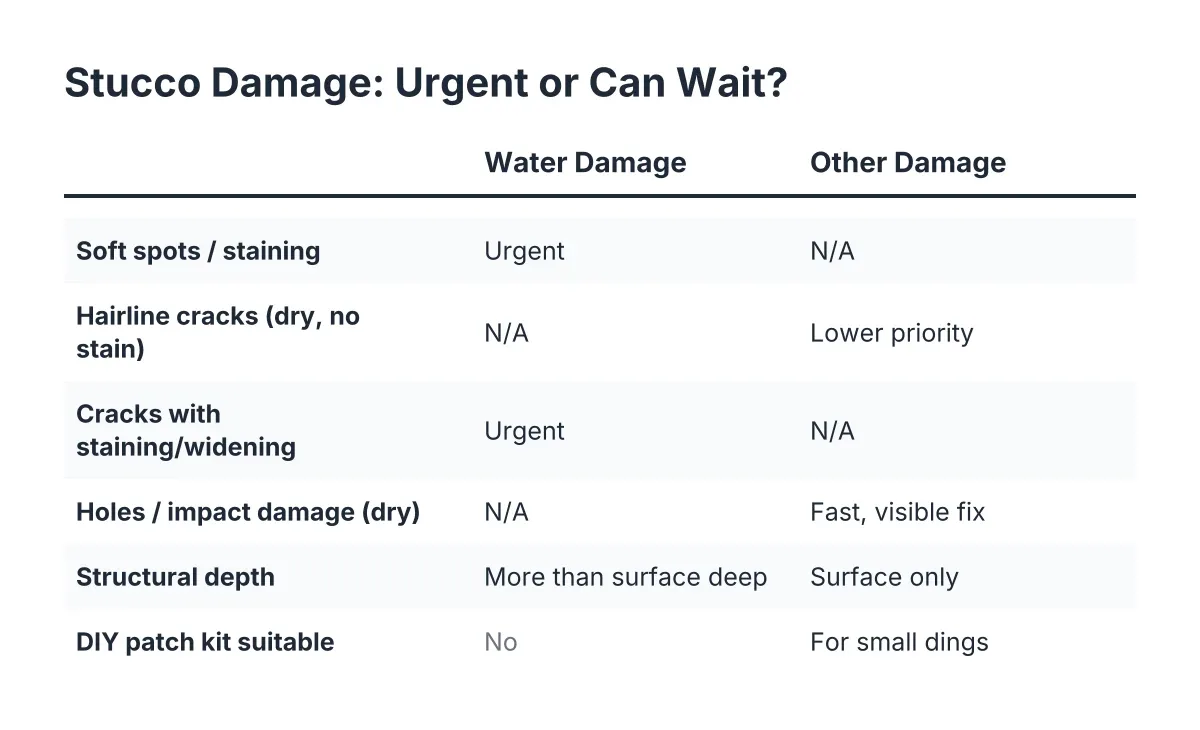
Not every stain means rot, and not every crack means water. Here is how to read what your wall is telling you, roughly in order of severity:
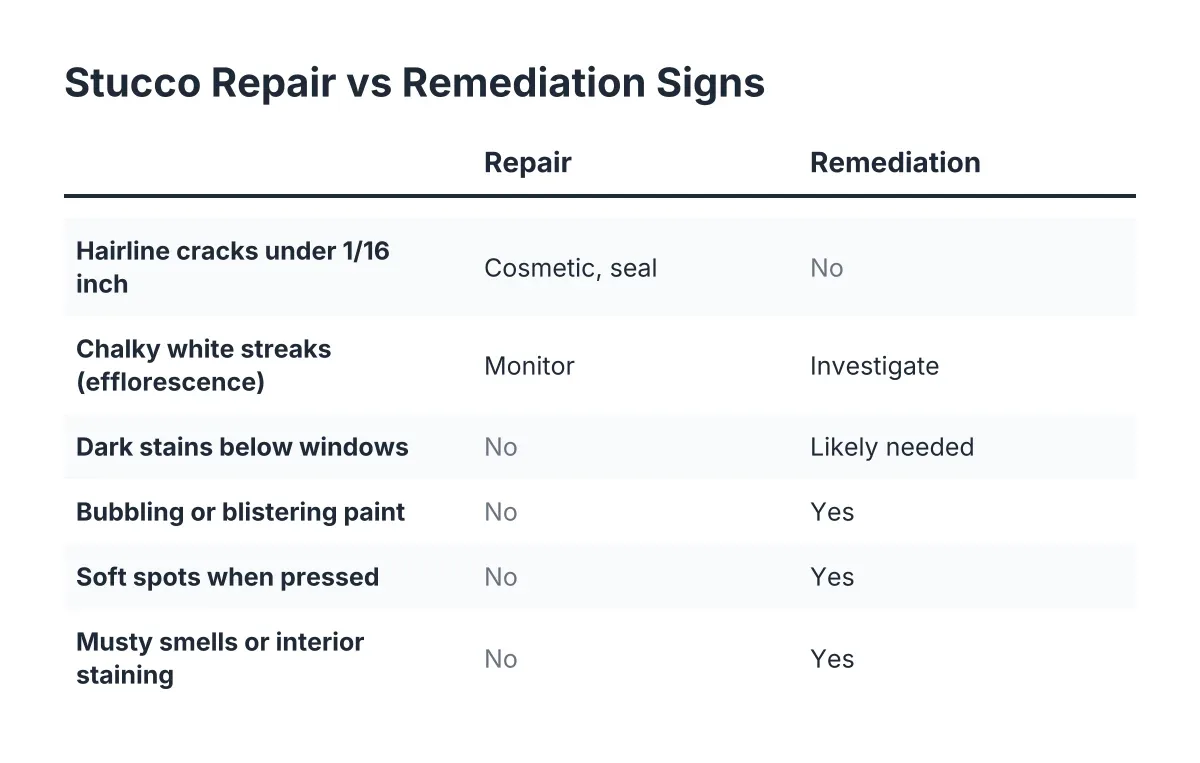
- Hairline cracks under 1/16 inch. Usually normal settling or shrinkage, especially on newer homes. Cosmetic in most cases, but worth sealing so they do not become entry points.
- Chalky white streaks (efflorescence). Minerals left behind when water moves through the stucco and evaporates. This confirms water is moving through the wall; the question is how much and from where.
- Dark stains below windows or at wall bases. A stronger signal, especially if the stain reappears after dry weeks. Water is getting in above and tracking down.
- Bubbling, blistering, or peeling paint on stucco. Moisture is pushing out from behind the surface. This is past cosmetic.
- Soft spots. Press on the stucco. If it gives, crumbles, or sounds hollow when tapped, the material has lost its bond or the sheathing behind it has softened. This means opening the wall to look.
- Interior clues. Musty smells, stained drywall, or swollen window trim on the inside of an exterior wall point to water that has made it all the way through.
A soft spot in a stucco wall is the line in the sand. Above that line, you are probably talking about crack repair, patching, and sealing. At or below it, someone needs to see what the sheathing looks like before anyone can honestly quote the job.
What Happens When Water Penetrates Stucco and Causes Rot on Newer Homes
Newer construction is not immune; in some ways it is more exposed. A wave of homes went up around Castle Rock, Stonegate, Meridian, and Carriage Club over the past decade, and stucco is only as good as the crew and the schedule behind it. Stucco applied in cold weather, cured too fast in dry heat, or layered over rushed flashing work can start cracking and delaminating within the first one to five years.
That timing is the painful part. Defects often surface right around the time the builder warranty expires or the builder stops returning calls. For example, suppose a homeowner in Stonegate notices diagonal cracks off two window corners at year three, files a warranty claim, and gets told the cracks are "normal settling." By year five the stucco below one window is soft and stained. The fix at year three might have been sealing and patching in the low hundreds. At year five it is more likely opening that section, replacing a strip of rotted sheathing, and re-stuccoing with texture matching, plausibly in the $1,500 to $5,000 range depending on what the wall reveals. Those figures are illustrative estimates, not quotes; the real number depends entirely on what is behind the stucco.
If your builder warranty is still active and the builder is responsive, use it first. An independent repair crew is the right call once that path is exhausted, not a replacement for it. A repair contractor also cannot fight the warranty claim for you; that is between you, the builder, and possibly an attorney.
When to Choose Repair Versus Remediation
This distinction between stucco repair and remediation is crucial because the two jobs differ by a factor of ten or more in cost and disruption.
When Repair Is Enough
Repair means the stucco itself is damaged but the wall behind it is sound. The work stays on the outside:
- Stucco crack repair. Cracks get routed out, filled with the right sealant or patching compound, and finished to match the surrounding texture.
- Stucco patching. Chipped, hail-damaged, or locally soft areas get cut out and rebuilt in layers, then textured and color-matched to the existing wall.
- Sealing and detail work. Recaulking window perimeters, clearing weep screeds, and fixing the small entry points before they cause bigger trouble.
Repair jobs on this scale often run from a few hundred dollars to a couple thousand, depending on the size and access. For a seller, this is usually the sweet spot: the wall photographs clean, the inspector sees maintained stucco instead of open questions, and you have not overspent on a house you are leaving.
When Remediation Is Required
Remediation means water penetrates stucco, causes rot in the sheathing or framing, and the fix has to go behind the surface. The stucco in the affected area comes off entirely. Damaged sheathing gets replaced, the weather barrier and flashing get rebuilt correctly, and new stucco goes on over the corrected assembly.
However, remediation is not automatically a whole-house job. If moisture testing shows the damage is limited to the wall under one window, the tear-off can be limited too. The horror stories, the ones where a family spends tens of thousands and still has leaks, usually trace back to remediation that fixed the stucco but never fixed the flashing detail that let water in. New stucco over an old leak is an expensive way to hide the same problem.
The honest trade-off: remediation costs more and takes longer, but patching over rot costs the most of all, because you pay for the patch now and the remediation later. There is no cosmetic fix for wet wood.
How Moisture Testing Tells You Which Job You Have
Stucco moisture testing is how you find out whether you need a patch or a tear-off without guessing. A proper inspection typically includes a visual survey of every crack, stain, and detail, moisture meter readings through the wall at suspect spots, and sometimes small probe holes to check the sheathing directly. Probe holes are minor; they get patched as part of the work.
The reading pattern tells the story. Dry readings behind a stained wall suggest an old leak that was already corrected, or surface staining with no active water path. Elevated readings around one window point to a localized flashing failure. Elevated readings along an entire wall base usually mean a buried weep screed or grading problem.
Therefore, be wary of anyone who quotes a full remediation from the sidewalk, and equally wary of anyone who promises a cheap patch without touching the wall. Both are selling a scope sight unseen. A general water damage restoration company can handle interior drying and mold, but diagnosing and rebuilding a stucco wall assembly is its own trade. If interior walls are wet or you suspect mold, bring in the right specialist for that part; stucco water damage on the exterior and moisture damage inside the house are related problems that sometimes need different crews.
What This Means If You Are Selling
Sellers face a specific version of this problem: the timeline is fixed and the inspection is coming either way. A few practical points for 2026 listings around Castle Rock, Lone Tree, and Stonegate:
First, deal with visible stucco issues before photos, not after the inspection report. Cracks and stains in listing photos invite lowball assumptions; buyers tend to mentally price small stucco flaws as big ones. Insurance pressure feeds that caution too. Colorado home insurance premiums rose 65% over the last five years, with hail a major driver, according to the National Association of Insurance Commissioners, so buyers here are already primed to worry about exterior condition.
Second, get the wall tested before you decide what to spend. If moisture readings are dry, a crack repair and patching pass with good texture matching may be all the house needs. That is a modest cost that protects the sale price. If readings show trapped moisture, you want to know now, on your schedule, not from the buyer's inspector two weeks before closing.
Third, do not paint over active problems. Fresh paint over a wet wall bubbles and stains again, sometimes within a season, and a sharp inspector will flag recent paint over suspect stucco anyway. Fix, then paint.
Finally, keep the paperwork. A written scope from a local stucco repair crew describing what was tested, what was found, and what was fixed is worth real money at the negotiating table. It turns "unknown stucco condition" into "documented repair," which is exactly what a nervous buyer wants to see.
The Bottom Line
Stucco fails at the details: window flashing, weep screeds, penetrations, and cracks left open through a few freeze-thaw winters. Stains and efflorescence say water is moving through the wall. Soft spots say it has been sitting there. The only honest way to price the fix is to test the wall first, because the difference between patching and remediation is the difference between a few hundred dollars and several thousand.
Whether you are correcting a builder defect on a five-year-old home in Meridian or getting an older Castle Rock house camera-ready for market, the order of operations is the same. Find the entry point, confirm what the water has done behind the wall, fix the assembly, then make the surface match. Done in that order, the repair holds. Done in reverse, you are painting over a problem that will come back with the next storm.
If you need stucco repair, Castle Rock Stucco Pros can help.
Prefer to talk it through? Call (720) 797-8506 — a quick call is usually the fastest way to get a straight answer for your situation.