Stucco Repair Pricing: Fixed Cost, Hourly Rate, or Square Footage Method?
If you have been staring at a crack in your stucco and trying to figure out what fixing it should cost, you have probably noticed that every contractor seems to price the job a different way. Understanding how a stucco repair pricing method works—whether as a flat bid, an hourly rate, or a per-square-foot calculation—is the single most useful thing you can learn before you pick up the phone. One gives you a flat number. Another talks about hourly rates. A third quotes by the square foot. It tells you whether a quote is fair, padded, or so low it signals a shortcut.
This guide walks through all three pricing methods, explains which one fits which kind of repair, and shows you what actually drives the number up or down on a Castle Rock home. By the end, you should be able to look at two different quotes, priced two different ways, and compare them on equal footing.
Why Stucco Repair Quotes Look So Different
Stucco repair is not one job. It ranges from sealing a hairline crack near a window corner to cutting out and rebuilding a full wall section after hail punches holes through the finish coat. Those two jobs share a material and almost nothing else. That range is why quotes vary so much, and why no single pricing method works for every repair.
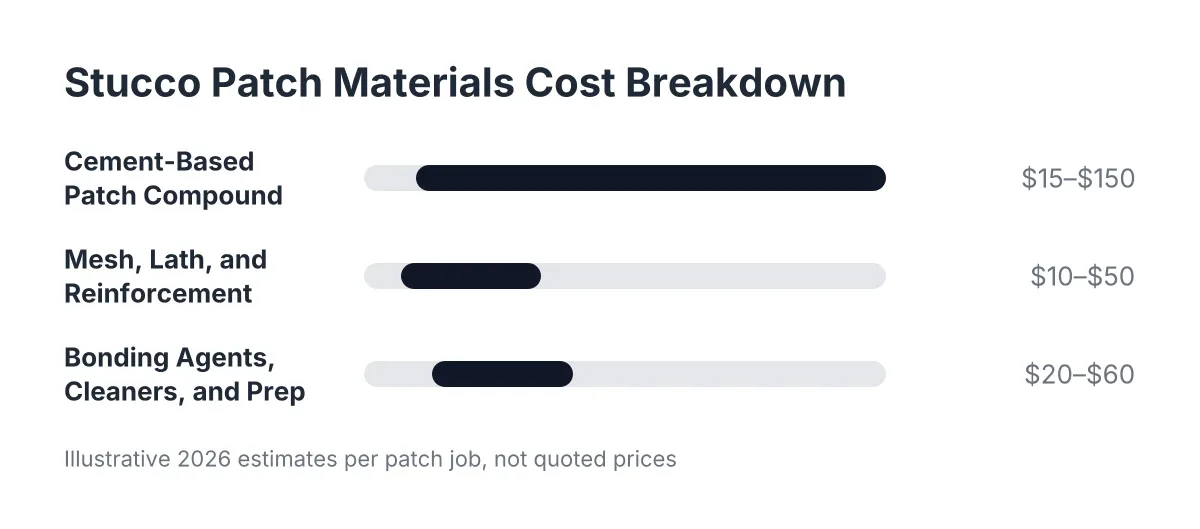
A small crack repair is mostly labor and skill. The materials, patch compound, sealant, and mesh, cost less than the gas to drive to the job. A large patch after water damage is the opposite; demolition, lath work, weatherproofing, multiple coats, and texture matching all stack up. A contractor who prices both jobs the same way is either overcharging the small job or undercharging the big one.
National franchise operations tend to flatten this complexity into a one-size estimate generated by someone in a call center who has never seen your wall. Thin local websites often do the reverse and throw out a lowball number to get the call, then revise it on site. Neither tells you how the price was built. A good local stucco repair quote should tell you which pricing method was used and why.
Understanding Your Stucco Repair Pricing Method Options
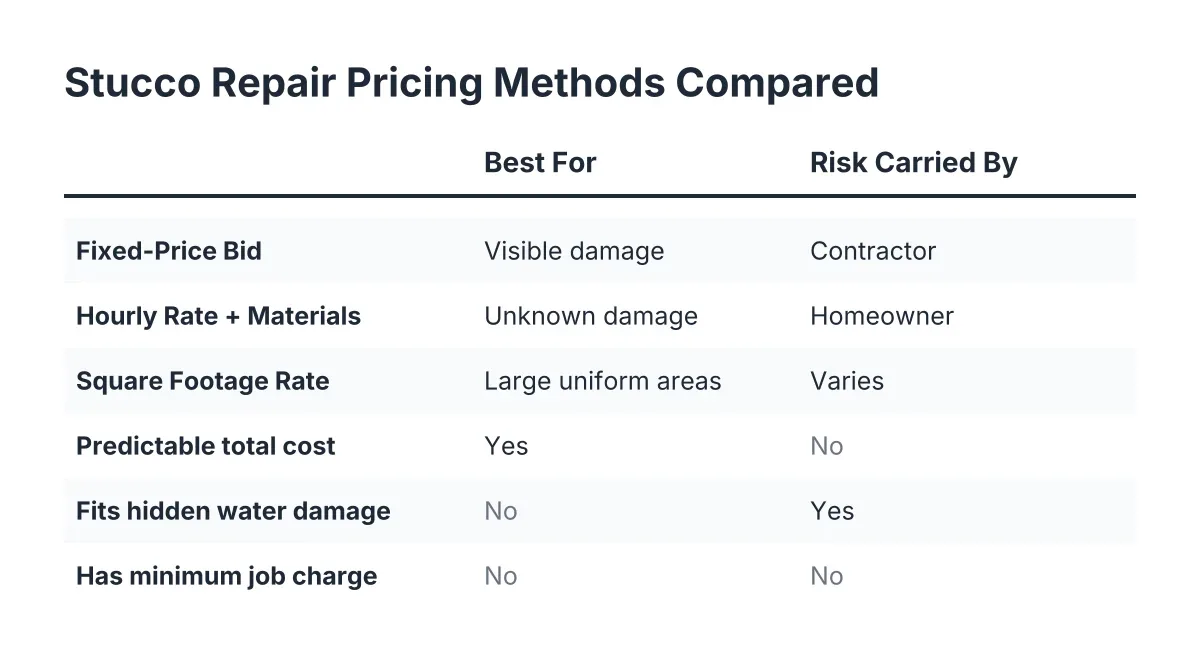
Stucco repair pricing gets fixed in one of three ways: a flat fixed bid for the whole job, an hourly labor rate plus materials, or a per-square-foot rate applied to the repair area. Each method fits a different kind of job, and each shifts risk differently between you and the contractor. Knowing which method fits your repair protects you from paying for the wrong one.
Fixed-Price Bids: Best for Defined, Visible Damage
A fixed bid means the contractor looks at the damage, scopes the work, and commits to one number. You know your total before anyone mixes a batch of patch compound. For most Castle Rock homeowners, this is the method you want for crack repair, stucco patching, and hail damage where the full extent is visible from the outside.
The strength of a fixed bid is predictability. The contractor carries the risk of the job taking longer than expected. Additionally, the weakness shows up when hidden damage appears. If the crew opens up a patch area and finds rotted sheathing or soaked insulation behind it, the fixed price no longer covers the real job. A fair contractor handles this with a written change order, not a verbal "it'll be a little more."
Here is what a trustworthy fixed bid should itemize:
- The exact repair area, measured or clearly described
- Demolition and removal of loose or buckling material
- Lath or mesh work, if the patch goes down to the wire
- Base coats and finish coat, or a one-coat polymer-modified repair product
- Texture matching to the surrounding wall
- Color matching or a note that painting is separate
- What happens, in writing, if hidden damage is found
If a quote is one line that says "stucco repair, $1,800," you have no way to compare it to anything. Ask for the breakdown. A contractor who built the number honestly can show you the parts.
Hourly Rate Plus Materials: Best for Unknowns
Time-and-materials pricing means you pay an hourly labor rate plus the actual cost of materials. This method makes sense when nobody can see the full scope yet. Water damage is the classic case. A stain or a soft spot on the wall tells you water got in, but not how far it traveled behind the stucco.
With hourly pricing, you carry the risk instead of the contractor. If the damage turns out to be minor, you pay less than a padded fixed bid would have charged. If the crew opens the wall and finds two studs' worth of rot, you pay for what it actually takes. Honest hourly pricing beats a fixed bid that was inflated to cover every possible surprise.
The protection you need with hourly work is a cap and a check-in point. Ask the contractor to stop and show you what they found once the wall is open, before the repair phase starts. At that point, many contractors will convert the rest of the job to a fixed price, because the unknowns are gone. That hybrid approach, hourly for discovery and fixed for repair, is often the fairest structure for stucco water damage repair.
Square Footage Pricing: Best for Large, Uniform Areas
Per-square-foot pricing applies a rate to the measured repair area. It works well when the damage is spread across a large, uniform surface, such as a full wall section that needs the stucco siding material replaced from corner to corner. It works poorly for small repairs, and this is where homeowners get burned in both directions.
The problem is setup cost. Whether a crew repairs 4 square feet or 40, they still drive out, set up, mix material, match texture, and clean up. On a small patch, that fixed overhead dominates the price. A per-square-foot rate that is fair for a 200-square-foot wall would not even cover the trip for a 5-square-foot patch. That is why most contractors carry a minimum job charge, and why the stucco repair cost per square foot you see in national calculators drops as the job gets bigger.
As a result, square footage quotes only tell you something useful above a certain size. For 2026 budgeting purposes, treat per-square-foot numbers as meaningful on jobs larger than about 50 square feet, and treat anything smaller as a fixed-bid or minimum-charge situation.
What Actually Drives the Number Up or Down
Whichever method fixes the price, the same underlying factors drive it. Understanding them lets you predict roughly where your job lands before anyone quotes it.
Depth of the damage. A hairline crack that only touches the finish coat is sealant and texture work. A crack or hole that goes through to the lath means demolition, new mesh, weatherproofing, and base coats before anyone touches the finish. Depth multiplies cost more than width or length does.
Texture matching difficulty. Castle Rock homes carry a range of finishes, from smooth sand textures to knockdown dash. Blending a patch into a knockdown dash finish means spraying finish coat onto the patch and lightly troweling it down so it disappears into the wall. That takes a skilled hand. A cheap repair often skips this, and the result is a patch you can spot from the street. A visible patch usually means a less skilled worker did the repair without matching the original technique.
Access. Ground-level repairs on a single-story wall cost less than second-story gable work that needs scaffolding or extended ladders. Height can add meaningful labor time to an otherwise small patch.
Hidden moisture. Water damage behind stucco is the biggest cost wildcard. Before any repair, all loose or buckling material has to come off; leaving it in place lets rain keep expanding the wood underneath and makes the damage worse over time. What is behind that loose material determines whether the job stays small.
Season and weather. Stucco and sealants are temperature-sensitive. Large crack repairs with caulking go better in cool morning hours than in hot afternoon sun, where the caulk cures poorly. In Colorado, shoulder-season scheduling can affect both the timeline and the quality of the cure.
The root cause. A patch on a cracked corner is quicker and cheaper than re-stuccoing, but if the cause, such as vibration or poor drainage, is not addressed, the crack comes back and you pay twice. A quote that includes a sentence about cause is worth more than one that only prices the patch.
A Hypothetical Castle Rock Example: Three Different Stucco Repair Pricing Methods
Suppose a hailstorm moves through Castle Rock and leaves a homeowner with a dozen impact chips on the west-facing wall, a spreading crack from a window corner, and one soft, stained patch near a downspout. The homeowner files an insurance claim and collects three estimates. The numbers below are illustrative, not quotes.
The first contractor offers a fixed bid of $2,400 covering the chips and the crack, with the soft spot excluded pending investigation. The second quotes time and materials at an hourly crew rate, estimating one to two days, which could land anywhere from $1,600 to $3,500 depending on what the soft spot hides. Furthermore, the third quotes $14 per square foot across a measured 180 square feet, about $2,500, treating the whole wall as one repair zone.
In that scenario, the smartest structure is a mix. Take a fixed price on the visible hail chips and crack repair, because the scope is fully visible. Take hourly discovery on the water-damaged spot, with a stop-and-show checkpoint once the wall is open. Skip the blanket square footage quote, because the damage is not uniform across the wall; you would pay wall-section rates for work that is mostly small patches.
This matters for insurance too. Colorado homeowners have felt hail in their premiums; according to Rocky Mountain Insurance Information Association, the average homeowner's insurance premium rate in Colorado increased 57.9% from 2018 to 2023, well above the 33.8% national average increase, driven partly by catastrophic hail and wildfire losses. Hail drives much of that; the state's May 2017 Front Range hailstorm caused $2.3 billion in insured damage, according to National Insurance Crime Bureau. Adjusters see a high volume of stucco claims, and an itemized, method-labeled estimate moves through a claim faster than a single-line number.
Comparing Quotes That Use Different Pricing Methods
The hardest comparison is a fixed bid against an hourly estimate, because one number is a commitment and the other is a range. To compare them fairly, convert everything to a worst-case total.
First, ask the hourly contractor for a not-to-exceed number. If they will not give one, ask what the job costs if everything that could go wrong does. Second, ask the fixed-bid contractor what triggers a change order and what those changes typically cost. Now you have two worst-case numbers, and you can compare them directly.
Next, check what each quote includes at the finish line. Two quotes can differ by $600 simply because one includes color and texture matching and the other hands you a gray patch and wishes you luck with the paint store. On stucco siding, the finish is most of what you see, so a quote without texture matching is not a complete repair quote.
Watch for these signals when reading quotes side by side:
- A number with no scope attached. If the quote does not describe the repair area and the layers involved, the price is a guess.
- A per-square-foot rate on a tiny patch. This usually means a minimum charge is hiding behind the math, or the rate was inflated to cover overhead.
- No mention of what is behind the stucco. Any quote on water damage that ignores the possibility of hidden rot is priced to win the job, not finish it.
- No change-order language. Verbal "we'll figure it out" arrangements are where budget disputes start.
- A price far below the others. Cheap stucco repair often means a skim coat over damage that needed removal. The crack returns, and the repair cost doubles because the second crew has to undo the first repair.
That last point deserves emphasis for anyone comparing cheap versus quality stucco repair. Proper repair starts by removing everything loose, works from the bottom of the repair area upward, and either rebuilds the coats or uses a polymer-modified one-coat repair product that replaces the traditional scratch and brown coats for patch work. A skim-coat shortcut skips the removal step, which is exactly the step that determines whether the repair lasts.
Where Each Method Fits: A Quick Decision Guide
Fixed-price bids fit small and medium repairs with fully visible damage: hairline cracks, hail chips, impact holes, and defined patches. Hourly plus materials fits jobs with hidden scope, mainly water damage, ideally with a checkpoint and a cap. Square footage fits large, uniform areas, typically full wall sections or stucco siding material replacement above roughly 50 square feet.
There is one more boundary worth knowing. When damage on a corner or wall section is widespread enough, the technically correct fix is removing the stucco and repatching the full section from corner to corner rather than spot-patching. At that scale, square footage pricing becomes the honest method, and comparing it against repeated small patches is how you find the break-even point between patching and section replacement.
One limitation to be clear about: no article can diagnose your wall. A crack that looks cosmetic from the lawn can connect to movement or moisture that only shows up when someone who knows stucco looks closely. If a crack is wider than a credit card edge, growing, running diagonally from a window or door corner, or paired with staining or soft spots, get a local professional's eyes on it before deciding anything about price. The same goes for anything that might be a foundation issue rather than a stucco issue; that calls for a structural evaluation, not a patch quote.
Questions to Ask Before Any Price Is Fixed
Before you accept a number, ask the contractor how the stucco repair pricing method was determined and make them defend the method, not just the total. Five questions do most of the work:
- Which pricing method is this quote based on, and why does it fit this job?
- What exactly is included: demolition, lath, coats, texture matching, color matching?
- What happens if you find hidden damage once the wall is open?
- How will you match the existing texture, and can I see the blended edge before final payment?
- What caused this damage, and does the repair address the cause or just the symptom?
A local Castle Rock contractor who works with stucco every week can answer all five in plain language on your porch. A call center reading from a script cannot. That difference, more than any per-square-foot rate, is what separates a repair priced to last from a number priced to close.
The method behind the price tells you as much as the price itself. Fixed bids reward visible, well-defined damage. Hourly rates handle the unknowns honestly. Square footage math earns its place on big, uniform sections. Match the method to your damage, demand an itemized scope either way, and you will know a fair quote when you see one, whether it is the highest number on the table or the lowest.
If you need stucco repair, Castle Rock Stucco Pros can help.
Prefer to talk it through? Call (720) 797-8506 — a quick call is usually the fastest way to get a straight answer for your situation.