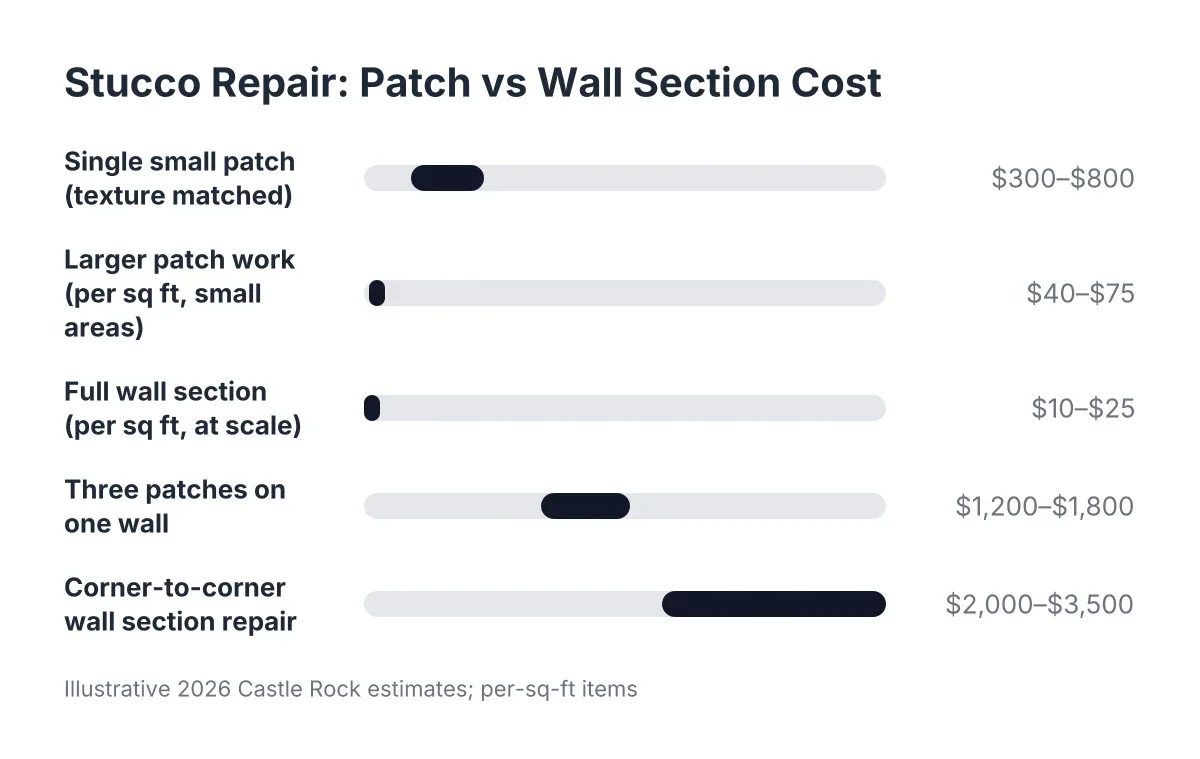
Stucco Repair Cost Per Square Foot: What Cracks and Patches Really Run
If you have been searching for stucco repair cost per square foot numbers, you have probably noticed a problem. Most of what comes up is either a national calculator that spits out one vague range for the whole country, or a thin local page that lists a suspiciously low price and no explanation of what it covers. Neither one helps you budget for the actual crack on your actual wall in Castle Rock. This guide provides a comprehensive stucco repair cost breakdown that takes a different approach than the typical online estimates.
This guide takes a different approach. Instead of one blended number, we break the cost down the way a stucco crew actually prices a job: by the type of damage, the size of the repair, and the work hiding behind the surface. By the end, you should be able to look at a quote and know whether it is itemized honestly or padded with air.
Why Per Square Foot Pricing Confuses Homeowners
Per square foot pricing works well for big jobs and poorly for small ones. That is the single most important thing to understand before you compare quotes.
Here is why. Every stucco repair carries fixed costs that do not shrink with the job: driving to your house, setting up, mixing material, matching your texture, and cleaning up. On a 200 square foot wall section, those fixed costs spread thin and the per square foot number looks reasonable. On a 4 square foot patch below a window, those same fixed costs get divided by four. The math makes small repairs look expensive per square foot even when the total dollar amount is modest.
So when a national cost guide says stucco repair runs a certain amount per square foot, ask which end of the job spectrum that number came from. A blended average of hairline crack repairs and full wall sections describes neither one accurately.
As a rough illustration, and these are estimates rather than quotes, small crack and patch work often lands in the low hundreds of dollars total, while larger wall sections with water damage can climb into the thousands. The per square foot figure on the small job might be several times higher than on the large one, and both prices can be fair.
What Stucco Repair Costs Per Job Type
Stucco repair costs vary by job type more than by any other factor. A hairline crack, a structural crack, a patch, and a water-damaged wall section are four different jobs with four different price logics. Comparing them under one number is how homeowners end up either overpaying for a simple fix or underestimating a serious one. Understanding the stucco repair cost breakdown for each category helps you make informed decisions about your property.
Hairline cracks: the cheapest fix on the list
Hairline cracks are thin surface cracks, usually under an eighth of an inch wide. Some appear as stucco cures and are a normal part of how the material behaves, not a defect. Repairing them typically means cleaning the crack, filling it with an elastomeric sealant or patch compound, and blending the texture.
For pricing, expect these jobs to be billed as a small flat fee or a short service call rather than by the square foot. The material cost is minor. What you are paying for is the trip, the prep, and the texture blending, which is the part most homeowners get wrong when they try it themselves.
Structural cracks: wider, deeper, and priced differently
Structural cracks are wider and deeper than hairline cracks, and they need more than paint or a smear of caulk. The correct repair usually involves opening the crack slightly, inserting backer rod, and then sealing over it. Backer rod is a closed-cell foam cord that creates a backing inside the crack before sealant goes on, according to Sika. Without it, sealant sinks into the gap and fails early.
Therefore, a quote for a wide crack should list more line items than a hairline quote: crack prep, backer rod, sealant, and texture work. If a bid for a quarter-inch crack looks identical to a bid for a hairline crack, one of them is priced wrong.
One useful piece of context: a crack at a corner where stucco sits on top of a concrete foundation is often a minor issue. The foundation and the stucco expand and contract at different rates, and the crack forms at the boundary. It still needs sealing so water stays out, but it is not usually a sign the wall is failing.
Patches: where stucco repair cost breakdown per square foot applies
Stucco patching covers holes, impact damage, crumbling spots, and small sections that have separated from the wall. Once a repair area gets larger than a dinner plate, per square foot thinking becomes more useful, because material and labor scale with area.
Modern polymer-modified patch products help keep these costs down. They can replace the traditional three-coat system with a single application, which cuts labor time on small and mid-size patches. On larger sections, or where the original stucco was a true three-coat system, matching the original build-up costs more.
The wild card in patch pricing is texture matching. A smooth or sand finish blends easily. A heavy lace or dash texture takes skill and time to replicate, and that shows up in the quote. When you see a repaired patch on a neighbor's house that stands out like a scar, that is usually the fingerprint of a worker who did not match the original finishing technique.
Water damage: the job where the visible stain is the smallest cost
Stucco water damage repair is the category where per square foot numbers break down completely, because the price depends on what is behind the wall, not on the wall's surface area.
If you are the homeowner staring at a brown stain that will not wash off, or pressing on a soft spot in a stucco wall near a window and feeling it give, here is the honest framing. The stain is a symptom. The cost drivers are underneath: wet sheathing, a torn moisture barrier, a failed flashing detail, or in the worst cases, rotted framing. No one can price that from the sidewalk, and anyone who quotes you a firm total without opening a small inspection area is guessing.
A fair water damage quote usually breaks into stages:
- Open a small section around the stain or soft spot to see what is wet.
- Fix the water source, whether that is flashing, a sealant joint, or drainage near a downspout.
- Let the wall assembly dry before closing it up.
- Rebuild the layers: barrier, lath, stucco, and texture.
- Match the color and texture so the repair does not advertise itself.
Each stage should appear on the quote as its own line. That structure protects you both ways. If the wall turns out to be dry behind the surface, you are not paying for framing repairs you did not need. If it turns out worse than expected, you see exactly where the added cost comes from instead of getting one bigger mystery number.
The Six Factors That Move Stucco Repair Prices Up or Down
The factors that affect stucco repair price are consistent from job to job, even when the totals are not. When you compare quotes, check how each bid handles these six items.
- Size and access. A patch at knee height costs less than the same patch two stories up on a gable end that needs scaffolding or a lift.
- Depth of damage. Surface-only repairs cost less than repairs that go through to the lath, the moisture barrier, or the sheathing.
- Texture complexity. Fine finishes blend cheaply. Heavy, layered textures take an experienced hand and more time.
- Color matching and painting. A repair on painted stucco can often be painted to blend. Integrally colored stucco is harder to match and may require painting a larger area or the whole wall for a uniform look.
- The underlying cause. A patch over an unfixed problem is temporary. If vibration, poor drainage, or a leaking window caused the damage, the cause needs addressing or the crack comes back and you pay twice.
- Weather and timing. Sealant and patch material behave badly in hot afternoon sun, so crews plan larger crack work for cooler morning hours. In Colorado, freeze-thaw cycles also limit the calendar for exterior work, which can affect scheduling more than price.
That fifth item deserves emphasis. The cheapest quote is often cheap because it skips the cause. Suppose two bids come in for the same cracked corner: one at a low price to fill and texture the crack, and one at a higher price that also regrades the downspout splash zone that has been soaking the base of that wall. The second bid costs more today and less over five years.
Repair, Repatch, or Replace: Evaluating the Stucco Repair Cost Breakdown
Repairing stucco costs less than replacing it in nearly every case, but there is a middle option most cost guides skip: repatching a full wall section.
Here is how the three paths compare. A spot repair fixes only the damaged area and blends it into the surrounding wall. A section repatch removes the stucco across a defined area, often corner to corner, and reapplies it as one continuous surface. Full replacement strips the stucco off the entire wall or house and starts over.
A spot patch on a deteriorated corner is the quicker, cheaper route, and for many homes it is the right call. However, the technically correct fix for a badly deteriorated corner is to remove the stucco and repatch the full section from corner to corner. The corner-to-corner approach costs more because you are paying stucco replacement cost per square foot across the whole section, but it eliminates the blend line and gives you one uniform surface that ages evenly.
For a Castle Rock rental owner, this trade-off is a practical business decision, not a purity test. Say a landlord has a duplex with a cracked, stained wall section and ten days before a new tenant moves in. In that scenario, a solid spot repair with the water source fixed, priced in the high hundreds, may beat a corner-to-corner repatch in the low thousands, as long as the landlord understands the blend line may show in raking light. What matters is that the quote tells you which path you are buying, because a repatch price and a spot-patch price are not comparable numbers.
Full replacement only makes financial sense when damage is widespread, when the original installation failed systemically, or when repair costs on an aging wall start recurring every season. If a contractor jumps straight to full replacement for one stained wall without opening it up first, get a second opinion.
How to Read a Stucco Repair Quote Like a Specialist
A trustworthy stucco repair quote answers four questions in writing: what is being removed, what is being fixed underneath, what is being rebuilt, and how the finish will be matched. If any of those four is missing, the number at the bottom is not really a price. It is a placeholder.
Compare that against the two failure modes you will run into while getting bids. The first is the vague franchise estimate: a single round number from someone who routed your call through a center two time zones away and may never see your wall before the crew shows up. The second is the lowball number from a thin website, priced to win the call and adjusted upward once the wall is open. Both hide the same information: what the price actually includes.
An itemized local quote should read something like this for a water-stained wall: open and inspect the damaged area, repair flashing at the window head, replace wet barrier and lath, apply patch material, match texture, and paint to blend. Six lines, each with a number or a clearly stated allowance for what cannot be known until the wall is open. That last part matters. An honest contractor will tell you which line items are firm and which depend on what the inspection reveals.
There is a broader cost picture worth naming here too. Colorado's climate is hard on every exterior surface, and insurers have noticed. The average homeowner's insurance premium rate in Colorado increased 57.9% from 2018 to 2023, well above the 33.8% national average, according to Rocky Mountain Insurance Information Association. Keeping stucco sealed and water out of the wall is one of the few maintenance items that directly protects you from the kind of compounding damage that turns a small stucco repair cost into an insurance claim.
When to Fix It Now Versus When It Can Wait
Water intrusion repairs should not wait a season; cosmetic cracks usually can. That is the simplest triage rule for budgeting.
Specifically, treat these as fix-soon situations: a dark stain that keeps growing or returns after cleaning, stucco that feels soft or crumbly near a window sill or downspout, and any musty smell inside along an exterior wall. Water inside a wall assembly does not stabilize on its own. Every wet month adds material to the eventual repair, which means the same stain costs more to fix next spring than it does now.
By contrast, a stable hairline crack that has not widened in a year is a schedule-when-convenient item. Seal it before winter if you can, since freeze-thaw cycles pump water into open cracks and widen them, but it is not an emergency.
One honest limitation: no article, including this one, can tell you what is behind your specific wall. Per square foot ranges and factor lists get you to a sound budget bracket. Confirming whether that soft spot near your window is a surface problem or a framing problem takes someone opening a small section and looking. For anything involving suspected water damage, mold, or structural movement, have a professional inspect before you commit to a number.
The Bottom Line on Budgeting for Stucco Repair
As of 2026, the most useful way to think about stucco repair cost breakdown is this: the number only means something once you know the job type behind it. Hairline cracks price as small flat fees. Structural cracks price by prep and materials like backer rod. Patches price by area and texture difficulty. Water damage prices by what the inspection finds.
Therefore, do not shop for the lowest single number. Shop for the most complete breakdown. Get quotes that itemize removal, underlying repairs, rebuild, and texture matching. Ask which lines are firm and which are allowances. Ask what caused the damage and whether the quote fixes the cause or just the surface.
A local crew that works with stucco every week can answer those questions on your porch in plain terms. That conversation, more than any calculator, is what tells you whether a price is fair.
If you need stucco repair, Castle Rock Stucco Pros can help.
Prefer to talk it through? Call (720) 797-8506 — a quick call is usually the fastest way to get a straight answer for your situation.