Stucco Patch Materials Cost: What Cement, Fibers, Pigment, and Labor Really Run
If you are comparing stucco repair quotes in Castle Rock and one bid is double the other, the first thing to pull apart is the stucco patch materials cost versus the labor. Materials are the smaller number on almost every patch job, but they are also where quotes get vague. A contractor who can tell you what the patch compound, mesh, pigment, and finish coat actually cost, and where the labor hours go, is giving you something you can compare. A contractor who hands you one round number is asking you to trust the number without seeing inside it.
This guide breaks a stucco patch down into its parts: the cement-based patch material, the reinforcement, the color and texture work, and the labor split. By the end you should be able to look at any quote and ask the right questions about each line, whether you are fixing a single crack or getting a wall ready before your home goes on the market.
Why Materials Are the Small Number and Labor Is the Big One
On a typical stucco patch, materials usually make up somewhere between 10 and 25 percent of the total price. Labor carries the rest. That ratio surprises homeowners who assume a $900 quote means $900 of product going on the wall. It does not. Most of what you pay for is skilled time: prep, mixing, application, texture matching, and cleanup.
This matters when you compare bids. Two Castle Rock contractors buying patch compound from the same supplier will pay about the same for it. The spread between their quotes comes from how many labor hours they plan, what they charge per hour, and how much texture and color matching work they expect. So when a quote looks high or low, the materials line is rarely the reason. Ask about hours instead.
It also explains why a "cheap" quote should make you careful rather than relieved. A contractor cannot cut much from the materials side; a bag of polymer-modified patch costs what it costs. The only place to cut deeply is labor, and cut labor on stucco means skipped prep, a rushed texture coat, or a single thick pass where two passes belong. The patch may look fine for a season and then crack or show a visible outline.
Breaking Down Stucco Patch Materials Cost Line by Line
A stucco patch needs four material categories: the base patch compound, reinforcement, bonding and prep products, and the finish layer that handles color and texture. Here is what each one does and what it typically runs. Treat every figure below as an illustrative 2026 estimate, not a quoted price; suppliers and job conditions move these numbers.
Cement-Based Patch Compound
The core of the repair is a cement-based patch material. For small repairs, most crews use a polymer-modified, rapid-setting stucco patch product. These products can replace the traditional three-coat system with a single application, which means no separate scratch and brown coats on a small patch. That is a real labor saver, and it is why a small patch can be done in one visit instead of three.
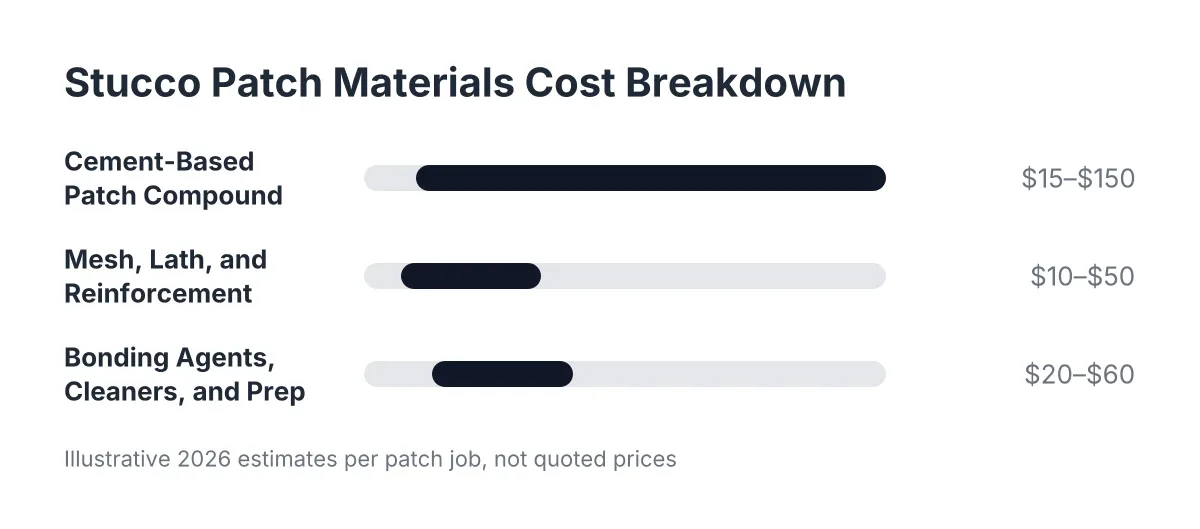
As an estimate, a bag of quality polymer-modified patch runs in the range of $15 to $40 depending on brand and bag size. A small crack repair might use part of one bag. A patch covering a few square feet might take two or three. Even a generous patch job rarely puts more than $100 to $150 of base compound on the wall. If a quote implies hundreds of dollars in patch material for a small repair, ask what else is in that line.
Traditional base-coat stucco mixed from cement, sand, and lime costs less per pound but takes more coats and more cure time between them. On larger wall sections, crews often go back to the traditional mix because it is cheaper at volume. On a patch, the rapid-set product usually wins because the labor savings outweigh the higher per-bag price.
Mesh, Lath, and Reinforcement
Cracks and holes need reinforcement so the new material does not just crack along the same line. Depending on the repair, that means fiberglass mesh tape over a crack, corner mesh on a damaged edge, or new wire lath behind a hole that goes through to the sheathing. Many patch products also come fiber-reinforced, with fibers mixed into the compound itself for added strength.
Reinforcement is cheap as a line item. Mesh tape, corner mesh, and small lath sections together usually land between $10 and $50 on a patch job. One trade-off worth knowing: fiber-reinforced coatings go on thick and can resist taking a fine texture, so the crew has to work the finish coat harder to hide the patch. On a low-visibility surface like a parapet wall, a slightly rougher match matters less. On the front of a house going up for sale, it matters a lot.
For deeper cracks, crews may use backer rod before sealant. Backer rod is a closed-cell foam cord that creates a backing inside the crack so the sealant sits at the right depth, according to Sika. It costs a few dollars per repair and makes the sealant joint last longer, so its presence on a quote is a good sign, not padding.
Bonding Agents, Cleaners, and Prep Products
Before any patch material goes on, the surface has to be clean. Loose debris, dust, oils, or grease will stop the new material from bonding to the old stucco, and a patch that never bonded will pop loose no matter how good the compound was. Prep products include bonding agent or latex additive, a masonry cleaner where needed, and masking supplies to protect windows and trim.
These items might total $20 to $60 per job. The product cost is trivial; the labor time behind it is not. A crew that budgets an hour of prep is doing the job right. A crew that skips it is where "cheap stucco repair near me" turns into paying twice.
Pigment, Paint, and the Finish Coat
The finish layer is where a patch becomes invisible or becomes a permanent gray square on your wall. If your stucco has integral color, the crew needs pigment mixed into the finish coat to match. If your stucco is painted, the patch gets primed and painted to match the existing color, which may mean repainting a larger area so the new paint does not flash against the faded old paint.
Pigment, primer, and paint for a patch typically run $30 to $100 in materials. Again, the material is cheap and the skill is expensive. Matching a hand-applied texture like lace, dash, or sand finish takes an experienced hand with a steel trowel, a rubber float, and often a sponge float to feather the new material into the edge of the existing texture. That feathering is what hides the patch line. When you see a repaired patch from the street on someone else's house, a different worker with a different technique almost always applied it.
Where Labor Hours and Stucco Patch Materials Cost Split Across the Job
Labor on a stucco patch splits into four stages, and each one shows up in a well-built quote. Understanding the split helps you see why two bids for the same crack can be hours apart.
- Prep and demolition. Cutting out loose or damaged stucco, cleaning the edges, and exposing sound material and lath. On a hole repair, the crew needs the wire lath left torn and exposed rather than ground off clean, because that torn edge is how they tie in the new patch and weatherproof it. A clean grinder cut forces them to open up more wall, which adds cost.
- Base patch application. Mixing and applying the patch compound, usually with a hawk and trowel. The hawk earns its keep on spot repairs because it lets the worker hold material right at the patch. Rapid-set products set up fast, so this stage rewards experience; hesitation wastes material.
- Texture and finish. Matching the existing texture, feathering the edges, and applying color or paint. On a visible wall, this stage can take as long as the first two combined.
- Cleanup and cure checks. Masking removal, site cleanup, and sometimes a return visit to paint after the patch cures.
As a rough 2026 estimate, a small crack repair might take two to four labor hours, a medium patch four to eight, and a full wall section a day or more. Multiply those hours by a skilled-trade rate in the $60 to $120 per hour range and you can see how the same materials produce different totals. That hourly math, not the bag of compound, is the real engine of stucco repair cost on any patch-sized job.
A Sample Patch Budget You Can Compare Quotes Against
Suppose a homeowner in Castle Rock has a listing date 45 days out, and the pre-listing inspection flagged a cracked patch of stucco about three feet square near the garage, plus two hairline cracks on the south wall. Here is what an itemized, illustrative quote for that scenario might look like:
- Polymer-modified patch compound, two bags: $60
- Mesh tape, corner mesh, and backer rod: $35
- Bonding agent, cleaner, and masking supplies: $40
- Pigmented finish coat or primer and paint: $75
- Materials subtotal: about $210
- Labor, six to eight hours of prep, patching, and texture matching: $500 to $800
- Illustrative total: $700 to $1,000
In that scenario, materials are about 20 to 25 percent of the job. If one quote for the same work comes in at $650 and another at $1,400, the materials cannot explain the gap. The difference is labor hours, the contractor's rate, or scope; maybe one bid includes repainting the whole wall section for a cleaner color match and the other paints only the patch. Neither bid is automatically wrong, but you should be able to find out which it is by asking one question: how many hours, and what does the finish stage include?
For a seller on a closing timeline, that second bid sometimes earns its price. A patch that is visible from the driveway can cost you more in a buyer's price reduction than the repair difference. A patch that disappears into the wall costs you nothing after closing day.
Why Cheap Patch Materials Fail in Colorado
Castle Rock stucco takes real abuse. Freeze-thaw cycles work moisture into hairline cracks and widen them every winter. Hail is a constant Front Range threat; the May 2017 storm caused $2.3 billion in insured damage, Colorado's costliest catastrophe, according to the National Insurance Crime Bureau. Hail and related losses have pushed Colorado home insurance premiums up 65 percent over the last five years, according to the National Association of Insurance Commissioners. The wall assembly protecting your house has to handle all of that.
Therefore the materials question is not only "how much" but "which ones." A bargain-bin crack filler from a tube might cost $8 against $35 for proper patch compound and mesh, and it will show the difference within a couple of Colorado winters. Caulk-style fillers stay flexible but weather chalky and obvious. Unmodified cement patches bond poorly to old stucco without a bonding agent. Spending an extra $30 to $50 on the right materials is the cheapest insurance in this whole job.
One honest caveat: a patch, even with the best materials, is still a patch. On a badly deteriorated corner, the technically correct repair is to remove the stucco and repatch the full wall section from corner to corner so there is no visible seam. In addition, if the damage came from water intrusion, poor drainage, or vibration, the underlying cause has to be fixed or the crack comes back through the new material. A repair crew that asks why the stucco failed before quoting the patch is thinking past the surface, and if you see staining or soft spots that suggest water damage behind the wall, bring in a professional to open it up before anyone patches over it.
Questions That Separate a Materials-Smart Quote from a Vague One
When you have two or three bids in hand, these questions expose how each contractor actually thinks about the costs of patch materials and labor:
- Can you break the quote into materials and labor? Any contractor who buys these products weekly can do this in a minute.
- What patch compound do you use, and is it polymer-modified? A one-coat rapid-set product on a small patch is standard practice; a three-coat plan on a hairline crack may be overscoped.
- How will you reinforce the repair? Listen for mesh, lath tie-in, or backer rod on deeper cracks, not just "we fill it."
- How do you match my texture and color? The answer should mention your specific finish type and whether paint or integral pigment is involved.
- Does the price include a return visit to paint after cure? Some finish steps cannot happen the same day, and a quote that pretends otherwise is cutting the stage that makes the patch invisible.
- What happens if you open the wall and find water damage? You want a unit price or a change-order process stated up front, not a shrug.
A local stucco repair outfit that works these walls all the time can answer every one of those without checking with anyone. A call center or a generalist handyman usually cannot, and that gap tells you more than the number at the bottom of the page.
The Bottom Line on Patch Material Pricing
The stucco patch materials cost on most Castle Rock repairs lands between $50 and $250: compound, mesh, prep products, and finish materials combined. Labor makes up the other 75 to 90 percent, and that is where quotes diverge. So compare bids on hours and scope, not on the bag of patch. Pay for proper prep, real reinforcement, and a finish stage with enough time budgeted to match your texture, because those are the line items that decide whether the repair disappears or announces itself to every buyer who pulls into the driveway.
Prefer to talk it through? Call (720) 797-8506 — a quick call is usually the fastest way to get a straight answer for your situation.