When Stucco Repair Needs a Professional: DIY Patch or Call a Pro in Castle Rock
If you own a home or a rental in Castle Rock and you are staring at a crack in your stucco, you have one real question: is this a weekend patch job or does this stucco repair need professional hands? A stucco patch pro can tell the difference faster than you will. The honest answer is that some small repairs are fine to do yourself, and some will cost you double if you try. This guide walks you through how to tell the difference, step by step, before you spend money on a quote or a bucket of patch compound.
The steps below come from how a local stucco crew actually sizes up a wall. Follow them in order and you will know exactly what you are dealing with before anyone gives you a price.
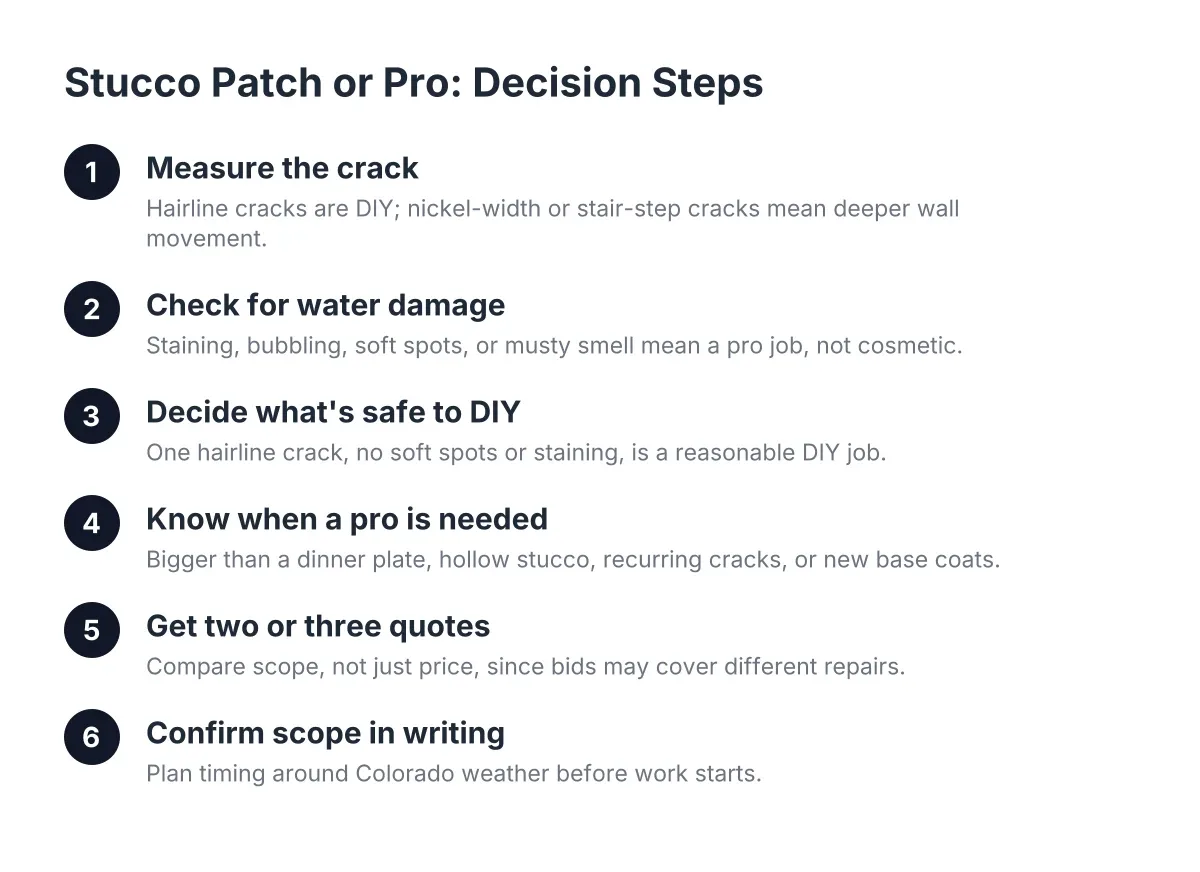
Step 1: Measure the Crack Before You Do Anything Else
Get a tape measure or a credit card and look at the crack up close. Width tells you more than length.
- Hairline cracks, thinner than a credit card, are usually surface movement. These are the only cracks a homeowner should consider patching alone.
- Cracks about the width of a nickel or wider often mean the wall behind the stucco has moved. That is not a caulk job.
- Cracks that follow a stair-step pattern near corners or windows point to settling or vibration. Patching over them without fixing the cause means the crack comes back.
Also press gently on the stucco around the crack. If it flexes, sounds hollow, or crumbles, the damage runs deeper than the surface, and a patch on top will not hold.
Step 2: Check for Water Damage, the Real Deal-Breaker
Water is the line between a cosmetic fix and a repair that needs a pro. Look for staining below the crack, bubbling or soft spots in the stucco, peeling paint, or a musty smell inside the house on that wall. Any of those signs means water has been getting behind the stucco siding, and the wet layers underneath have to be opened up, dried, and rebuilt.
This matters in Castle Rock more than most places. Colorado's freeze-thaw cycles push moisture into cracks, freeze it, and widen the gap every winter. Hail does its share too. Colorado home insurance premiums rose 65% over the last five years, with hail cited as a major driver, according to the National Association of Insurance Commissioners. Hail that dents a gutter can also bruise stucco, and those small impact points become water entry points a season later.
If you see water damage, stop here. This is a case where stucco repair needs professional work, because the fix involves lath, weather barrier, and sometimes sheathing behind the wall, not just the surface coat.
Step 3: Decide What You Can Safely Patch Yourself
Suppose you find one hairline crack on a garage wall, no soft spots, no staining. That is a reasonable DIY job. Here is what doing it right looks like:
- Clean the crack of loose debris, dust, and any oils or grease. Contaminants stop new patch material from bonding to the old stucco.
- Tape off trim, windows, and anything next to the repair so patch material does not stick where it should not.
- For wider gaps, set a foam backing in the crack before sealing. Backer rod, a closed-cell foam cord, creates a foundation inside a crack before sealant goes on, according to Sika.
- Apply patch compound with a steel trowel or rubber float. Materials like patch compound, latex additive, and mesh are stocked at general hardware stores.
- Work one coat per day. Let each coat set overnight before the next. Professional crews can move faster because they know the material; you should not try to match their pace.
The trade-off with DIY is the finish. Texture matching is a skill, and a patch that does not match the original technique will stand out from the curb. For a rental owner trying to pass a turnover inspection, a slightly visible patch on a back wall may be acceptable. On the front of your own home, it usually is not.
Step 4: When a Stucco Patch Needs a Professional
A stucco repair needs professional attention when any of the following is true. If you hit even one of these, get quotes instead of getting supplies:
- The damaged area is bigger than a dinner plate, or there are several damaged spots on one wall.
- The stucco is soft, hollow-sounding, or pulling away from the wall.
- You see water damage signs from Step 2, inside or out.
- The crack keeps returning after a previous patch. Something underneath, like poor drainage or vibration, is still causing it.
- The repair needs new base coats. Applying scratch and brown coats is harder than it looks, and it is the layer that keeps water out. This is the part most worth paying for.
- You care about the repair blending in. A well-done patch, properly textured and painted, becomes hard to spot. A bad one advertises itself for years.
One more note for anyone opening up stucco to install a vent, panel, or new siding section: do not make a clean grinder cut. A pro needs the wire lath at the edge exposed and torn to weatherproof the patch correctly. A clean cut forces the crew to open up more wall, which adds cost to your repair.
Step 5: Get Two or Three Quotes and Compare Them the Right Way
Once you know the repair is beyond DIY, gather quotes. This is where most Castle Rock homeowners get confused, because one bid comes in at three times another and nobody explains why. Usually the gap comes down to scope: one contractor priced a surface patch, and the other priced opening the wall to fix the water damage underneath. Neither is lying; they are quoting different jobs.
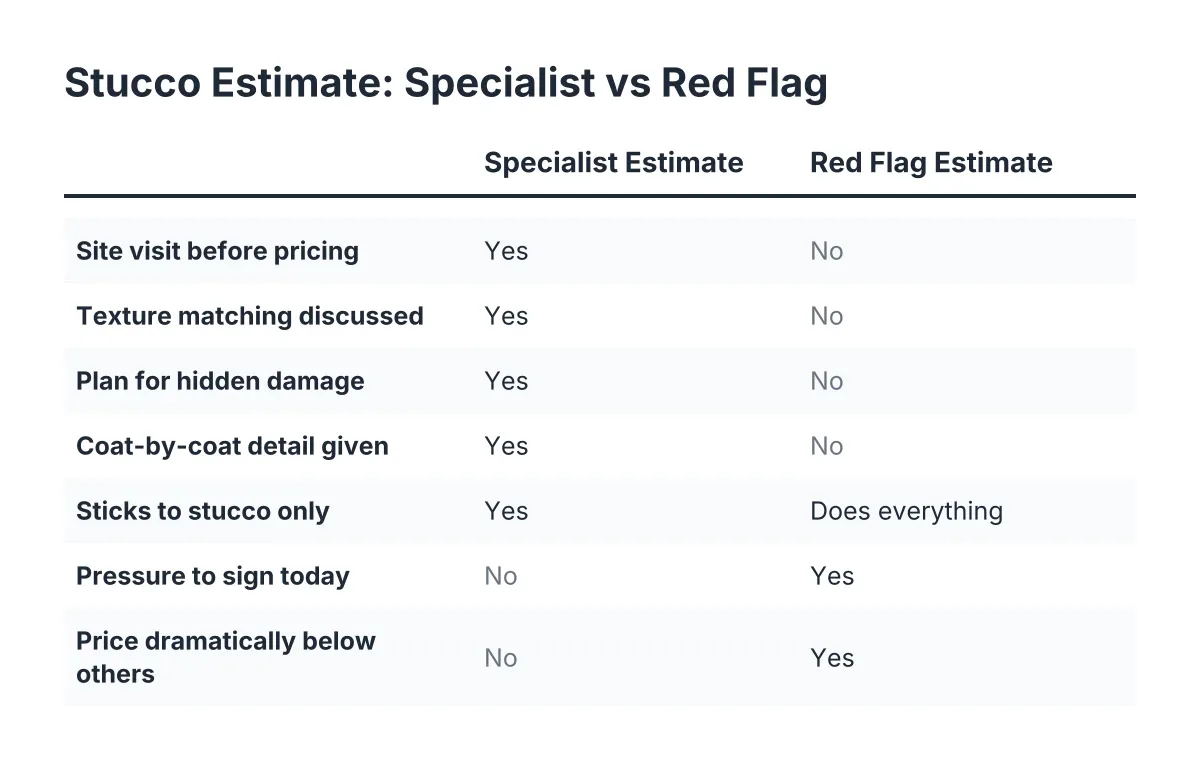
A good stucco patch pro will answer your questions directly. When hiring a stucco contractor, ask each bidder these three questions and write down the answers:
- What exactly is included? A complete exterior stucco repair quote covers removing damaged material, repairing or replacing lath and weather barrier if needed, applying base and finish coats, and texture matching. Paint and color matching may be extra, so ask.
- What could change the price once the wall is open? A straight answer sounds like: "If the sheathing behind the stucco is rotted, that adds material and labor, and I will show you before I fix it." A vague answer is a red flag.
- Who actually does the work? A dedicated stucco crew handles the material daily. A general painter or handyman may treat your wall as a side job, and a poor texture match is often the tell that someone without stucco experience did the patch.
Be careful with the lowest bid if it is thin on detail. Cheap stucco repair near me is a common search, but a patch slapped over active water damage is money spent twice.
Step 6: Plan the Timing Around Colorado Weather
Stucco cures best in moderate temperatures. In Castle Rock, that makes spring through fall the practical window for exterior stucco repair; winter work is possible but slower and more weather-dependent. A small crack repair might take a crew part of a day. A repair involving water damage, new lath, and multiple coats takes longer because each coat needs cure time before the next goes on.
For example, say a landlord in Castle Rock has a duplex with a cracked, water-stained corner and a tenant moving in at the end of the month. In that scenario, a partial patch on the corner is a faster and cheaper route than re-stuccoing the wall, and it can be a sound choice, as long as the crew also addresses whatever caused the crack. Skip the cause, and you will pay for the same corner again next turnover.
Step 7: Confirm the Scope in Writing Before Work Starts
Before anyone mixes material, get the scope on paper: the area being repaired, what happens if hidden damage turns up, whether texture and color matching are included, and how the finished patch will be blended with the surrounding wall. This one page prevents nearly every dispute that comes up mid-job, and it is how you avoid the upsell worry that keeps quote-comparing homeowners up at night.
One honest limitation: even a skilled crew cannot promise an invisible patch on badly faded or weathered stucco, because the surrounding wall has aged and the new material has not. Sometimes painting the full wall after the repair is the only way to get a uniform look, and a straightforward contractor will tell you that up front rather than after the fact.
The Bottom Line for Castle Rock Homeowners
Hairline crack, dry wall, back of the house: patch it yourself, one coat a day, and take your time on the texture. Anything soft, wet, recurring, or bigger than a plate: that is when stucco repair needs a professional, and the money you spend on a proper fix protects the wall, the framing behind it, and your ability to rent or sell the place without surprises.
If you are in Castle Rock or nearby and want a local set of eyes on your wall before you decide, reach out for an estimate. A short walk around the house is usually enough to tell you whether you are looking at a simple crack repair or something that needs the wall opened up, and you will get a plain answer either way.
If you need stucco repair, Castle Rock Stucco Pros can help.
Prefer to talk it through? Call (720) 797-8506 — a quick call is usually the fastest way to get a straight answer for your situation.