Rapidset Stucco Patch Kits vs. Pro Repair: Texture Match and Longevity in Castle Rock, CO
If you have a cracked or hail-damaged wall and you're standing in the hardware store aisle right now, you've probably already found rapidset stucco patch kits. They're cheap, they set fast, and the bag says they work on cracks and holes. The real questions are different: will the patch match your home's texture, and will it still look right in five years? A quality stucco patch kit texture is crucial to getting results that last. This article compares rapid-set patch kits against a professional stucco repair, side by side, so a Castle Rock, CO homeowner can decide which route actually fits the damage on their wall.
This matters most for two groups we see searching for "stucco repair near me" around Castle Rock. First, storm-damage responders, homeowners whose stucco took hail or wind damage and who want the exterior looking right again before winter. Second, owners of newer homes in neighborhoods like Stonegate, Meridian, or Carriage Club, where stucco cracking or delamination showed up in the first few years and the builder is no longer answering the phone. Both groups end up asking the same thing: patch kit or pro?
What Rapid-Set Stucco Patch Kits Actually Are
A rapid-set stucco patch is a polymer-modified cement product that sets quickly and replaces the traditional three-coat stucco system with a single application for small repairs. That's the honest appeal. You skip the separate scratch and brown coats, and many of these products bond to existing stucco without a bonding primer. For a hairline crack or a golf-ball-sized hole, that's a real shortcut.
The kits come in small boxes and larger bags. You mix with water, work it into the prepared crack or hole, and trowel it flush. Some patch products applied with a steel trowel naturally produce a stucco-like texture on their own, which is why the marketing photos look convincing.
Here's what the bag doesn't explain: the material is only half the repair. The other half is prep, texture matching, and color, and that's where most DIY patches go sideways.
Stucco Patch Kit Texture and Surface Finish
Rapidset stucco patch kits do a solid job on small, low-visibility repairs where a perfect texture match doesn't matter much. Think hairline cracks you plan to paint over, small holes behind a downspout, or damage on a parapet wall or garage side nobody looks at closely. Used correctly, the patch itself is durable cement and will hold.
They're strong in a few specific situations:
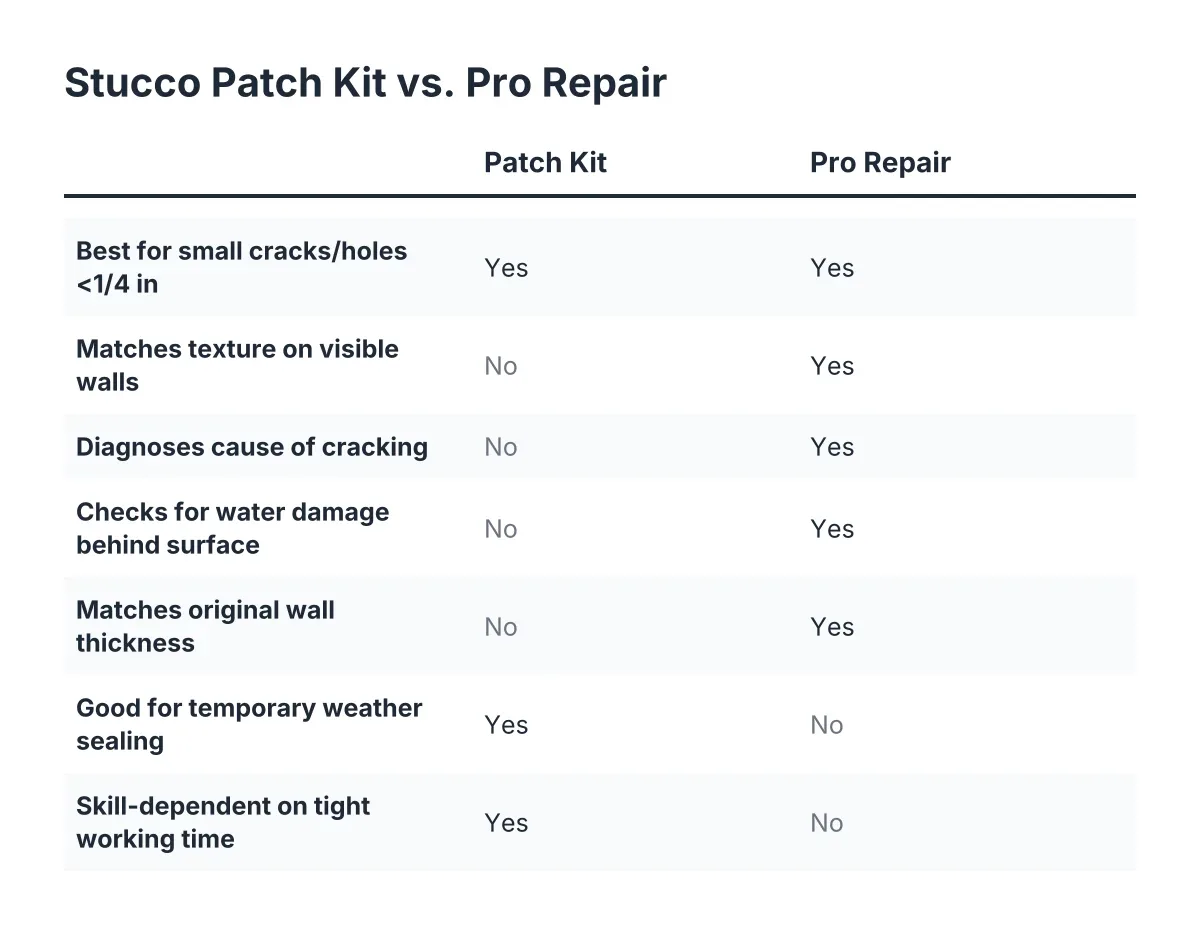
- Small cracks and holes. Under about a quarter inch wide, a patch kit can fill and seal the damage without the full three-coat process.
- Hidden or textured areas. Textured, flattened stucco finishes hide repair imperfections better than smooth finishes, so a patch blends in more easily there.
- Temporary weather sealing. After a hailstorm, sealing cracks fast keeps water out of the wall while you sort out insurance or schedule a proper repair.
- Whole-wall repaints. If you're painting the entire wall anyway, minor texture differences matter less because paint unifies the color.
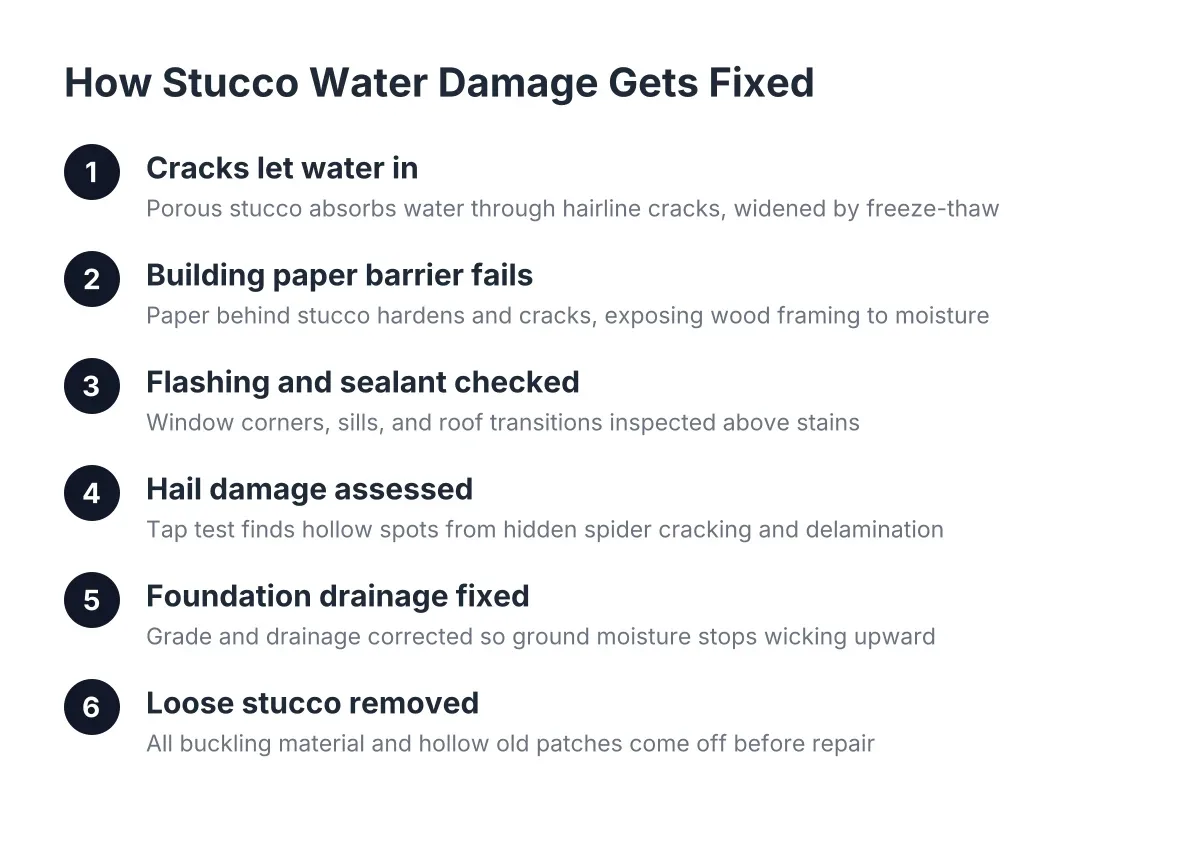
For a Castle Rock homeowner staring down a fall storm season, that last point about weather sealing is worth taking seriously. An open crack lets water in, and water damage behind stucco costs far more to fix than the crack itself.
Where Patch Kits Fall Short: Texture Matching and Blend
The biggest weakness of any patch kit is not the cement. It's the finish. A stucco patch stays visible after painting if the texture doesn't blend with the surrounding wall. Paint changes color; it does not hide a flat trowel mark sitting in the middle of a sand-float finish, or a smooth spot in a lace texture.
Fiber-reinforced patch products add another wrinkle. They tend to stand up thick, and the fibers make it hard to reproduce a fine surrounding texture. On a parapet wall that nobody sees up close, that's fine. On the front elevation facing the street, it reads as a scar.
There's also a working-time problem. Rapid-set means rapid. You get a short window to fill the hole, level it, and recreate the texture before the material stiffens. Recreating a lace, dash, or sand finish is a skill; doing it against a countdown clock on your first try is how most visible patches happen. When a repaired patch looks obviously wrong, the usual cause is that someone attempted the repair without knowing the original finish technique, not that the material failed.
Suppose a homeowner in Meridian has three hail cracks on a south-facing wall with a heavy lace texture. Say they patch all three with a kit on a Saturday. The cement holds, the cracks are sealed, and from the street the wall looks fine. Up close, all three patches read as smooth ovals in a textured field, and paint alone won't fix that. In that scenario, the fallback is either painting the whole wall section for a uniform look, or having someone knock down and blend the high spots and re-texture the patches by hand.
What a Professional Stucco Repair Includes in Castle Rock, CO
A professional exterior stucco repair in Castle Rock, CO covers more than filling the crack. The scope typically includes diagnosing why the stucco cracked, cutting out damaged or delaminated material, checking for water damage behind the surface, patching in layers that match the original wall thickness, and matching both the texture and the color of the surrounding stucco. That last step is the one homeowners can't buy in a box.
A good local crew will usually walk through this sequence:
- Inspect the damage and the cause. Hail impact, settling cracks, and improper curing on a new build each call for a different fix. A crack from an ongoing movement problem will reopen through any patch.
- Open up and prep the repair area. Loose and delaminated stucco comes out. If water got behind the wall, that gets addressed first, because patching over wet substrate hides the problem instead of fixing it.
- Rebuild the patch. Depending on depth, that may be a rapid-set product or a traditional base and finish coat. When choosing materials, professionals consider how a stucco patch kit texture will blend with the existing wall.
- Match texture and color. The finisher reproduces your wall's existing technique, whether that's lace, sand, dash, or a knockdown finish, then color-matches or recommends painting the section.
Notice that a pro may use the same rapid-set materials sold in the patch kits. The difference isn't the bag. It's knowing which walls need full base-coat rebuilds, and having the hand skill to work texture into fast-setting material before it locks up. A properly matched and painted patch should be hard to find once the wall dries; that's the standard to hold any repair to, DIY or hired.
What's usually extra: full-wall repaints, stucco siding material replacement on large sections, and structural work behind the stucco. Ask up front so the quote and the scope match.
Cost and Turnaround: Patch Kit vs. Hiring a Local Crew
There's no honest single number here, but the shape of the comparison is clear. A patch kit is a material cost, typically a small fraction of a professional repair, plus your Saturday and the risk of a visible result. A professional stucco repair on a newer home commonly runs anywhere from a few hundred dollars for a small crack repair up to several thousand for larger sections with water damage or delamination; treat those as illustrative ranges, not quotes, because access, damage extent, and texture complexity move the price.
Turnaround differs too. A DIY patch is done in an afternoon, though color blending may drag it out. A professional repair on a typical home is often a one-to-few-day job once scheduled, but scheduling itself matters in Colorado. After a major hailstorm, every exterior contractor's calendar fills at once, so homeowners who call early get repairs done before the freeze-thaw season starts working on open cracks.
Insurance is part of this math for storm damage. Hail is not a small problem here; Colorado logged 182,591 hail insurance claims from 2013 to 2015, the second-highest in the nation, according to the Rocky Mountain Insurance Information Association. Premium pressure follows the losses. Colorado home insurance premiums rose 65% over the last five years, with hail as a major driver, according to the National Association of Insurance Commissioners. If an adjuster flagged your stucco, get the repair documented and estimated properly before deciding a patch kit is good enough; a written scope from a local stucco repair contractor gives you something concrete to compare against the adjuster's numbers.
When DIY Is Fine and When to Call a Pro
Handle it yourself when the damage is a hairline crack, a small hole in a low-visibility spot, or a temporary seal before winter. Prep the crack properly; for wider cracks, installing backer rod, a closed-cell foam cord, gives sealant a proper backing inside the crack, according to Sika. Work in small batches, because fast-setting materials leave little forgiveness.
Call a professional when you see any of these:
- Cracks wider than about a quarter inch, or cracks that keep reopening
- Stucco that sounds hollow when tapped, which suggests delamination
- Staining, bubbling, or soft spots, which point to water damage behind the wall
- Damage on a prominent wall where texture matching matters
- A newer home with widespread early cracking, which may signal an installation or curing problem rather than surface wear
That last one is common on recent builds around Castle Rock. Stucco on new construction stucco and siding projects sometimes cures too fast in Colorado's dry air, or gets installed thin, and cracking shows up in years one through five. If the builder warranty is exhausted or the builder won't respond, an independent repair that addresses the cause is the durable path; a patch kit over a curing defect just resets the clock on the same crack. One honest caveat: no repair contractor can promise a patch will be invisible in every light on every finish, and on smooth finishes especially, painting the full wall section is sometimes the right call to get a uniform look.
How to Choose: Kit, Contractor, or Both
Start with three questions. First, does the texture matter where the damage is? If yes, weight the decision toward a pro, because texture matching is the skill rapidset stucco patch kits cannot include in the box. Second, is there any sign of water damage or delamination? If yes, don't patch over it; find the moisture problem first. Third, is insurance involved? If yes, get a professional scope in writing before you touch the wall.
When you compare local contractors in 2026, a fair quote should name the repair method, say how texture and color will be matched, state whether painting is included or separate, and put the work in a defined scope rather than a vague line item. Ask whether the same crew that quotes the job does the work, and ask to see how they handle texture matching on finishes like yours. A contractor who works on stucco every day will answer both questions without hesitation; a generalist will talk around them.
The short version: rapidset stucco patch kits are a legitimate tool for small, low-visibility fixes and emergency sealing. For hail damage on a visible wall, recurring cracks on a newer build, or anything involving water behind the stucco, the patch is the easy part and the match is the hard part. If your Castle Rock home has damage you're weighing right now, have a local stucco repair specialist look at the wall and give you a written estimate. Comparing that scope against a bag of patch mix is the fastest way to know which fix your wall actually needs.
If you need stucco repair, Castle Rock Stucco Pros can help.
Prefer to talk it through? Call (720) 797-8506 — a quick call is usually the fastest way to get a straight answer for your situation.