Stucco Crack Repair Warranty: What’s Covered, What’s Not, and How Long It Lasts
If you've already paid for one stucco patch that didn't blend in, the next question matters more than the next quote: what does stucco repair warranty coverage actually include, and for how long? Most homeowners in Castle Rock never read the warranty terms until a repair fails. By then, the contractor's answer is usually "that's not covered." This guide walks through what a repair warranty on stucco cracks typically covers, what it excludes, how long different parts of the work should hold up, and the questions to ask before anyone mixes a batch of patch material on your driveway.
This matters most if you're getting a home ready to list. A buyer's inspector will flag visible cracks and obvious patches. A written warranty on the repair is one of the few documents you can hand a buyer that turns a flagged defect into a closed item.
Why the Warranty Question Comes Up After a Bad Patch
Here's the pattern we hear about most. A homeowner has a crack patched, often by a handyman or a previous owner's contractor. The patch holds, but it's the wrong texture, or the color is close but off enough to catch the eye from the driveway. When the homeowner calls back, the contractor says the patch is "structurally fine" and the look isn't a warranty issue.
That's the gap. Most repair warranties cover the repair failing, meaning the crack reopening or the patch material falling off. They do not cover the repair being visible. If a blended match matters to you, and it should if you're listing the home, the texture and color match has to be written into the scope of work, not assumed under the warranty.
So before we get into coverage terms, understand the two separate promises in any stucco repair:
- The durability promise: the crack stays sealed and the patch stays bonded. This is what a stucco crack repair warranty covers.
- The appearance promise: the repair blends into the surrounding wall. This lives in the written scope, not the warranty, unless the contractor puts it there.
A contractor who repairs stucco every day will talk about both without being asked. A contractor who dodges the appearance question will dodge it again when you call back unhappy.
Understanding Stucco Repair Warranty Coverage Terms
A typical warranty on stucco crack repair covers workmanship: the patch debonding, the fill material shrinking out of the crack, or the repaired crack reopening along the same line within the warranty period. If the crack comes back where it was fixed, the contractor returns and redoes it at no charge. That is the core of the promise, and it's worth getting in writing every time.
Beyond that core, coverage varies by contractor. Here's what you'll commonly see included, and what you won't.
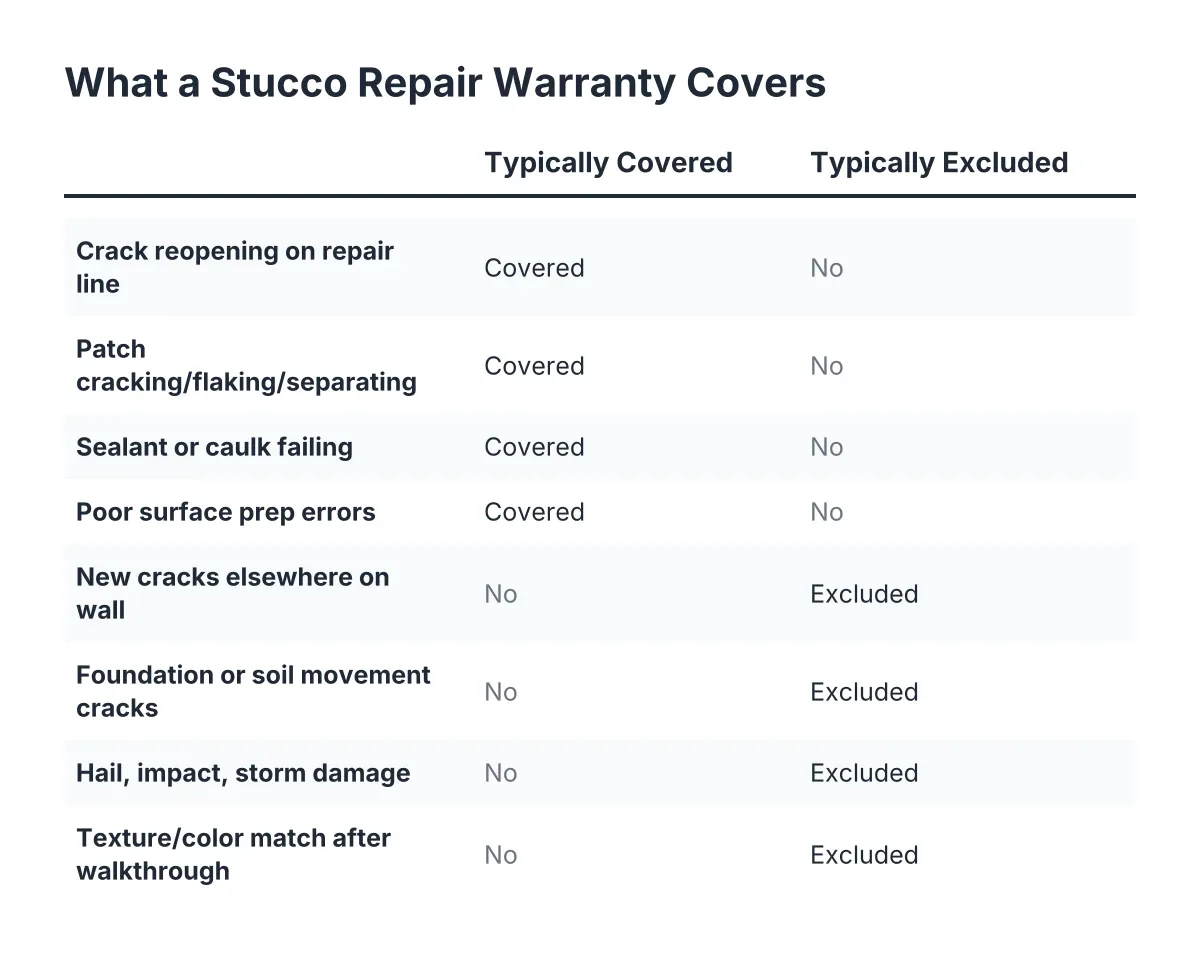
Typically covered
- The repaired crack reopening along the original repair line
- Patch material cracking, flaking, or separating from the wall
- Sealant or caulk failing inside the warranty window
- Workmanship errors, such as poor surface prep that caused the failure
Typically excluded
- New cracks forming elsewhere on the wall
- Cracks caused by foundation settling, soil movement, or structural shifts
- Hail, impact, and storm damage
- Water intrusion from roofs, gutters, flashing, or windows above the repair
- Color fade from sun exposure over time
- Texture or color match complaints raised after the final walkthrough
That last exclusion is the one that burns the texture-match perfectionist. The fix is simple: do the walkthrough before you pay the balance, look at the repair from the street at midday, and raise the match issue then. Once you sign off, the appearance is accepted work.
How Long a Stucco Crack Repair Warranty Should Last
A reasonable warranty on crack repair runs one to two years for workmanship, and some operators go longer on specific materials. Sealant manufacturers often back their products for longer than the labor warranty, sometimes five years or more, but the manufacturer's coverage only pays for material, not the labor to redo the work. One year is the practical floor; anything shorter tells you the contractor expects callbacks.
Why does the length matter so much on stucco specifically? Because Castle Rock walls go through real freeze-thaw cycles. A patch that looks fine in September has not been tested until it survives a winter of expansion and contraction, plus the next summer's heat. A warranty that runs at least a full year guarantees the repair gets through one complete seasonal cycle before the contractor is off the hook.
In addition, the warranty length should match the repair method. Here's a rough way to think about it:
- Hairline cosmetic cracks sealed with primer and paint: expect a short workmanship warranty, often a year. Hairlines are normal in stucco; a quality paint bridges and seals them without caulk.
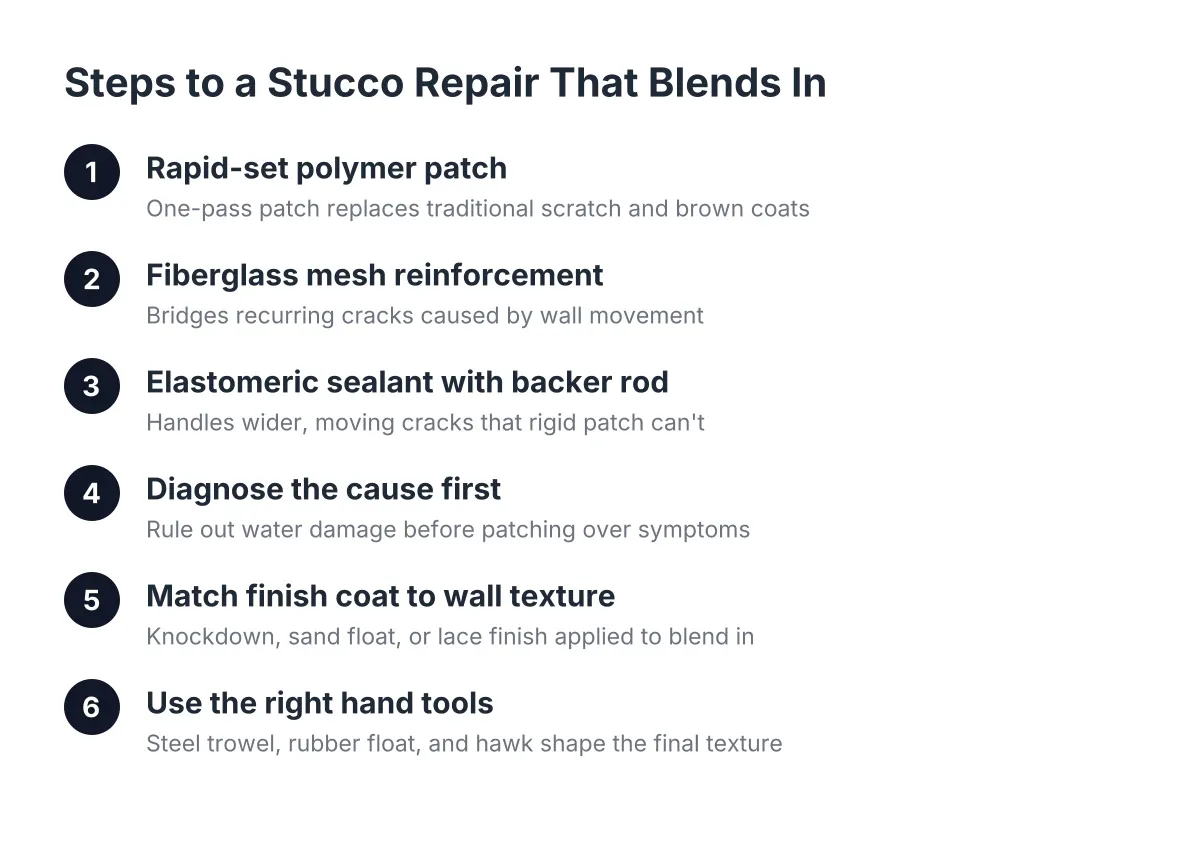
- Structural cracks filled with backer rod and sealant: expect one to two years on workmanship. Backer rod, a closed-cell foam cord, creates a backing inside the crack before sealant goes in, according to Sika. Done right, this is the longest-lasting crack fix.
- Patch and re-texture repairs where stucco is cut out and rebuilt: expect the strongest warranty here, since the contractor controlled every layer from lath to finish coat.
If a contractor offers the same blanket term for all three, ask why. The methods fail differently, and an operator who knows the material will explain the difference without flinching.
Why the Repair Method Decides Whether the Warranty Ever Gets Used
A warranty is a backstop, not a plan. The goal is a repair that never triggers it, and that comes down to diagnosing the crack correctly before filling it. A crack in stucco is information about what's happening behind the wall, and the repair method has to answer the cause, not just the symptom.
Hairline cracks, the ones thinner than a credit card edge, usually come from normal curing and surface shrinkage. Small cracks even show up after the first coat of stucco goes on during original construction; that's part of how the material cures, not a defect. These don't need caulk. Forcing sealant into a hairline creates a shiny, smeared line that reads as an obvious repair, which is exactly the problem you're trying to escape if you're redoing a bad patch.
Structural cracks are wider and deeper, and they behave differently. These need the crack opened, backer rod set, and sealant pushed deep. On a wall about an inch thick, the fill should reach all the way back to the building paper, not sit at the surface like frosting. A surface-only fill is the number one reason a repaired crack reopens within a year, and it's the failure most warranty claims come from.
Timing matters too. Large sealant repairs behave better in cool morning hours than in hot afternoon sun, where the material can skin over or cure poorly. A crew that schedules caulking around the weather is thinking about the warranty before the work starts. A crew that shows up at 2 p.m. in July and caulks a west-facing wall is planning to be somewhere else when the crack comes back.
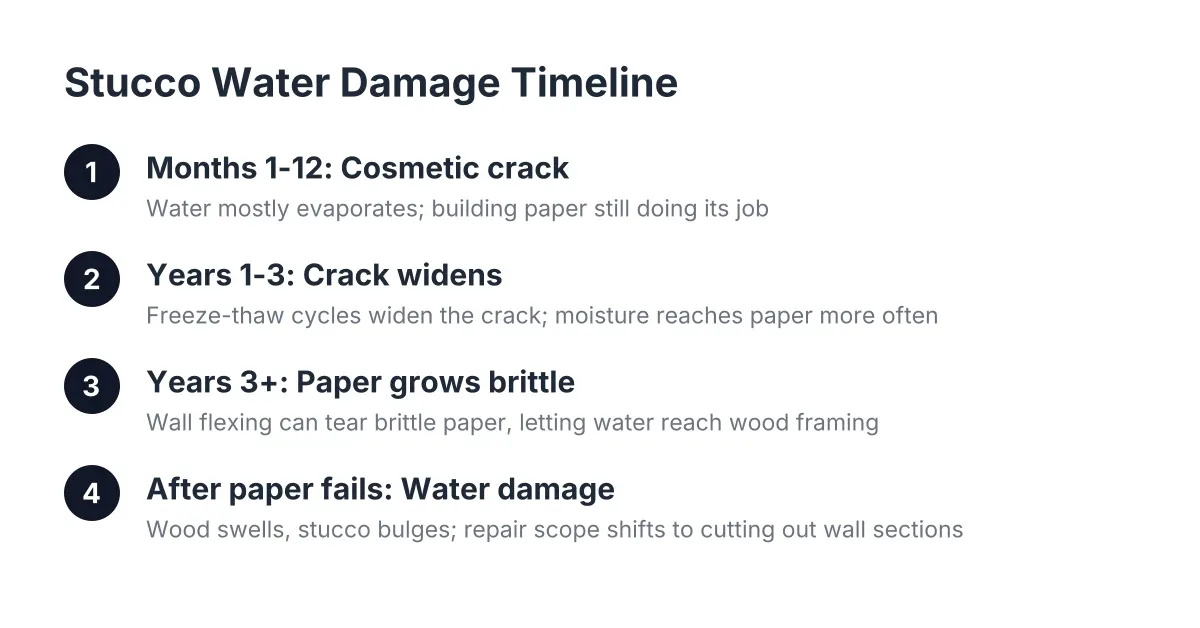
There's one more reason not to wait on a structural crack. The building paper behind old stucco gets brittle with age, and a wall that keeps flexing along an open crack can eventually tear that paper. Once the paper tears, water gets past the wall's last defense, and you've moved from a crack repair into water damage repair. No crack warranty covers damage that happened before the repair was done.
Texture Matching and Stucco Repair Warranty Coverage: Where Bad Patches Come From
If you can see exactly where the last repair was done, the patch didn't fail; the match did. This is the most common complaint we hear from Castle Rock homeowners, and it's worth understanding why it happens, because the warranty won't save you from it.
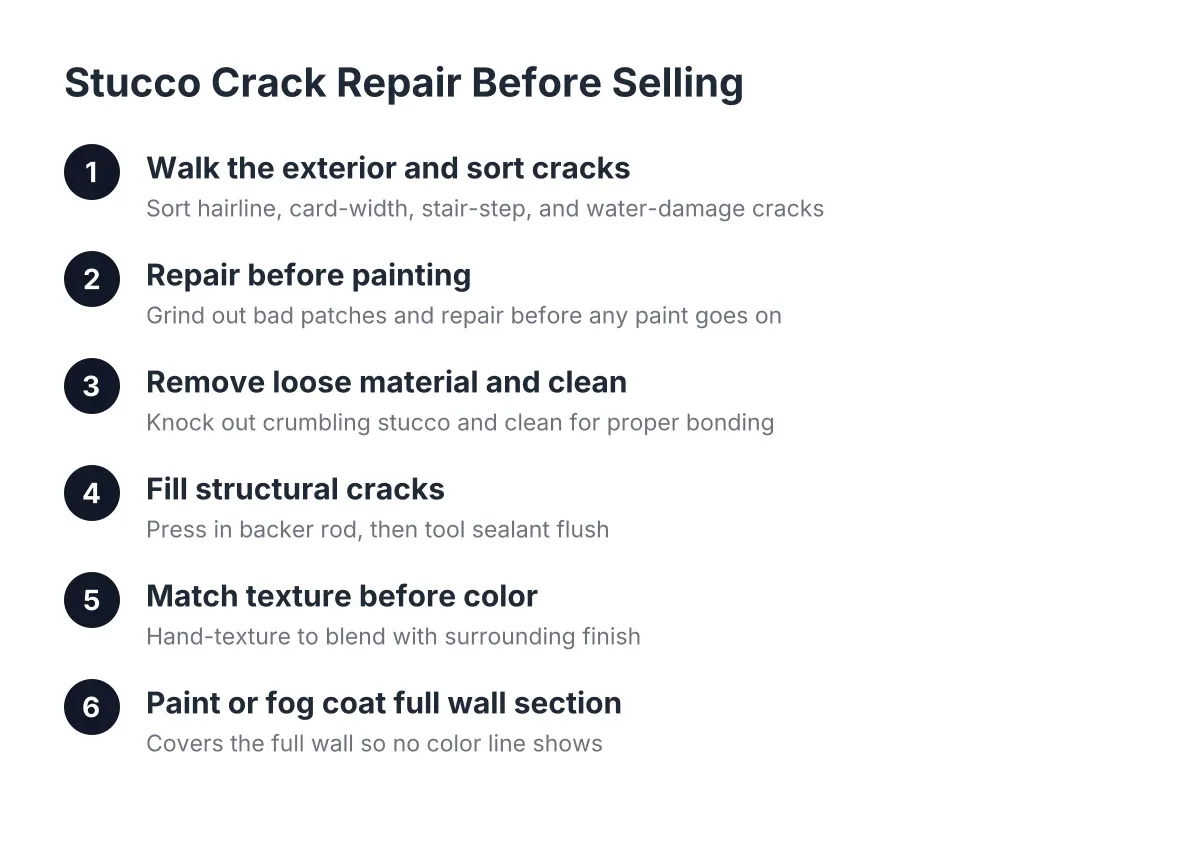
Texture matching is a separate skill from crack sealing. The finisher has to identify your wall's existing texture, match the aggregate size and trowel technique, and feather the new finish into the old so there's no hard edge. Then the color has to account for how your existing stucco has weathered. A fresh patch tinted to the original color will look wrong next to a wall that's had fifteen years of Colorado sun. Honest limitation: on an older, heavily weathered wall, a perfect invisible match isn't always possible on the patch alone; sometimes the right answer is blending the repair and then painting the full wall plane to a corner, so the eye never finds a transition line.
Suppose a homeowner in Castle Pines is listing in 45 days. A pre-listing inspection flags a stair-step crack near a garage corner and a palm-sized patch from a previous owner that sits flat and smooth on an otherwise sand-float wall. In that scenario, the right scope is three items: open and properly fill the crack with backer rod and sealant, cut back the old flat patch and re-texture it to match the sand-float finish, and repaint that wall section to the nearest corners. Illustrative budget: somewhere in the $800 to $2,500 range depending on access and wall size, framed here as an estimate, not a quote. The warranty covers the crack staying sealed. The scope of work covers the match. Both go in writing before work starts.
One more note on corners, since that's where sellers see cracks most. A corner crack where stucco sits on top of a hard concrete foundation is usually minor; the foundation and the stucco expand and contract at different rates, and the softer material gives. A partial patch at a corner is a legitimate, cheaper alternative to re-stuccoing the wall, but if vibration or poor drainage caused the crack, address the cause or expect the crack to return, warranty visit or not.
Questions That Separate a Real Warranty From a Handshake
When you're comparing contractors for stucco crack repair, the warranty conversation tells you more than the price. Ask these before you sign anything:
- Is the warranty in writing, and does it state a specific term in months or years?
- Does it cover the repaired crack reopening, or only the patch material falling off?
- Who handles the claim if the repair fails, the local crew or a call center?
- Is texture and color matching written into the scope, with a walkthrough before final payment?
- What voids the warranty? Painting over the repair? New landscaping against the wall?
- If the failure traces to a cause outside the repair, such as a gutter dumping water on the wall, what happens?
The third question matters more than people expect. A warranty is only as good as your ability to reach the person who honors it. National franchise operations route calls through call centers and rotate crews, so the person who did your repair may not be the person who answers the callback, if anyone local answers at all. A local operator who works in Castle Rock has a shorter path between your phone call and a truck in your driveway, and a stronger reason to make a callback right, since their next five jobs come from your neighborhood.
Insurance, Hail, and What a Repair Warranty Won't Touch
Colorado homeowners sometimes assume storm damage folds into a repair warranty. It doesn't, and the distinction matters here more than in most states. Hail is an insurance question, not a workmanship question, and it's a big one along the Front Range. Colorado logged 182,591 hail insurance claims from 2013 to 2015, second in the nation behind only Texas, according to the Rocky Mountain Insurance Information Association. The May 8, 2017 Front Range hailstorm alone caused $2.3 billion in insured damage, the state's costliest catastrophe, according to the National Insurance Crime Bureau.
As a result, insurers have tightened up. Colorado home insurance premiums rose 65% over the last five years, with hail cited as a major driver, according to the National Association of Insurance Commissioners. The practical takeaway for a seller: if hail pocked your stucco, that's an insurance claim with its own process. If a crack reopened six months after a repair, that's a warranty call. Keep the two separate, document which is which with dated photos, and don't let anyone blur them, because a warranty claim denied as "storm damage" with no evidence is hard to argue after the fact.
For pre-listing sellers, there's a paperwork angle too. Keep the repair invoice, the written scope, and the warranty document in one folder. When the buyer's inspector notes "repaired stucco crack, southwest elevation," you hand over the file and the item dies there instead of becoming a credit negotiation.
What to Walk Away With
A stucco crack repair warranty worth having is written, runs at least a year so the repair survives a full freeze-thaw cycle, names what's covered and what voids it, and is backed by someone local enough to answer the phone when you call. It covers durability, not appearance, so the texture and color match goes into the scope of work with a walkthrough before final payment.
However, remember the better goal: a repair diagnosed and built so the warranty never gets used. Hairlines get primer and paint. Structural cracks get backer rod and sealant pushed back to the paper. Patches get re-textured and feathered, then painted to a natural break. If a crack is wide, growing, or stair-stepping near a foundation, bring in a professional to rule out movement before anyone fills it; no sealant fixes a foundation problem. Get the method, the match, and the warranty in writing, and the patch you're tired of looking at can finally disappear into the wall.
If you need stucco repair, Castle Rock Stucco Pros can help.
Prefer to talk it through? Call (720) 797-8506 — a quick call is usually the fastest way to get a straight answer for your situation.