Stucco Crack Repair Cost in Castle Rock: What You’ll Pay by Crack Severity
If you're pricing out stucco crack repair cost in Castle Rock, the first thing to understand is that the crack itself is only half the story. A crack in stucco is a message from the wall. Sometimes it says "the house settled a little, no big deal." Sometimes it says "water has been getting behind here for two years." The price to fix it depends almost entirely on which message you're reading, and that is why quotes for what looks like the same crack can range from a few hundred dollars to several thousand. Understanding the stucco crack severity and cost is essential to getting the right repair plan.
This guide walks through what cracks actually tell you about what's happening behind the wall, how to tell a hairline cosmetic crack from a structural one, and what each severity level tends to cost to repair. It's written the way a crew that works on stucco every day would explain it standing on your driveway, not the way a national pricing calculator spits out a number without ever seeing your wall.
Why Stucco Cracks Form and Their Severity Affects Cost
Stucco is a cement-based coating, and cement moves less than almost everything around it. Your framing expands and contracts with temperature swings. Castle Rock gets big swings, warm afternoons and freezing nights in the same week for much of the year. The stucco can't flex with the wood behind it, so it cracks.
Hail and wind add their own damage on top of that. Colorado's May 2017 Front Range hailstorm caused $2.3 billion in insured damage, the costliest catastrophe in state history, according to the National Insurance Crime Bureau. Hail doesn't usually crack stucco in long lines; it chips and spiders it, leaving impact marks that let water in. After a storm, a lot of Castle Rock homeowners find cracks they never noticed before, some caused by the storm and some that were already there.
There are a few other common causes worth knowing:
- Normal curing. Small cracks often show up after stucco is first applied. That is part of the material curing, not a defect.
- Settling. Every house settles. Diagonal cracks off window and door corners are the classic sign.
- Material transitions. Where stucco sits on top of a concrete foundation, the two materials expand and contract at different rates. A crack along that line is usually minor, not structural.
- Water damage. Stucco that stays wet behind the surface softens, stains, and eventually bulges or crumbles. Cracks near rooflines, around windows, and at the base of walls deserve a closer look.
- Vibration and impact. Garage doors, nearby construction, even removing a siding panel next to a stucco section can create spider-web hairline cracking in the surrounding material.
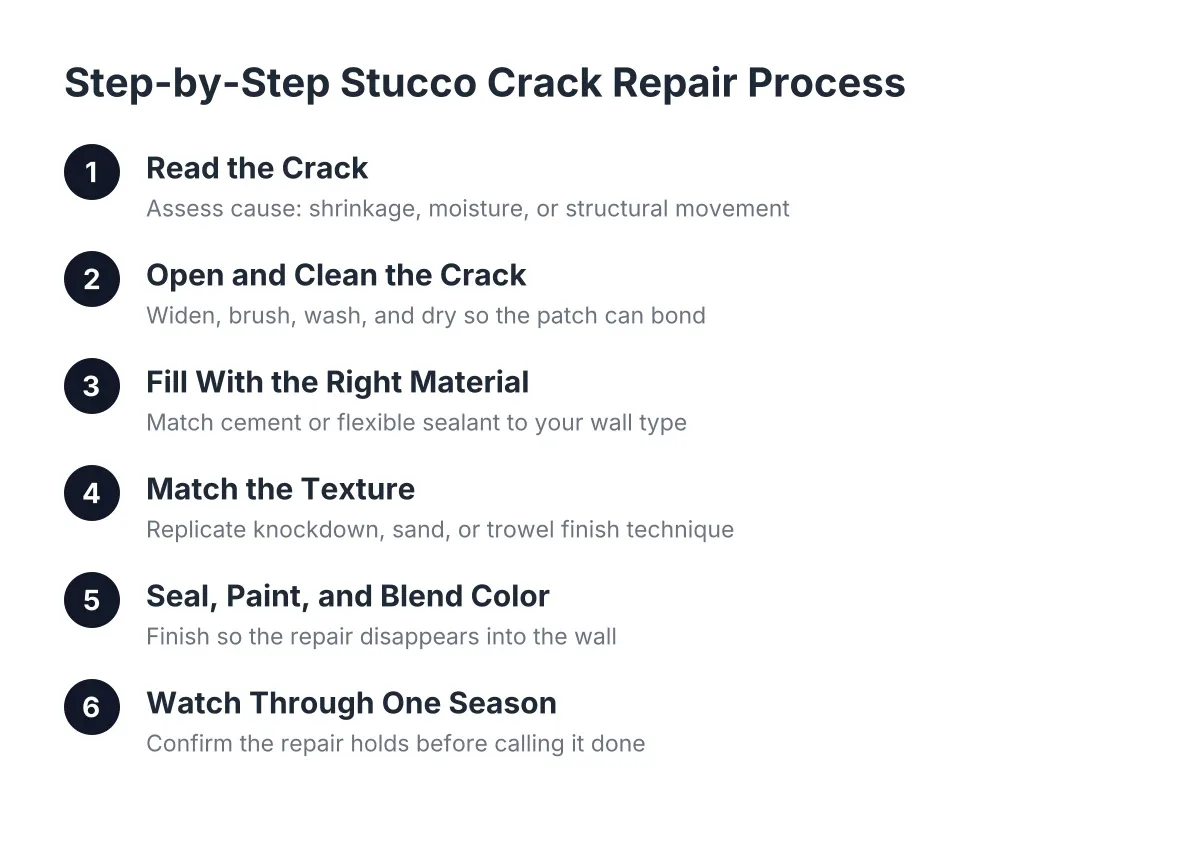
The cause matters because it drives the repair, and the repair drives the cost. Caulking over a crack caused by a drainage problem buys you one season before the crack comes back.
Hairline vs. Structural Cracks: Reading What the Wall Is Telling You
The single biggest factor in what you'll pay is whether the crack is cosmetic or structural. Here is the plain-English test most stucco crews use.
Hairline Cracks and Their Severity Impact on Cost
A hairline crack is thinner than a credit card edge, usually under 1/16 of an inch. You can see it, but you can't fit anything into it. These are surface cracks. They don't go through the stucco to the building paper behind it, and they don't need caulking forced into a cavity. A good quality primer and paint will flood the hairline and seal it on their own.
Hairline cracks are the cheapest fix because the "repair" is often part of a paint job. If you were already planning exterior painting, many hairline cracks get handled in that scope at little extra cost.
Structural Cracks and Repair Costs
A structural crack is wider and deeper. You can slide a card edge or a fingernail into it. It may step along the mortar pattern, run diagonally from a window corner, or show slight offset where one side of the crack sits higher than the other. These cracks go through the stucco, which means water can reach the building paper and framing behind the wall.
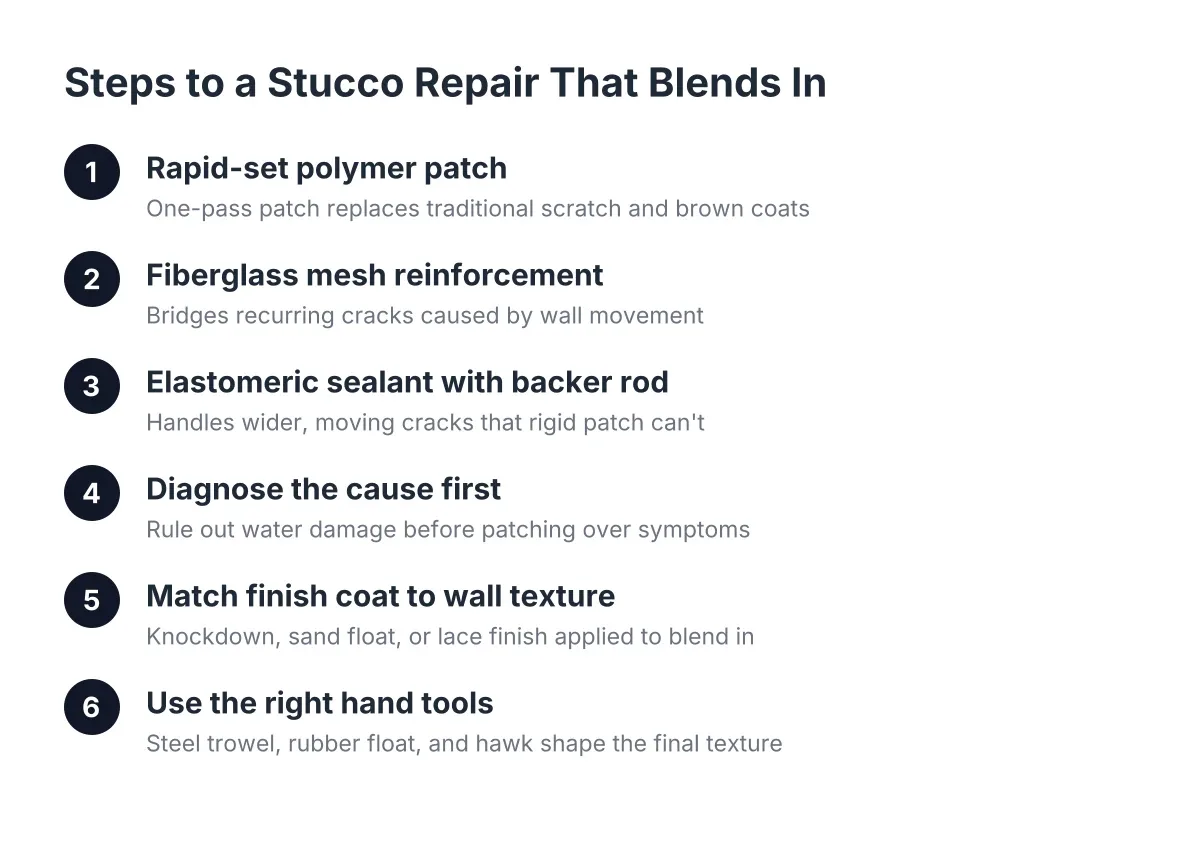
These need a real repair: the crack gets cleaned out, a backer rod goes in to give the sealant a foundation, and flexible caulk gets tooled into the gap before patching and texture matching. Backer rod is a closed-cell foam cord that creates a backing inside the crack before sealant is applied, according to Sika. Paint alone will not hold a structural crack closed.
When to worry about stucco cracks
Worry when a crack is wider than about 1/8 inch, when it keeps growing, when it shows displacement, or when you see staining, bubbling, or soft spots nearby. Those are signs of water intrusion, and the cost of ignoring them compounds. Behind a structural crack, the building paper is the last line of defense. Leave the crack open for years and that paper gets brittle; the wall flexes, the paper tears, and now water has a direct path to the sheathing. At that point you've moved from a crack repair into a water damage repair, and the price moves with it.
Stucco Crack Severity Cost Ranges by Repair Tier
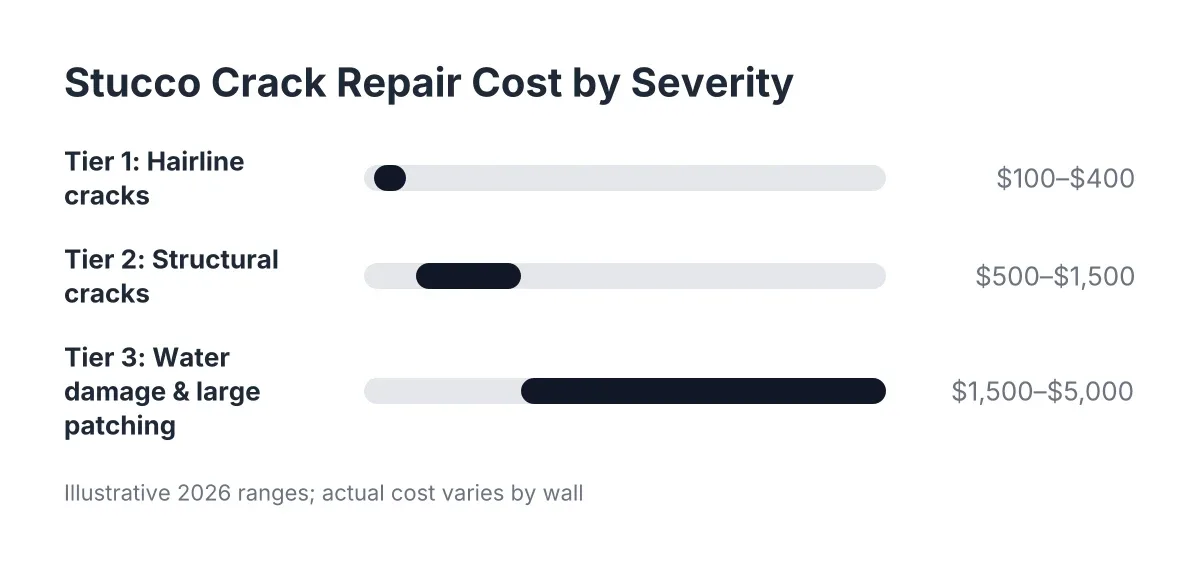
Stucco crack severity determines the cost approach in Castle Rock. Repairs typically run from roughly $100 to $400 for hairline cracks, $500 to $1,500 for structural cracks that need backer rod and sealant, and $1,500 to $5,000 or more when water damage or large patching is involved. These are illustrative 2026 ranges, not quotes; your wall, access, and texture all move the number.
Here is how those tiers break down in practice.
Tier 1: Hairline cracks, roughly $100 to $400
This covers sealing a handful of surface cracks with elastomeric primer and paint on one or two walls. If the cracks are scattered across the whole house, many homeowners fold this into a full repaint instead of paying for crack work separately. For a small landlord turning over a rental in Castle Rock or Parker, this tier usually handles the "pass the walkthrough" cracks a tenant or inspector flagged.
Tier 2: Structural cracks, roughly $500 to $1,500
This is the clean-out, backer rod, sealant, patch, and texture-match repair on one or more cracks that go through the stucco. Price climbs with crack length, height on the wall, and how fussy the texture match is. A heavy lace or dash texture takes more time to blend than a smooth sand finish. Corner cracks where stucco meets the foundation often land at the low end of this tier because they're usually expansion-related rather than a sign of foundation trouble.
Tier 3: Water damage and large-area patching, roughly $1,500 to $5,000+
When the stucco is soft, stained, or bulging, the crew has to open the wall, replace damaged building paper and sometimes sheathing, re-lath, and re-stucco the section in coats, working from the bottom up. This is the tier most hail-damage repairs land in when the damage went unaddressed for a season or two. A partial patch on a damaged corner is a quicker, cheaper alternative to re-stuccoing a whole wall, but the underlying cause, whether drainage, flashing, or vibration, still has to be fixed or the crack returns.
For context on what's not in these tiers: full re-stucco of an entire house is a different project entirely, usually five figures, and belongs in a repair-versus-replace conversation rather than a crack repair estimate.
What Moves the Price of a Stucco Crack Repair Up or Down
Two cracks of the same length can price out differently for reasons that have nothing to do with the crack. When you compare bids, these are the variables behind the numbers.
- Access. Ground-level cracks are cheap to reach. Second-story cracks near a roofline need ladders or scaffolding, and that adds labor.
- Texture matching. Blending the patch into your existing texture is the difference between a repair you can't find and a repair you see every time you pull into the driveway. More complex textures cost more to match.
- Color matching. If your stucco is integrally colored rather than painted, matching the finish coat takes more skill and sometimes a full-wall paint to blend.
- Number of cracks. Mobilization is a fixed cost. Fixing six cracks in one visit costs far less per crack than six separate visits.
- Weather windows. Sealant and stucco both have temperature limits. Large caulking repairs go better in early morning than in hot afternoon sun, when caulk cures poorly. In Castle Rock, the repair season has real edges, and crews book up before the freeze.
- What's behind the wall. No estimate survives contact with hidden water damage. An honest contractor will tell you the number may change once the wall is open, and that honesty is worth more than a low bid that assumes the best case.
A Realistic Castle Rock Scenario: Hail Damage Plus an Old Crack
Suppose a Castle Rock homeowner takes hail on the west-facing wall in a June storm. The adjuster flags chipped stucco and a dented gutter. While the homeowner is out looking at the hail marks, they notice a diagonal crack running off the kitchen window corner that has clearly been there longer than the storm.
In that scenario, the hail chips are Tier 1 to Tier 2 work: patch the impact points, seal, and blend the texture, say $600 to $1,200 depending on how many impact marks there are. The window-corner crack is a separate item. If it's tight and stable, it rides along in the same visit for a couple hundred dollars more. If a screwdriver sinks into soft stucco below it, there's water damage behind the wall, and the job steps up into Tier 3.
The insurance claim likely covers the storm damage but not the pre-existing crack. That split is normal, and a contractor who documents which damage is which, with photos and a line-itemed estimate, makes the claim conversation with your adjuster far easier. Those are estimate figures for illustration, not a quote; your wall is the only thing that can price your wall.
DIY Crack Kits vs. Hiring a Local Crew
Can stucco cracks be repaired by a homeowner? For true hairline cracks, yes. A stucco crack repair kit from the hardware store, or just quality elastomeric paint, will seal surface cracks fine. If you're handy and the crack is at ground level, there is no reason to pay someone for that.
The DIY math breaks down at the structural tier. Three things go wrong consistently:
- Caulk smeared over the surface instead of tooled into the crack. Without backer rod and proper depth, the sealant bridges the gap instead of filling it, and it splits again within a year or two.
- Texture mismatch. A smooth caulk line through a lace texture is visible from the street. Texture matching is the craft part of stucco crack repair, and it's where most DIY jobs announce themselves.
- Missed water damage. The crack gets sealed while the soft stucco six inches away gets ignored, and the real problem keeps growing behind a fresh coat of paint.
On foam versus cement repair: traditional three-coat cement stucco gets patched with cement-based materials, while foam-backed synthetic systems need compatible acrylic products. Using the wrong one is a common DIY failure, because the patch and the wall move differently and the crack telegraphs right back through.
The honest trade-off: paying a crew for a hairline crack is overkill, and DIYing a structural crack usually costs more over three years than hiring it done once. If you're unsure which you have, the card-edge test and a close look for staining or soft spots will sort most cracks. When a crack shows displacement or keeps growing season over season, bring in a professional; that can indicate movement a stucco repair alone won't solve.
Does Insurance Cover the Cost of Stucco Crack Repair?
Insurance generally covers stucco damage from a specific storm event, such as hail impact marks, and generally does not cover cracks from settling, age, or deferred maintenance. The line between the two is exactly where most claim disputes happen, so documentation matters more than anything else you do after a storm.
Hail is not a rare event here. Colorado filed 182,591 hail insurance claims from 2013 to 2015, second in the nation behind only Texas, according to the Rocky Mountain Insurance Information Association. Those losses show up in premiums too; Colorado home insurance premiums rose 65% over the last five years, with hail cited as a major driver, according to the National Association of Insurance Commissioners.
Practically, that means three things for a Castle Rock homeowner or a small landlord with a rental in the area:
- Photograph everything the day you notice damage, with dates, before any repairs start.
- Get a contractor's written assessment that separates storm damage from pre-existing cracks. Adjusters and contractors sometimes disagree about scope; a line-itemed estimate gives you something concrete to negotiate with.
- Don't wait on the pre-existing items. Even if insurance only pays for the hail chips, an open structural crack heading into a Colorado winter gets worse with every freeze-thaw cycle.
Getting a Straight Bid in Castle Rock
When you search "stucco crack repair near me," you'll get national franchise call centers, lead-generation sites that sell your phone number, and a handful of actual local crews. The useful filter is not who answers first; it's who can explain your specific crack.
A bid worth trusting will name the crack type (hairline or structural), describe the repair method (paint-sealed, backer rod and sealant, or cut-out and re-patch), state how texture and color will be matched, and flag what could change the price once the wall is open. A bid that just says "stucco repair, $X" tells you nothing about whether the fix will last past next summer.
Timing matters too. Stucco and sealant work has temperature limits, so the Castle Rock repair calendar compresses in fall as homeowners try to button up before winter. If a storm or a walkthrough has already flagged your cracks, getting an assessment early beats competing for a crew in October.
The crack in your wall already knows whether it's a $200 problem or a $3,000 problem. The whole job of a good estimate is reading it correctly before you pay for the wrong fix.
If you need stucco repair, Castle Rock Stucco Pros can help.
Prefer to talk it through? Call (720) 797-8506 — a quick call is usually the fastest way to get a straight answer for your situation.