Santa Barbara Stucco Finish: Colonial and Modern Texture Options Explained
If you are staring at a crack or a hail chip in a smooth, mottled stucco wall, there is a good chance you are looking at a Santa Barbara stucco finish. It is one of the hardest finishes to repair invisibly, and it is the one most often botched by crews who treat matching as an afterthought. This guide explains what a Santa Barbara finish actually is, how the colonial and modern versions differ, why patches on this finish stand out so badly, and what a careful crew does to blend a repair so you stop seeing it every time you pull into the driveway.
We write from the perspective of stucco repair work in Castle Rock, where hail and freeze-thaw cycles do most of the damage. However, the matching principles here apply to any home with this finish, no matter where it sits.
What Is a Santa Barbara Stucco Finish?
A Santa Barbara stucco finish is a smooth, hand-troweled finish with soft, subtle variation in color and texture across the wall. Instead of a uniform sprayed pattern, it has gentle trowel marks, slight waves, and a mottled, old-world look. It is applied in thin coats of fine-sand finish material, worked by hand until the surface reads as smooth from a few feet away.
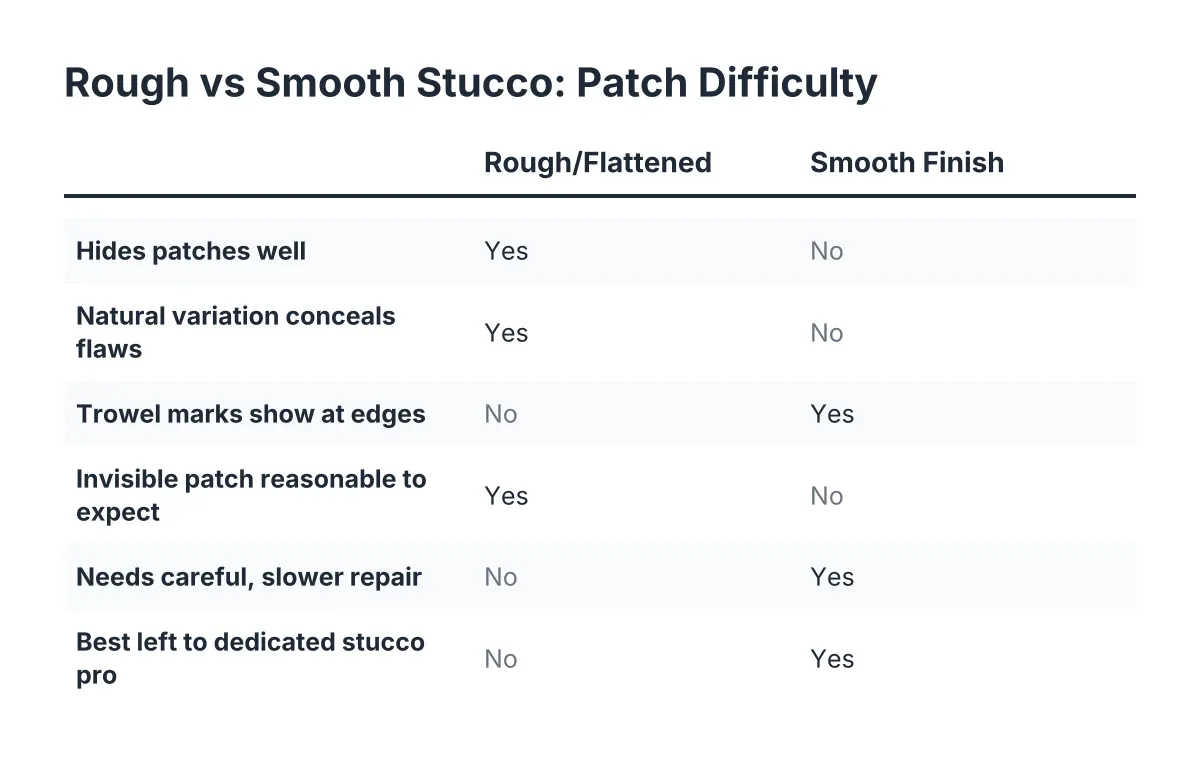
That "smooth" is the key word, and it is also the trap. Most stucco textures, like knockdown or dash, hide imperfections because the texture itself is busy. Stucco is popular partly for that reason; a rough surface conceals small flaws that a smooth wall would broadcast. A Santa Barbara finish gives up that camouflage on purpose. The payoff is a clean, high-end look. The cost is that every patch, trowel line, and sheen difference shows in raking light.
The finish traces back to Spanish Colonial and Mission-style architecture, which is why some suppliers sell it as a "Mission finish." In Castle Rock and nearby areas like Castle Pines and Parker, you will see it on newer custom homes and on remodels where owners wanted something quieter than the standard knockdown texture used on most tract housing.
How It Differs From Regular Smooth Stucco
People often use "smooth stucco" and "Santa Barbara finish" interchangeably. They are not the same thing, and the difference matters when someone repairs your wall.
- A true smooth finish aims for a flat, even, almost plaster-like surface with minimal variation.
- A Santa Barbara stucco finish is intentionally imperfect. It keeps soft trowel movement, slight undulation, and color mottling as part of the look.
- Smooth finishes are often painted a solid color. Santa Barbara finishes frequently rely on an integral color coat, where the pigment is in the material itself rather than in paint.
Why does this matter for repair? Because a crew that treats your wall as generic smooth stucco will trowel a patch dead flat and paint over it. On a Santa Barbara wall, that flat, uniform patch reads like a bandage. The repair has to recreate the hand movement and the mottling, not erase it.
Colonial and Modern Versions of the Santa Barbara Finish
The Santa Barbara stucco finish comes in two broad styles, and identifying which one you have is the first step in any repair that hopes to disappear. Call them colonial and modern. The material is similar; the hand technique and the final look are different.
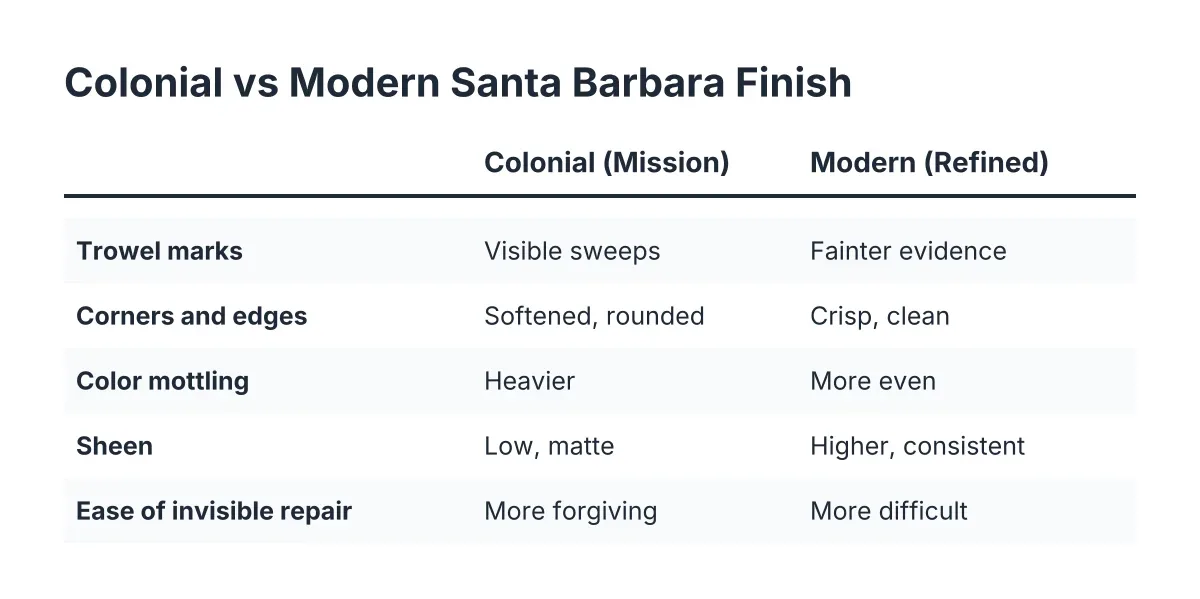
The Colonial (Traditional Mission) Style
The colonial version leans into the old-world character. Expect these traits:
- Visible, rounded trowel sweeps, sometimes called "cat faces" when small unfinished spots are left on purpose
- Softened, slightly rounded corners and edges rather than crisp lines
- Heavier color mottling, with light and dark areas that shift across the wall
- A low, matte sheen that reads like aged plaster
This style forgives a little more during repair because variation is already part of the design. A patch with some movement in it can hide among the existing trowel marks, if the crew matches the sweep direction and pressure of the original work.
The Modern (Refined) Style
The modern take tightens everything up:
- Flatter surface with fainter trowel evidence
- Crisp corners, clean reveals around windows, and straight control joints
- More even color, often achieved with a fog coat or paint over the finish
- A slightly higher, more consistent sheen from harder troweling
Textured, flattened finishes are the easiest to patch invisibly; the modern Santa Barbara style is the opposite. It sits close to true smooth stucco, so every high spot, low spot, and sheen shift in a patch shows. Repairs on this version demand more skill, more time feathering the edges, and usually a plan to unify color across the whole wall section afterward.
If you are not sure which style you have, look at the wall in early morning or late afternoon light, when the sun rakes across it. Colonial walls show sweeping shadows from the trowel work. Modern walls look calm and even, with shadows only at corners and joints.
Why Patches on This Finish Look Different After Repair
A patch on a Santa Barbara wall looks different for three reasons: texture, sheen, and color. Most failed repairs miss at least two of the three. Understanding each one helps you judge whether a crew's plan will actually work, or whether you are about to pay for a patch you will stare at for years.
First, texture. Traditional stucco goes on in three coats: a scratch coat that gets scored so the next layer bonds, a brown coat that builds the flat base, and a finish or color coat that carries the look. The finish coat on a Santa Barbara wall is thin and hand-worked. If a repair crew builds the patch too proud of the wall, or trowels it with a different rhythm than the original plasterer, the patch shows as a flat island or a raised scar. A skilled crew can sometimes fix a slightly proud patch by knocking down and scraping high spots to blend it, rather than tearing out the base coat and starting over.
Second, sheen. Hard troweling burnishes the surface and raises the sheen. A patch troweled harder or softer than the surrounding wall will catch light differently even if the texture and color match. This is the detail almost everyone misses, and it is why a patch can look fine on a cloudy day and glare at you at 5 p.m.
Third, color. Many Santa Barbara walls carry integral color, and that color has weathered for years under Colorado sun. Fresh material, even from the same product line, cures to a different shade. Sand matters here too; the fineness of the sand in the repair mix has to match the original finish, because coarser sand changes both texture and how the surface holds light.
A poor match on an older patch usually tells a story: a different, less skilled worker repaired it without identifying the finish type or copying the original technique. If your wall already has one bad patch, point it out to the next crew. It is a useful reference for what not to repeat.
Matching a Santa Barbara Stucco Finish Step by Step
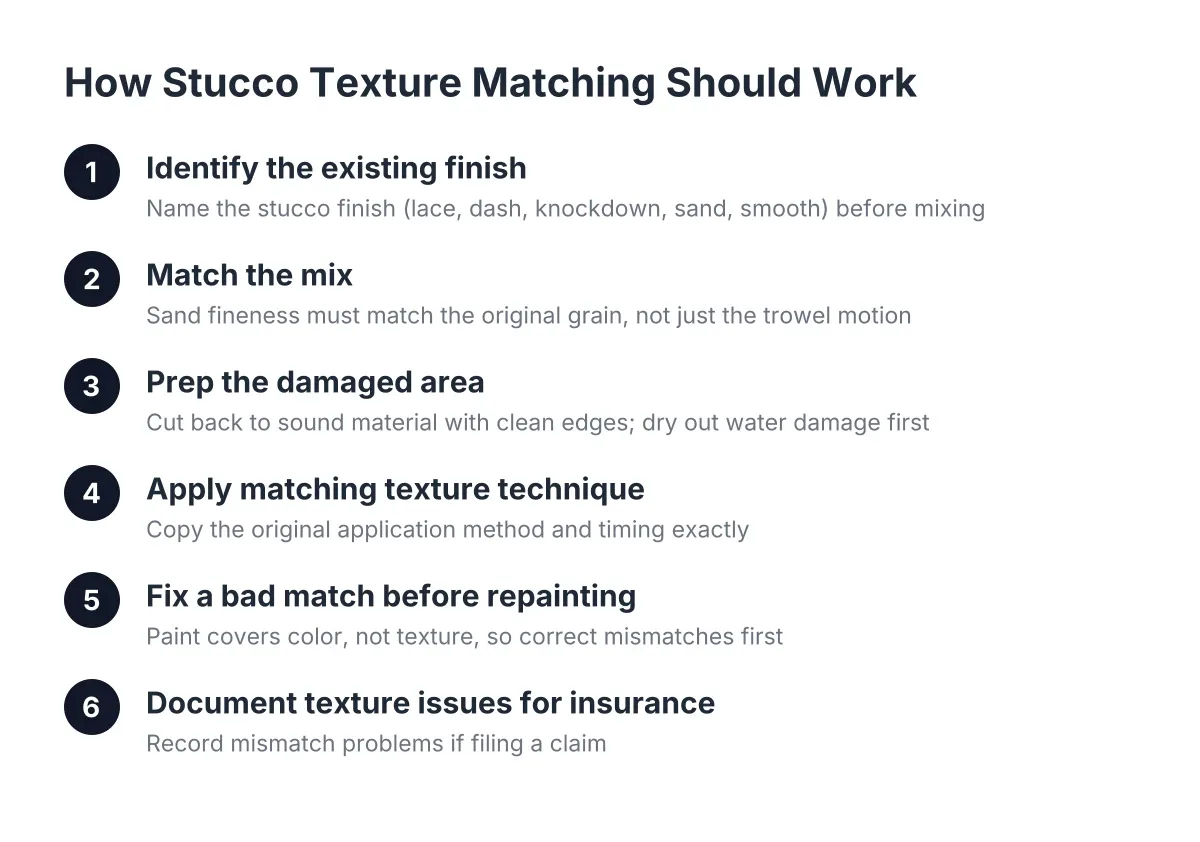
Matching this finish is a process, not a product you buy in a bag. Here is what a careful repair looks like, in order. Use this as a checklist when you talk to any local stucco repair crew.
- Identify the style and technique. The crew studies the wall in raking light, notes the trowel direction, the size of the sweeps, corner treatment, and whether the color is integral or painted.
- Open up the damage properly. Cracks get cut out, not just smeared over. For wider cracks, backer rod, a closed-cell foam cord, creates a backing inside the crack before sealant goes in, according to Sika. For hairline cracks, acrylic latex caulk with sand mixed in blends far better than plain caulk, because the sand ties into the wall finish.
- Repair the base honestly. If hail or water damage broke through the finish coat, the brown coat gets patched flat and cured before any finish work starts. Rushing this step telegraphs through the finish later.
- Match the mix. The finish material is chosen and gauged with sand fineness that matches the original. On this finish, sprayed application rarely matches; a stucco sprayer or stucco sprayer machine is the right tool for dash and lace textures, and a stucco dash brush can flick on heavier textures, but a Santa Barbara finish is troweled by hand. Equipment choice is a quick way to tell whether a crew knows this finish.
- Sample before committing. A good crew trowels a test patch in an inconspicuous spot, lets it cure, and compares it in morning and afternoon light before touching the visible wall.
- Feather wide. The finish coat gets worked well past the damage, feathering into the surrounding wall so there is no hard edge for light to catch.
- Unify sheen and color. After curing, the crew evaluates the result. If the color cannot be matched closely enough, the fallback is honest and effective: paint or fog-coat the entire wall or section so it reads as one uniform surface, corner to corner. A consistent wall beats a close-but-visible patch every time.
Notice what is not on this list: any promise that a small patch will vanish on day one. Fresh material needs weeks of weather and curing before a final judgment, and a straightforward crew will say so up front.
A Hail Damage Scenario in Castle Rock
Suppose a June storm rolls through Castle Rock and leaves a dozen quarter-sized impact chips scattered across the south and west walls of a home with a modern Santa Barbara stucco finish. The homeowner files an insurance claim, the adjuster wants a written estimate, and the homeowner wants the wall to look like nothing happened.
In that scenario, the wrong approach is obvious in hindsight: a crew dabs patching compound into each chip, textures it with a sponge, and paints twelve little circles. Six months later the wall looks like it has chickenpox, because each circle carries its own sheen and shade.
The better approach treats the wall, not the chips. The crew repairs each impact point, feathers the finish coat across the affected areas, then fog-coats or paints each damaged wall corner to corner so the color and sheen unify. Additionally, the estimate spells that out for the adjuster: point repairs plus full-wall color unification, not twelve isolated patches. As a rough illustrative range, that kind of scope on a couple of walls often lands somewhere between $1,500 and $6,000 depending on wall size and access, which is squarely the kind of job insurance claims in this area cover after the deductible.
This is not a rare situation here. Colorado had 182,591 hail insurance claims from 2013 to 2015, the second-highest total in the country behind Texas, according to the Rocky Mountain Insurance Information Association. Hail is also a major reason Colorado home insurance premiums rose 65% over the last five years, according to the National Association of Insurance Commissioners. If a storm hit your zip code recently, getting a clear, well-documented repair estimate helps both the wall and the claim.
Cracks in a Santa Barbara Finish: Cosmetic or Serious?
Most cracks in a Santa Barbara stucco finish are cosmetic, caused by normal shrinkage, thermal movement, or hail impact, and they show more on this finish only because the smooth surface hides nothing. A hairline crack under about the width of a credit card edge is usually a surface issue, not a structural one. The finish makes it look worse than it is.
That said, this finish does have a reputation for hairline cracking, and there is a reason. Thin, hard-troweled coats are less flexible than heavy textures, so movement in the wall reads through faster. On the internet you will find plenty of worry about Santa Barbara stucco finish cracking; most of it traces back to normal shrinkage in those thin coats, not to failing walls.
Watch for these signs that a crack is more than cosmetic and worth a professional look:
- Cracks wider than about 1/8 inch, or cracks that widen month over month
- Diagonal cracks running from window or door corners that keep growing
- Cracks paired with soft, bulging, or stained stucco, which points to water damage behind the finish
- Cracking that lines up with cracks in the foundation or interior drywall
A mismatched patch, on the other hand, is a cosmetic problem, not a structural warning. If an old repair looks different but the wall around it is sound and dry, you are dealing with a texture and color issue, not a safety issue. Good stucco texture matching can fix the eyesore without any structural work at all.
One honest limitation: even the best hand can only get so close on an aged, integrally colored wall. Sun, dust, and years of weather change the original color in ways no fresh mix duplicates exactly. When that gap is too wide, painting the full wall section is the professional answer, and any crew that promises a perfect invisible spot-match on a 15-year-old integral color wall is overselling.
Getting the Repair Right the First Time
Everything above comes down to one habit: treat the match as the job, not a finishing touch. Cracks get filled, holes get patched, and water damage gets dried and rebuilt, and none of it counts as done until the wall reads as one surface in afternoon light.
Before you hire anyone for stucco crack repair or exterior stucco repair on a Santa Barbara wall, ask three questions. Which style is this finish, colonial or modern? Will you do a cured sample patch before repairing the visible wall? If the color match falls short, what is the plan for unifying the wall? A crew that answers all three plainly understands this finish. A crew that says "we'll blend it in, no problem" and reaches for a sprayer probably does not.
For Castle Rock homeowners as of 2026, with hail seasons getting more expensive and insurance scrutiny getting tighter, the difference between those two crews is the difference between a repair you forget about and a patch you notice every single day. Take the extra week to find the first kind.
If you need stucco repair, Castle Rock Stucco Pros can help.
Prefer to talk it through? Call (720) 797-8506 — a quick call is usually the fastest way to get a straight answer for your situation.