What Hairline Cracks in Stucco Tell You About What’s Behind the Wall
A crew that repairs stucco every day reads cracks the way a mechanic listens to an engine. Hairline cracks in stucco are not random. Each one points to a cause: moisture working behind the wall, the house settling into Castle Rock's expansive soil, or our big daily temperature swings pulling the material apart. Before you caulk anything or compare quotes, learn to read what the crack is telling you. This guide walks you through it step by step, the same way a good stucco contractor would if you walked the wall with them.
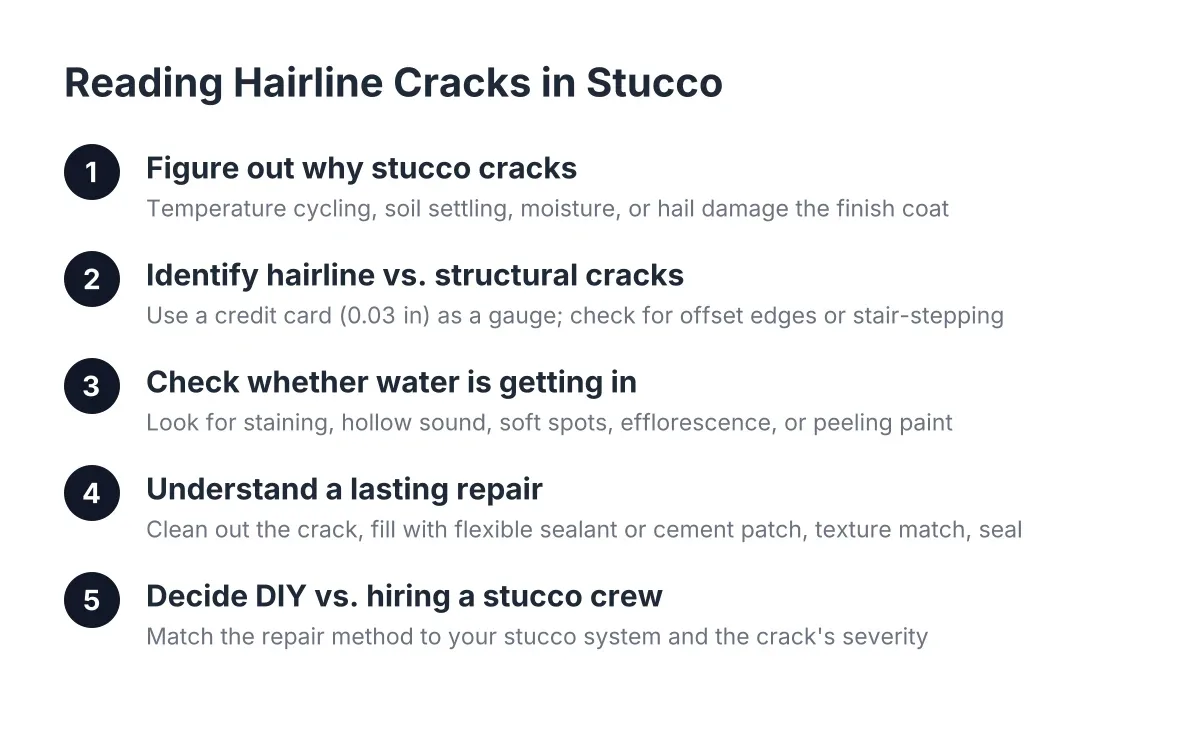
Step 1: Figure Out Why Stucco Cracks in the First Place
Stucco is a cement-based coating, and cement is rigid. Your house is not. Framing shifts, soil moves, and temperatures swing 40 degrees in a single Colorado day. Something has to give, and the stucco gives first.
Three causes account for most cracks we see on Castle Rock homes:
- Temperature cycling. Stucco expands in afternoon sun and contracts overnight. Over years, that constant movement opens thin cracks, often near windows, doors, and corners where stress concentrates.
- Settling and soil movement. Douglas County has expansive clay soils that swell when wet and shrink when dry. As the foundation moves, the walls above it flex, and stucco telegraphs that movement as cracks, often diagonal ones running from the corners of openings.
- Moisture. Water gets behind the stucco through a failed sealant joint, a roof edge, or an old crack. It soaks the base layers, freezes, expands, and pushes the stucco apart from the inside.
Hail and wind add a fourth cause here. A storm can chip the finish coat or crack it on impact, which then gives moisture a way in. That matters, because hail is not rare in this part of Colorado. Colorado had the second-highest number of hail insurance claims in the country from 2013 to 2015, totaling 182,591 claims, according to the Rocky Mountain Insurance Information Association.
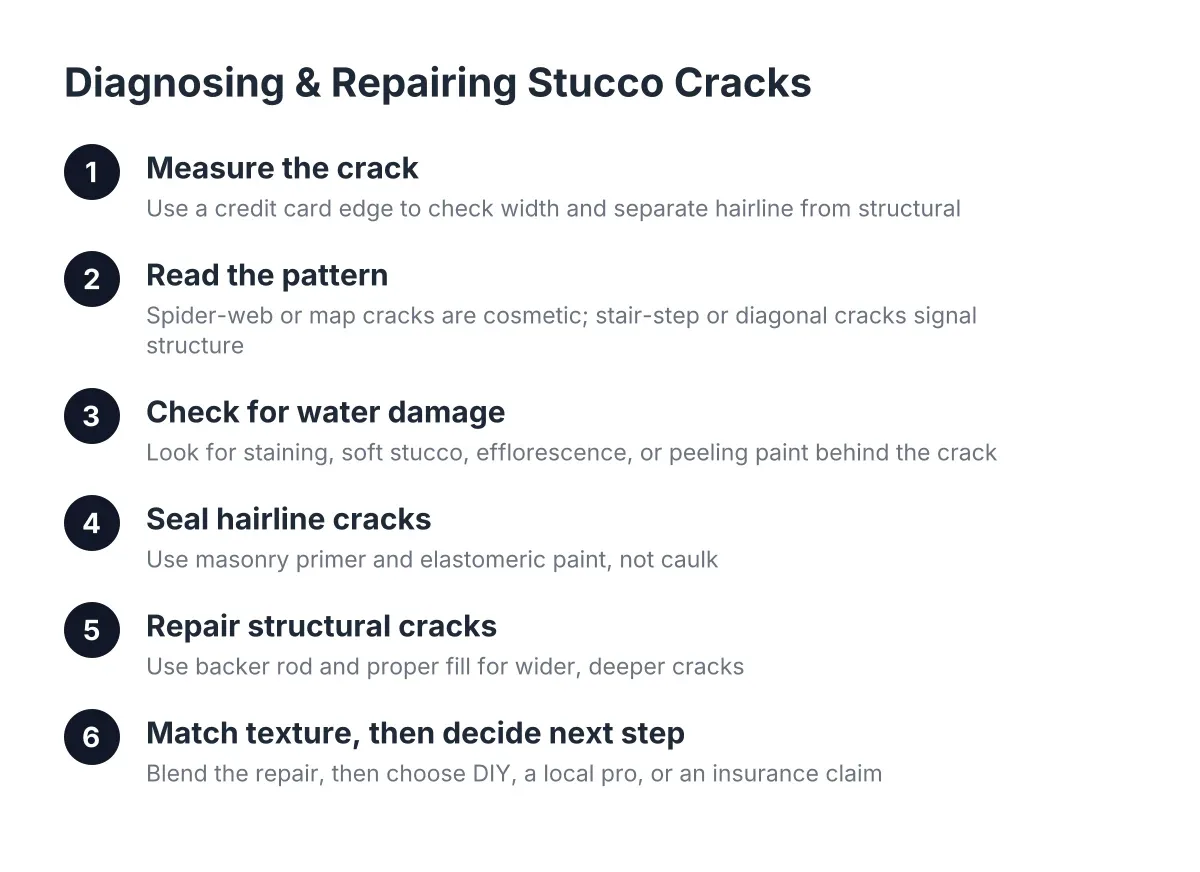
Step 2: Identify Stucco Hairline Cracks vs. Structural Damage
Now walk your walls and measure. The single most useful tool is a credit card, which is about 0.03 inches thick.
Hairline cracks in stucco are thinner than that card. You cannot slide the card edge into them. They usually run in shallow, irregular patterns, sometimes a faint spiderweb near a window corner. These are common on both new and older homes. Hairline cracks in new stucco often show up in the first year as the coating cures and the framing settles, and by themselves they are normal.
Cracks that deserve a closer look have different traits:
- Wide enough to fit a credit card edge, or wide enough to see daylight into
- One side of the crack sits higher than the other when you run a finger across it
- Long diagonal cracks running from the corners of windows or doors toward the roof or ground
- Stair-step cracks that follow a block or brick pattern underneath
- Cracks paired with soft, dark, or bulging stucco nearby
The first group is a maintenance item. The second group can point to foundation movement or water damage behind the wall, and that is when to worry about stucco cracks. If you see offset edges or stair-stepping, bring in a professional before anyone patches anything. Covering a structural crack with filler hides the evidence without fixing the cause, and no honest stucco crack repair should start there.
Step 3: Check Whether Water Is Already Getting In
Do hairline cracks in stucco need to be repaired? Yes, eventually, because even thin cracks give water a path into the wall. A single hairline crack rarely causes a leak on its own. However, dozens of them across a wall that faces driving rain and hail will let moisture through over time, and freeze-thaw cycles widen them every winter.
Look for the warning signs of water already behind the stucco:
- Staining or streaking below the crack, especially under windows
- Stucco that sounds hollow when you tap it with a knuckle
- Soft or crumbly spots you can dent with a screwdriver handle
- Efflorescence, the white chalky mineral residue that water leaves behind
- Peeling paint or damp drywall on the inside of the same wall
If you find any of these, the job has changed. You are no longer filling hairline stucco cracks; you are dealing with stucco water damage repair, which means opening the wall, checking the moisture barrier, and replacing what is wet. Any contractor who quotes you a simple crack-fill price without checking for these signs is guessing.
Step 4: Understand What a Lasting Repair Actually Involves
This is where quotes start to differ, and why one bid can be triple another for what sounds like the same crack. Here is the short version of how fixing hairline cracks in stucco should go when it is done to last.
First, the crack gets cleaned out. Loose material comes out with a wire brush or a slight widening of the crack so the filler has something to grip. Filler smeared over dust fails fast.
Next comes the fill. For thin cracks, an elastomeric, sandable stucco-grade sealant works because it flexes with the wall instead of cracking again next winter. For wider cracks or damaged sections, the repair moves to cement-based patching. Foam-backed and cement stucco systems also behave differently; a repair method that works on traditional three-coat cement stucco can fail on a foam-and-synthetic system, so the contractor needs to know which one your home has.
Then comes texture matching, the step most homeowners never think about until they see a bad repair. A filled crack that is not floated and textured to match the surrounding wall shows up as a smooth, shiny scar. On exterior stucco repair, matching the existing texture and color is half the craft. It is the difference between a repair you forget about and one you notice every time you pull into the driveway.
Finally, the repair gets sealed or the wall section gets painted so the patch weathers at the same rate as everything around it.
Why Caulking Cracks in Stucco Often Backfires
Caulking cracks in stucco with standard hardware-store caulk is the most common DIY mistake we see. Regular caulk does not bond well to cement, cannot be textured, and turns into a shiny bead that collects dirt. Worse, some caulks trap moisture in the wall instead of letting it dry out. A stucco crack repair kit from a DIY aisle can handle a short, thin crack on a low wall if you follow the steps above. For anything wider, higher, or repeated across a wall, the kit approach usually costs you twice: once for the kit, and again when a pro has to grind out the failed caulk before doing it right.
Step 5: Decide Between DIY and Hiring a Local Stucco Crew
Be honest about the scope. A single hairline crack under a first-floor window is a reasonable weekend project. A wall with a dozen cracks, hollow spots, or storm damage is not.
For example, suppose a homeowner in Castle Rock takes hail damage on a west-facing wall: chips in the finish coat, a few impact cracks, and one soft spot near the hose bib. In that scenario, a realistic professional repair might run anywhere from several hundred dollars for isolated crack repair to a few thousand if a section needs to be opened, dried, patched, and texture matched. Those are illustrative estimates, not quotes; the real number depends on wall access, the stucco system, and what shows up once the wall is open.
Storm damage also changes the paperwork. If a hailstorm caused the cracking, document it with photos and dates before any repair, because your insurance adjuster will want a written estimate that separates storm damage from normal wear. That distinction is getting more attention, not less. Colorado home insurance premiums rose 65% over the last five years, with hail cited as a major driver, according to the National Association of Insurance Commissioners. Adjusters look closely at stucco claims, so clean documentation from a contractor who works on stucco daily helps your claim move.
Questions That Separate a Stucco Specialist From a Generalist
When you gather quotes, ask each contractor these questions and compare the answers:
- Is this a hairline crack, or is something moving behind it? How can you tell?
- Will you check for water damage before pricing the repair?
- What filler will you use, and why that one for my stucco system?
- How will you match the existing texture and color?
- What happens to the price if you open the wall and find wet material?
A crew that repairs stucco every day answers these without hesitating. A generalist who treats stucco as one more line on a long services list usually cannot, and that gap is what a suspiciously low quote often hides.
The Bottom Line on Reading Your Cracks
Hairline cracks in stucco are your wall talking. Thin, shallow, and stable means normal aging you should seal on your schedule. Wide, offset, or paired with soft spots means water or movement, and that needs a real diagnosis before anyone fills anything. Read the crack first, check for moisture second, and only then compare repair quotes. The homeowner who does those three steps in order almost never pays for the same repair twice.
If you need stucco repair, Castle Rock Stucco Pros can help.
Prefer to talk it through? Call (720) 797-8506 — a quick call is usually the fastest way to get a straight answer for your situation.