Small Stucco Patch Cost vs. Full Wall Repair: Where the Break-Even Point Sits
You found a crack or a soft spot in your stucco, and now you are trying to figure out what fixing it should cost. The honest answer depends on one question most websites skip: at what point does a small stucco patch cost more, per square foot, than just redoing the whole wall section? Understanding the difference between a patch vs wall repair is essential to this decision. That break-even point is real, and knowing where it sits is the difference between paying for the right repair once and paying for the wrong repair twice.
This guide walks through what a small patch actually involves, what a full wall section repair involves, realistic 2026 price ranges for each, and the factors that push a job from one category into the other. It is written for Castle Rock homeowners, including owners of newer homes in neighborhoods like Stonegate, Meridian, and Carriage Club, where stucco defects often show up in the first few years, sometimes right after the builder warranty runs out.
Why Small Patches Cost So Much Per Square Foot
Here is the part that surprises people. A patch the size of a dinner plate might run a few hundred dollars, while a full 200-square-foot wall section might run a few thousand. Divide those numbers by the area, and the small patch costs far more per square foot. That is not a contractor padding the bill. It is how the work actually breaks down.
Every stucco repair, no matter the size, carries the same fixed steps:
- Driving to the house, setting up, and protecting the area around the repair
- Cutting out the damaged stucco and checking the lath and paper behind it
- Mixing material, applying base and finish coats, and waiting on cure times between them
- Matching the texture to the surrounding wall, which is skilled work regardless of patch size
- Cleanup and at least one return trip, since stucco cures in stages
Therefore, a one-square-foot patch and a ten-square-foot patch cost close to the same amount in labor and trips. The material is cheap. The time is not. This is why most local stucco repair crews carry a minimum charge, and why a small stucco patch cost quote can look high next to the size of the hole.
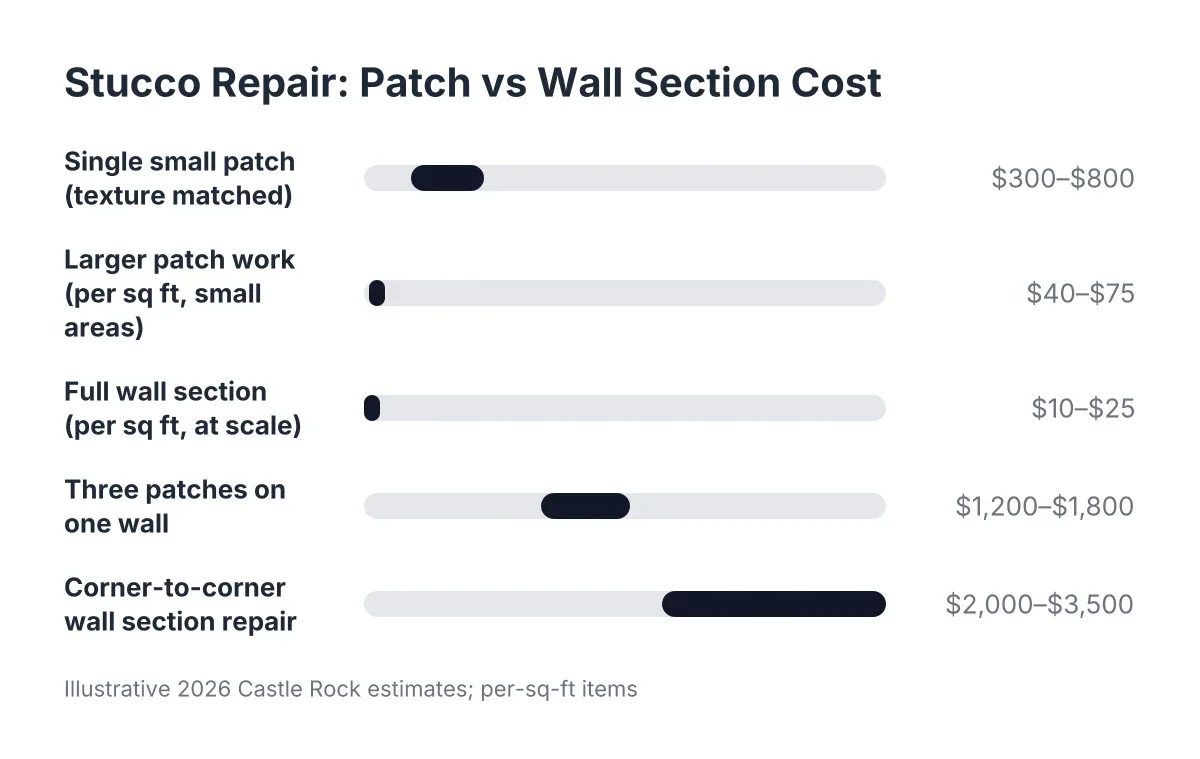
As an illustrative estimate, a minor stucco repair in the Castle Rock area in 2026 might land anywhere from about $300 to $800 for a single small patch with texture matching, while larger patch work often runs $40 to $75 per square foot for small areas and drops fast as the area grows. Full wall sections can fall into the $10 to $25 per square foot range once the crew is set up and working at scale. These are ballpark figures to help you budget, not quotes; your wall, your texture, and what the crew finds behind the stucco all move the number.
Patch vs Wall Repair: What Counts as Each One
A small patch means the damage is contained, the lath and moisture barrier behind the stucco are sound, and the crack or hole is not being fed by an ongoing problem. Think of a hairline crack running from a window corner, a golf-ball-sized impact hole, or a spot where a satellite dish came off.
A full wall section repair means removing the stucco from natural break line to natural break line, usually corner to corner or from one trim line to the next, and rebuilding that whole area. Crews go this route when damage is spread out, when water has gotten behind the stucco, or when the original application failed.
Several signs push a job from patch territory into wall territory:
- Multiple cracks across the same wall. Three or four patches on one wall cost more than one continuous repair, and the wall ends up looking quilted.
- Hollow or drummy sounds when you tap. Stucco that sounds hollow has separated from the wall behind it. A patch on top of delaminated stucco fails. If a patched area gives under light finger pressure, the material or method underneath failed, and it needs to come out and be redone, not skim-coated.
- Staining, bubbling, or soft spots below the crack. Those point to water damage behind the stucco. The repair now includes fixing the paper and lath, and possibly framing, which changes the scope entirely.
- A crack that keeps returning after previous patches. Repeat cracking means something is moving or something is wet. Patching over it again buys time, not a fix.
On corners, the trade-off shows up clearly. A partial patch on a deteriorated stucco corner is quicker and cheaper, but the technically correct repair is often to remove the stucco and repatch the full section from corner to corner. If the cause of the damage, such as poor drainage or repeated impact, is not addressed, the crack tends to come back either way.
The Break-Even Math: When a Patch Stops Making Sense
The break-even point arrives when patch costs stack up to meet the cost of one wall section repair. Because each patch carries its own fixed setup and texture-matching cost, two or three patches on the same wall can equal the price of redoing that section once, done right.
Suppose a homeowner in Meridian has a four-year-old home with three cracks spreading from window corners on the same south-facing wall. Say each patch would run an estimated $400 to $600 with texture matching. That is $1,200 to $1,800 for three patches, three blend points where the texture has to match, and no answer to why the wall is cracking. In that scenario, a corner-to-corner repair of that wall section might be estimated at $2,000 to $3,500. The patches are cheaper today. However, if a fourth crack shows up next spring, the math flips, and the homeowner has now paid patch prices on the way to a wall repair anyway.
A rough rule of thumb for the break-even decision:
- One isolated crack or hole, sound wall behind it: patch it. This is the right call the large majority of the time.
- Two problems on one wall, no signs of moisture: patch both, but ask the crew what is driving the cracking before you pay.
- Three or more problems on one wall, or any hollow or wet areas: get a price for the full section repaired corner to corner and compare it to the stacked patch total. The section repair usually wins on cost per year of service, even when it loses on cost today.
Full replacement of all the stucco siding on a home is a different conversation entirely, and it is rarely the answer for localized damage. Comparing stucco repair cost against full replacement only makes sense when failure is widespread across multiple walls, which is uncommon on homes under ten years old unless the original installation was defective.
What a Fair Small Patch Estimate Should Itemize
A trustworthy estimate for a small stucco patch breaks the cost into parts you can read and question. Vague one-line quotes, whether from a national call center or a thin local site, hide the two things that actually determine whether the repair lasts: what is behind the stucco, and who is matching the texture. As of 2026, a solid itemized estimate for exterior stucco repair should show:
- Removal and inspection. Cutting out the damaged area and checking the lath, paper, and sheathing. One detail worth knowing: a repair opening should not be cut clean and square with a grinder. The lath needs to stay exposed and torn at the edges so the new patch can tie into it and be properly weatherproofed. A clean cut forces the crew to open up more wall, which adds cost.
- Substrate repair, priced as a contingency. If the paper or lath behind the crack is damaged, that work should be listed as a separate line with a unit price, not buried in the total or sprung on you later.
- Base coat and cure time. Stucco repair happens in coats with waiting between them. An estimate that promises everything in one visit for a cement-based repair deserves a follow-up question.
- Finish coat and texture matching. This is the line that separates crews. Matching a knockdown dash texture, for example, means spraying finish coat onto the patch and lightly troweling it down to blend with the wall. When a patch stands out, it is usually because a different, less skilled worker attempted the finish without matching the original technique.
- Color approach. If the color cannot be matched closely enough, the fallback is painting the wall or section so everything reads uniform. A good estimate tells you upfront whether painting will be needed, because that changes the total.
If a quote for crack repair or stucco patching does not mention texture matching at all, treat that as a red flag. A structurally sound patch that looks like a scar is only half a repair.
Where DIY Fits in the Small Patch Budget
For a hairline crack or a coin-sized ding, DIY is a legitimate option and the cheapest one on paper. The materials for a small stucco patch, including patch compound, latex additive, and corner mesh, are stocked at general hardware stores. Pre-mixed stucco patch in a tub handles hairline cracks; bagged products like quikrete stucco mix or a rapid set stucco mix handle slightly larger holes without you having to mix raw ingredients like a mason would on a big wall. For a small homeowner project, pre-mixed bags are the practical choice.
The catch is never the material cost, which might be $20 to $60 as a rough estimate. The catch is texture. A smooth gray smear on a dashed or lace-textured wall is visible from the street, and it stays visible for years. DIY also cannot tell you what is behind the crack. If the crack came from moisture or movement, patching the surface hides the symptom while the problem continues.
A reasonable line to draw: DIY the true hairlines on a wall you know is dry and sound, and call a local pro for anything wider than a credit card edge, anything near a window corner that is spreading, or anything on a wall that sounds hollow. If you suspect water damage or structural movement, skip the patch kit and have someone look at it; that is a judgment call best made by a person standing at your wall, not by any article, including this one.
Getting the Most From the Repair You Already Decided On
If you have already decided to hire out the work, a few steps protect your money and improve the result.
First, photograph the damage now, dated, before anyone touches it. On a newer home, this record matters if you are still contesting anything with the builder. Be clear-eyed about that path, though. A repair crew fixes stucco; it does not fight warranty claims for you. Many owners of homes under five years old end up paying for an independent repair after the builder stops responding, and having your own documentation makes both conversations cleaner.
Next, ask each bidder the same three questions. What is your plan if you open the wall and find damaged paper or lath, and how do you price that? Who on your crew does the texture matching, and can I see a photo of a blended patch on a texture like mine? Will this patch need paint to blend, and is that in the number?
In addition, compare quotes by scope, not just by total. A $450 quote that covers cutout, base coat, finish coat, and texture matching is not the same job as a $300 quote for "fill and seal crack." Cheap stucco repair that skips the texture coat or smears sealant over a moving crack is the most expensive option once you pay to have it done again. Lowball numbers from thin listing sites and vague ranges from franchise call centers both fail the same test: neither tells you what is actually included.
Finally, judge the finished work by feel and by distance. A sound patch is hard; press on it with a finger, and it should not give or sound hollow. A well-matched patch, viewed from ten feet after paint, should be hard to pick out from the surrounding wall. If you can find it instantly from the curb, say so before the crew leaves.
The Bottom Line for Castle Rock Homeowners
For one contained crack or hole on a dry, solid wall, a small patch is the right repair, and the cost is money well spent to keep water out before Colorado's freeze-thaw cycles widen the crack. For a wall with multiple cracks, hollow spots, or moisture signs, run the break-even math: add up the patch prices, compare them to one corner-to-corner section repair, and factor in that the section repair also lets the crew fix whatever is failing behind the stucco.
Either way, insist on an itemized estimate, ask who handles texture matching, and get the cause diagnosed, not just the crack filled. A patch that addresses the symptom and ignores the cause is the one repair that never breaks even.
If you need stucco repair, Castle Rock Stucco Pros can help.
Prefer to talk it through? Call (720) 797-8506 — a quick call is usually the fastest way to get a straight answer for your situation.